







Copy in clipboard...
Iran says Strait of Hormuz reopening hinges on US actions
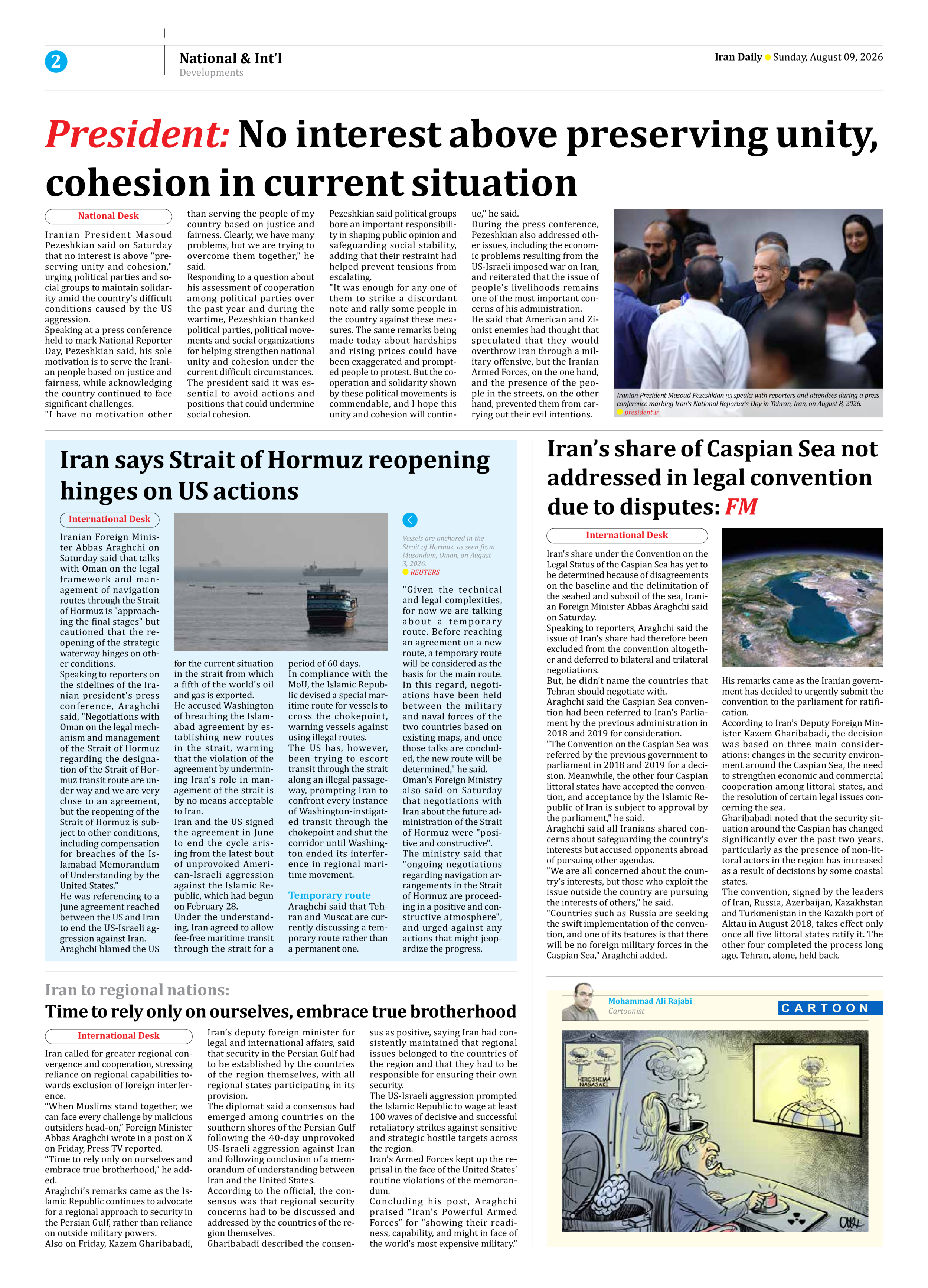
Iranian Foreign Minister Abbas Araghchi on Saturday said that talks with Oman on the legal framework and management of navigation routes through the Strait of Hormuz is "approaching the final stages" but cautioned that the reopening of the strategic waterway hinges on other conditions.
Speaking to reporters on the sidelines of the Iranian president's press conference, Araghchi said, "Negotiations with Oman on the legal mechanism and management of the Strait of Hormuz regarding the designation of the Strait of Hormuz transit route are under way and we are very close to an agreement, but the reopening of the Strait of Hormuz is subject to other conditions, including compensation for breaches of the Islamabad Memorandum of Understanding by the United States."
He was referencing to a June agreement reached between the US and Iran to end the US-Israeli aggression against Iran.
Araghchi blamed the US for the current situation in the strait from which a fifth of the world's oil and gas is exported.
He accused Washington of breaching the Islamabad agreement by establishing new routes in the strait, warning that the violation of the agreement by undermining Iran’s role in management of the strait is by no means acceptable to Iran.
Iran and the US signed the agreement in June to end the cycle arising from the latest bout of unprovoked American-Israeli aggression against the Islamic Republic, which had begun on February 28.
Under the understanding, Iran agreed to allow fee-free maritime transit through the strait for a period of 60 days.
In compliance with the MoU, the Islamic Republic devised a special maritime route for vessels to cross the chokepoint, warning vessels against using illegal routes.
The US has, however, been trying to escort transit through the strait along an illegal passageway, prompting Iran to confront every instance of Washington-instigated transit through the chokepoint and shut the corridor until Washington ended its interference in regional maritime movement.
Temporary route
Araghchi said that Tehran and Muscat are currently discussing a temporary route rather than a permanent one.
"Given the technical and legal complexities, for now we are talking about a temporary route. Before reaching an agreement on a new route, a temporary route will be considered as the basis for the main route. In this regard, negotiations have been held between the military and naval forces of the two countries based on existing maps, and once those talks are concluded, the new route will be determined," he said.
Oman's Foreign Ministry also said on Saturday that negotiations with Iran about the future administration of the Strait of Hormuz were "positive and constructive".
The ministry said that "ongoing negotiations regarding navigation arrangements in the Strait of Hormuz are proceeding in a positive and constructive atmosphere", and urged against any actions that might jeopardize the progress.