





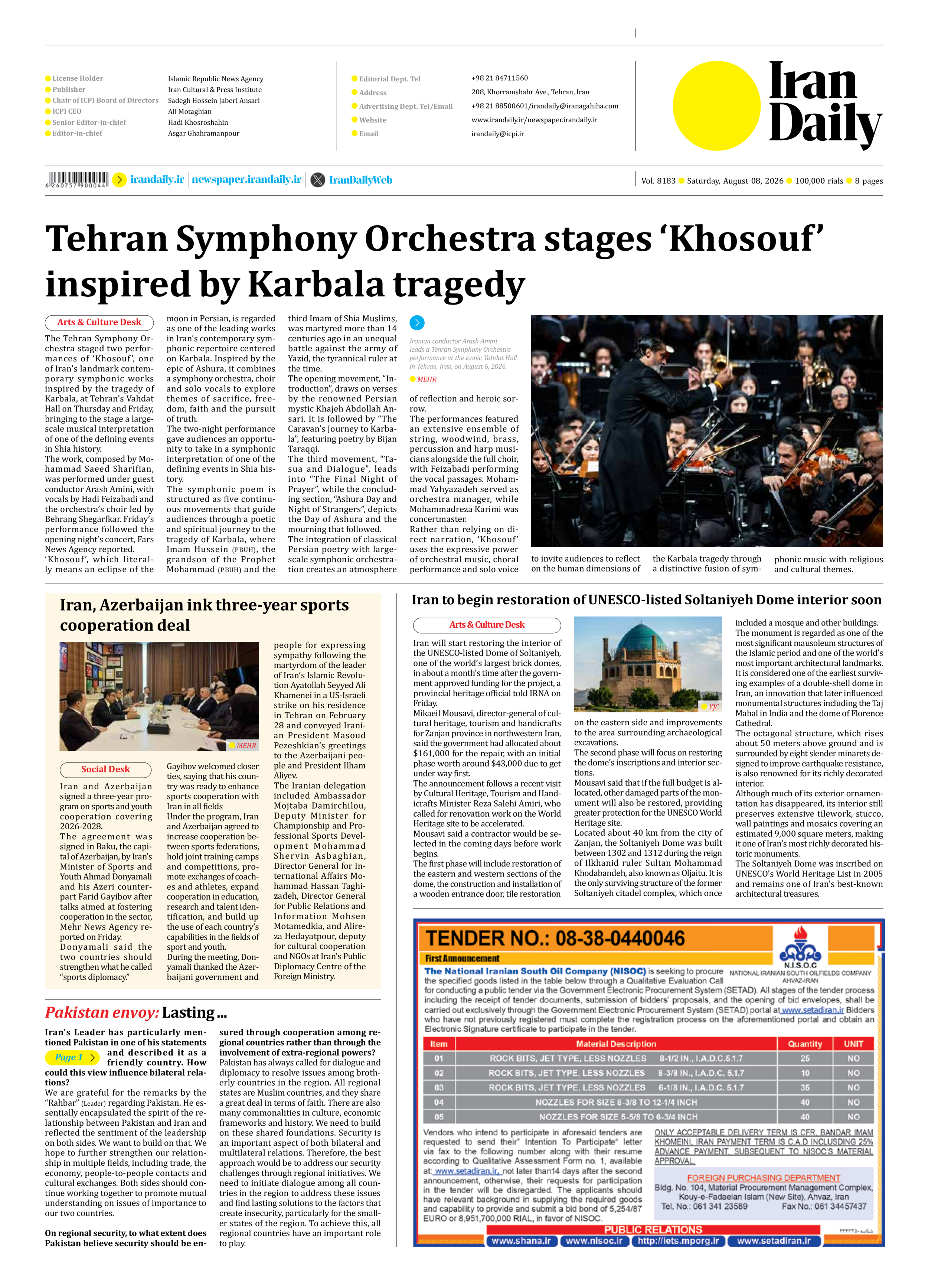


Tehran Symphony Orchestra stages ‘Khosouf’ inspired by Karbala tragedy
The Tehran Symphony Orchestra staged two performances of ‘Khosouf’, one of Iran’s landmark contemporary symphonic works inspired by the tragedy of Karbala, at Tehran’s Vahdat Hall on Thursday and Friday, bringing to the stage a large-scale musical interpretation of one of the defining events in Shia history.
The work, composed by Mohammad Saeed Sharifian, was performed under guest conductor Arash Amini, with vocals by Hadi Feizabadi and the orchestra’s choir led by Behrang Shegarfkar. Friday’s performance followed the opening night’s concert, Fars News Agency reported.
‘Khosouf’, which literally means an eclipse of the moon in Persian, is regarded as one of the leading works in Iran’s contemporary symphonic repertoire centered on Karbala. Inspired by the epic of Ashura, it combines a symphony orchestra, choir and solo vocals to explore themes of sacrifice, freedom, faith and the pursuit of truth.
The two-night performance gave audiences an opportunity to take in a symphonic interpretation of one of the defining events in Shia history.
The symphonic poem is structured as five continuous movements that guide audiences through a poetic and spiritual journey to the tragedy of Karbala, where Imam Hussein (PBUH), the grandson of the Prophet Mohammad (PBUH) and the third Imam of Shia Muslims, was martyred more than 14 centuries ago in an unequal battle against the army of Yazid, the tyrannical ruler at the time.
The opening movement, “Introduction”, draws on verses by the renowned Persian mystic Khajeh Abdollah Ansari. It is followed by “The Caravan’s Journey to Karbala”, featuring poetry by Bijan Taraqqi.
The third movement, “Tasua and Dialogue”, leads into “The Final Night of Prayer”, while the concluding section, “Ashura Day and Night of Strangers”, depicts the Day of Ashura and the mourning that followed.
The integration of classical Persian poetry with large-scale symphonic orchestration creates an atmosphere of reflection and heroic sorrow.
The performances featured an extensive ensemble of string, woodwind, brass, percussion and harp musicians alongside the full choir, with Feizabadi performing the vocal passages. Mohammad Yahyazadeh served as orchestra manager, while Mohammadreza Karimi was concertmaster.
Rather than relying on direct narration, ‘Khosouf’ uses the expressive power of orchestral music, choral performance and solo voice to invite audiences to reflect on the human dimensions of the Karbala tragedy through a distinctive fusion of symphonic music with religious and cultural themes.