







Ostad village blends natural beauty with centuries of history
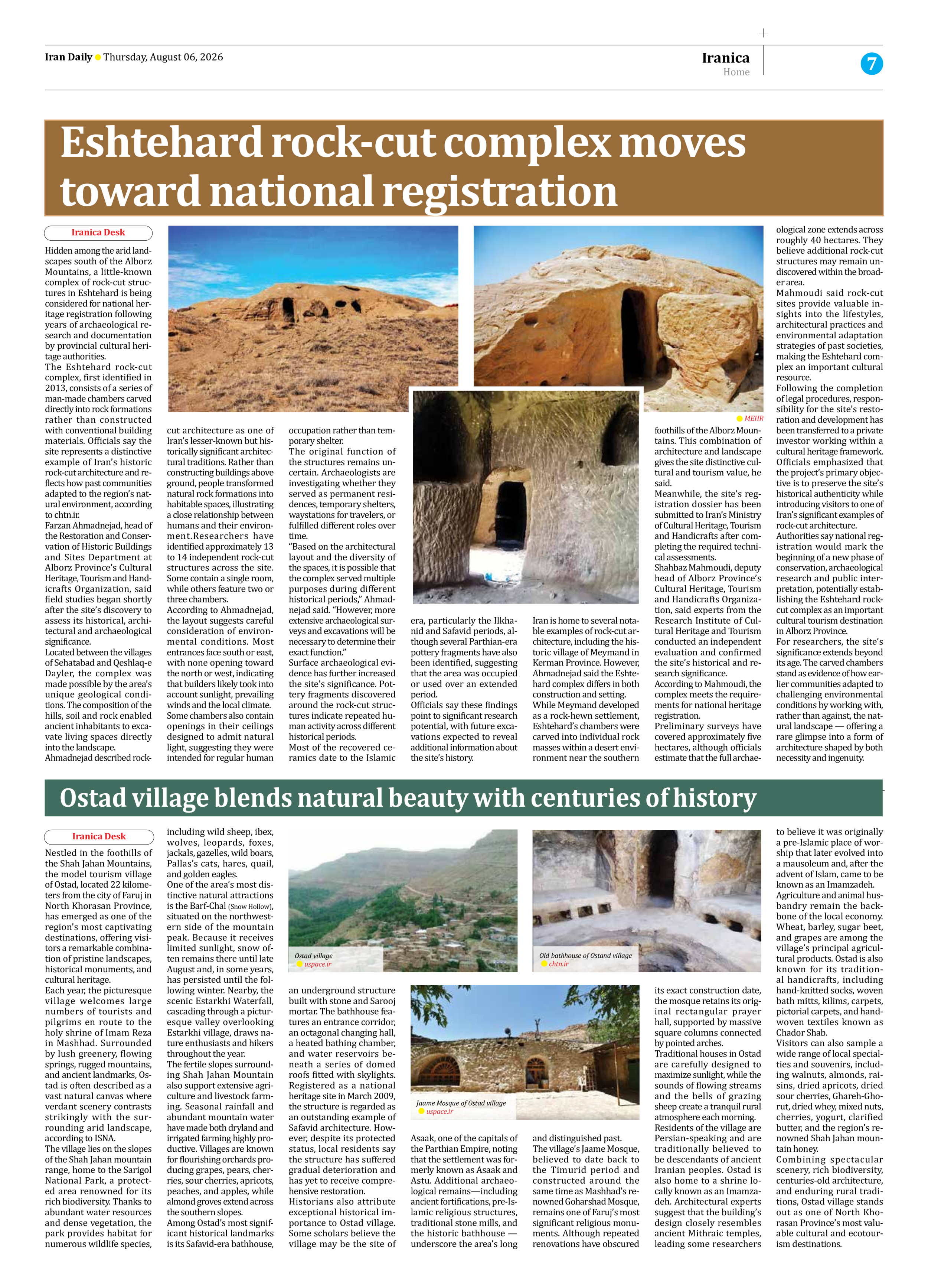
Nestled in the foothills of the Shah Jahan Mountains, the model tourism village of Ostad, located 22 kilometers from the city of Faruj in North Khorasan Province, has emerged as one of the region’s most captivating destinations, offering visitors a remarkable combination of pristine landscapes, historical monuments, and cultural heritage.
Each year, the picturesque village welcomes large numbers of tourists and pilgrims en route to the holy shrine of Imam Reza in Mashhad. Surrounded by lush greenery, flowing springs, rugged mountains, and ancient landmarks, Ostad is often described as a vast natural canvas where verdant scenery contrasts strikingly with the surrounding arid landscape, according to ISNA.
The village lies on the slopes of the Shah Jahan mountain range, home to the Sarigol National Park, a protected area renowned for its rich biodiversity. Thanks to abundant water resources and dense vegetation, the park provides habitat for numerous wildlife species, including wild sheep, ibex, wolves, leopards, foxes, jackals, gazelles, wild boars, Pallas’s cats, hares, quail, and golden eagles.
One of the area’s most distinctive natural attractions is the Barf-Chal (Snow Hollow), situated on the northwestern side of the mountain peak. Because it receives limited sunlight, snow often remains there until late August and, in some years, has persisted until the following winter. Nearby, the scenic Estarkhi Waterfall, cascading through a picturesque valley overlooking Estarkhi village, draws nature enthusiasts and hikers throughout the year.
The fertile slopes surrounding Shah Jahan Mountain also support extensive agriculture and livestock farming. Seasonal rainfall and abundant mountain water have made both dryland and irrigated farming highly productive. Villages are known for flourishing orchards producing grapes, pears, cherries, sour cherries, apricots, peaches, and apples, while almond groves extend across the southern slopes.
Among Ostad’s most significant historical landmarks is its Safavid-era bathhouse, an underground structure built with stone and Sarooj mortar. The bathhouse features an entrance corridor, an octagonal changing hall, a heated bathing chamber, and water reservoirs beneath a series of domed roofs fitted with skylights. Registered as a national heritage site in March 2009, the structure is regarded as an outstanding example of Safavid architecture. However, despite its protected status, local residents say the structure has suffered gradual deterioration and has yet to receive comprehensive restoration.
Historians also attribute exceptional historical importance to Ostad village. Some scholars believe the village may be the site of Asaak, one of the capitals of the Parthian Empire, noting that the settlement was formerly known as Asaak and Astu. Additional archaeological remains—including ancient fortifications, pre-Islamic religious structures, traditional stone mills, and the historic bathhouse — underscore the area’s long and distinguished past.
The village’s Jaame Mosque, believed to date back to the Timurid period and constructed around the same time as Mashhad’s renowned Goharshad Mosque, remains one of Faruj’s most significant religious monuments. Although repeated renovations have obscured its exact construction date, the mosque retains its original rectangular prayer hall, supported by massive square columns connected by pointed arches.
Traditional houses in Ostad are carefully designed to maximize sunlight, while the sounds of flowing streams and the bells of grazing sheep create a tranquil rural atmosphere each morning.
Residents of the village are Persian-speaking and are traditionally believed to be descendants of ancient Iranian peoples. Ostad is also home to a shrine locally known as an Imamzadeh. Architectural experts suggest that the building’s design closely resembles ancient Mithraic temples, leading some researchers to believe it was originally a pre-Islamic place of worship that later evolved into a mausoleum and, after the advent of Islam, came to be known as an Imamzadeh.
Agriculture and animal husbandry remain the backbone of the local economy. Wheat, barley, sugar beet, and grapes are among the village’s principal agricultural products. Ostad is also known for its traditional handicrafts, including hand-knitted socks, woven bath mitts, kilims, carpets, pictorial carpets, and handwoven textiles known as Chador Shab.
Visitors can also sample a wide range of local specialties and souvenirs, including walnuts, almonds, raisins, dried apricots, dried sour cherries, Ghareh-Ghorut, dried whey, mixed nuts, cherries, yogurt, clarified butter, and the region’s renowned Shah Jahan mountain honey.
Combining spectacular scenery, rich biodiversity, centuries-old architecture, and enduring rural traditions, Ostad village stands out as one of North Khorasan Province’s most valuable cultural and ecotourism destinations.