







Eshtehard rock-cut complex moves toward national registration
Hidden among the arid landscapes south of the Alborz Mountains, a little-known complex of rock-cut structures in Eshtehard is being considered for national heritage registration following years of archaeological research and documentation by provincial cultural heritage authorities.
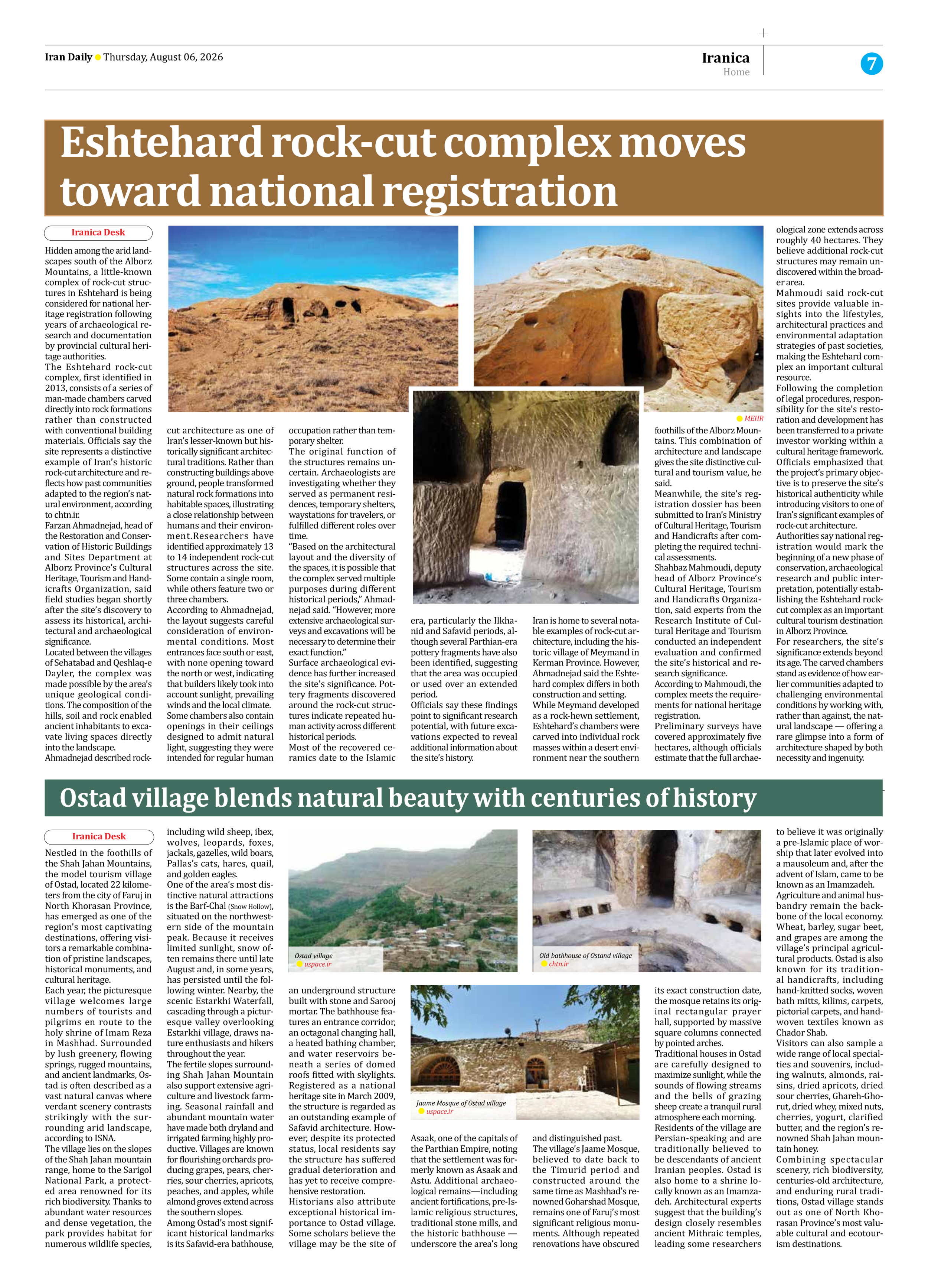
The Eshtehard rock-cut complex, first identified in 2013, consists of a series of man-made chambers carved directly into rock formations rather than constructed with conventional building materials. Officials say the site represents a distinctive example of Iran’s historic rock-cut architecture and reflects how past communities adapted to the region’s natural environment, according to chtn.ir.
Farzan Ahmadnejad, head of the Restoration and Conservation of Historic Buildings and Sites Department at Alborz Province’s Cultural Heritage, Tourism and Handicrafts Organization, said field studies began shortly after the site’s discovery to assess its historical, architectural and archaeological significance.
Located between the villages of Sehatabad and Qeshlaq-e Dayler, the complex was made possible by the area’s unique geological conditions. The composition of the hills, soil and rock enabled ancient inhabitants to excavate living spaces directly into the landscape.
Ahmadnejad described rock-cut architecture as one of Iran’s lesser-known but historically significant architectural traditions. Rather than constructing buildings above ground, people transformed natural rock formations into habitable spaces, illustrating a close relationship between humans and their environment.Researchers have identified approximately 13 to 14 independent rock-cut structures across the site. Some contain a single room, while others feature two or three chambers.
According to Ahmadnejad, the layout suggests careful consideration of environmental conditions. Most entrances face south or east, with none opening toward the north or west, indicating that builders likely took into account sunlight, prevailing winds and the local climate.
Some chambers also contain openings in their ceilings designed to admit natural light, suggesting they were intended for regular human occupation rather than temporary shelter.
The original function of the structures remains uncertain. Archaeologists are investigating whether they served as permanent residences, temporary shelters, waystations for travelers, or fulfilled different roles over time.
“Based on the architectural layout and the diversity of the spaces, it is possible that the complex served multiple purposes during different historical periods,” Ahmadnejad said. “However, more extensive archaeological surveys and excavations will be necessary to determine their exact function.”
Surface archaeological evidence has further increased the site’s significance. Pottery fragments discovered around the rock-cut structures indicate repeated human activity across different historical periods.
Most of the recovered ceramics date to the Islamic era, particularly the Ilkhanid and Safavid periods, although several Parthian-era pottery fragments have also been identified, suggesting that the area was occupied or used over an extended period.
Officials say these findings point to significant research potential, with future excavations expected to reveal additional information about the site’s history.
Iran is home to several notable examples of rock-cut architecture, including the historic village of Meymand in Kerman Province. However, Ahmadnejad said the Eshtehard complex differs in both construction and setting.
While Meymand developed as a rock-hewn settlement, Eshtehard’s chambers were carved into individual rock masses within a desert environment near the southern foothills of the Alborz Mountains. This combination of architecture and landscape gives the site distinctive cultural and tourism value, he said.
Meanwhile, the site’s registration dossier has been submitted to Iran’s Ministry of Cultural Heritage, Tourism and Handicrafts after completing the required technical assessments.
Shahbaz Mahmoudi, deputy head of Alborz Province’s Cultural Heritage, Tourism and Handicrafts Organization, said experts from the Research Institute of Cultural Heritage and Tourism conducted an independent evaluation and confirmed the site’s historical and research significance.
According to Mahmoudi, the complex meets the requirements for national heritage registration.
Preliminary surveys have covered approximately five hectares, although officials estimate that the full archaeological zone extends across roughly 40 hectares. They believe additional rock-cut structures may remain undiscovered within the broader area.
Mahmoudi said rock-cut sites provide valuable insights into the lifestyles, architectural practices and environmental adaptation strategies of past societies, making the Eshtehard complex an important cultural resource.
Following the completion of legal procedures, responsibility for the site’s restoration and development has been transferred to a private investor working within a cultural heritage framework. Officials emphasized that the project’s primary objective is to preserve the site’s historical authenticity while introducing visitors to one of Iran’s significant examples of rock-cut architecture.
Authorities say national registration would mark the beginning of a new phase of conservation, archaeological research and public interpretation, potentially establishing the Eshtehard rock-cut complex as an important cultural tourism destination in Alborz Province.
For researchers, the site’s significance extends beyond its age. The carved chambers stand as evidence of how earlier communities adapted to challenging environmental conditions by working with, rather than against, the natural landscape — offering a rare glimpse into a form of architecture shaped by both necessity and ingenuity.