







Tehran, Islamabad sign trade cooperation MoU
Ministers eye closer cooperation in mining
Iran and Pakistan signed a memorandum of understanding on expanding trade cooperation on Wednesday, reaffirming their commitment to raising bilateral trade to $10 billion and making progress toward a free trade agreement during the 10th session of the Joint Trade Committee in Islamabad.
The committee concluded with both sides emphasizing the removal of trade barriers, stronger industrial and investment cooperation, and the development of infrastructure to support economic exchanges.
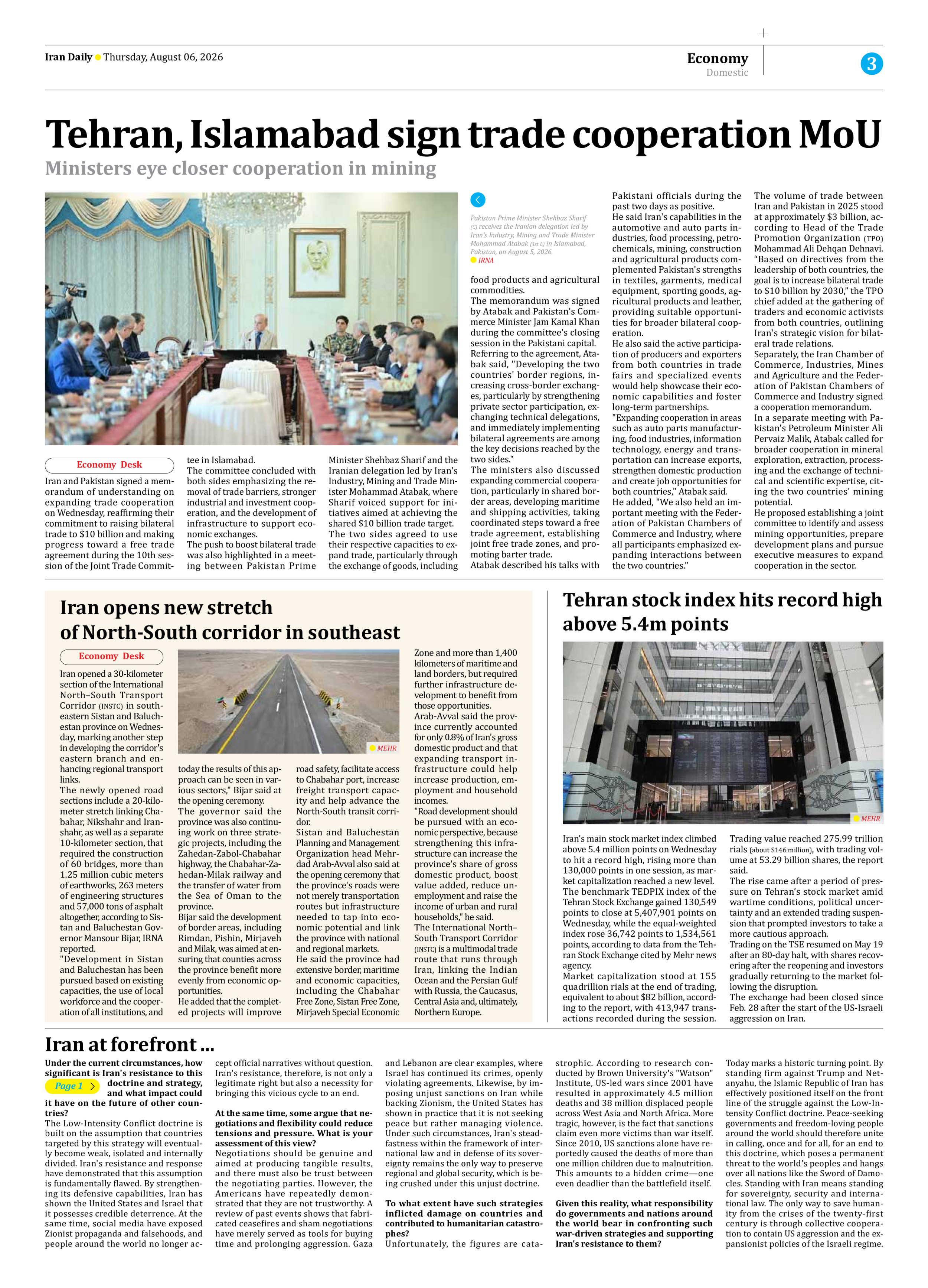
The push to boost bilateral trade was also highlighted in a meeting between Pakistan Prime Minister Shehbaz Sharif and the Iranian delegation led by Iran's Industry, Mining and Trade Minister Mohammad Atabak, where Sharif voiced support for initiatives aimed at achieving the shared $10 billion trade target.
The two sides agreed to use their respective capacities to expand trade, particularly through the exchange of goods, including food products and agricultural commodities.
The memorandum was signed by Atabak and Pakistan's Commerce Minister Jam Kamal Khan during the committee's closing session in the Pakistani capital.
Referring to the agreement, Atabak said, "Developing the two countries' border regions, increasing cross-border exchanges, particularly by strengthening private sector participation, exchanging technical delegations, and immediately implementing bilateral agreements are among the key decisions reached by the two sides."
The ministers also discussed expanding commercial cooperation, particularly in shared border areas, developing maritime and shipping activities, taking coordinated steps toward a free trade agreement, establishing joint free trade zones, and promoting barter trade.
Atabak described his talks with Pakistani officials during the past two days as positive.
He said Iran's capabilities in the automotive and auto parts industries, food processing, petrochemicals, mining, construction and agricultural products complemented Pakistan's strengths in textiles, garments, medical equipment, sporting goods, agricultural products and leather, providing suitable opportunities for broader bilateral cooperation.
He also said the active participation of producers and exporters from both countries in trade fairs and specialized events would help showcase their economic capabilities and foster long-term partnerships.
"Expanding cooperation in areas such as auto parts manufacturing, food industries, information technology, energy and transportation can increase exports, strengthen domestic production and create job opportunities for both countries," Atabak said.
He added, "We also held an important meeting with the Federation of Pakistan Chambers of Commerce and Industry, where all participants emphasized expanding interactions between the two countries."
The volume of trade between Iran and Pakistan in 2025 stood at approximately $3 billion, according to Head of the Trade Promotion Organization (TPO) Mohammad Ali Dehqan Dehnavi.
“Based on directives from the leadership of both countries, the goal is to increase bilateral trade to $10 billion by 2030,” the TPO chief added at the gathering of traders and economic activists from both countries, outlining Iran's strategic vision for bilateral trade relations.
Separately, the Iran Chamber of Commerce, Industries, Mines and Agriculture and the Federation of Pakistan Chambers of Commerce and Industry signed a cooperation memorandum.
In a separate meeting with Pakistan's Petroleum Minister Ali Pervaiz Malik, Atabak called for broader cooperation in mineral exploration, extraction, processing and the exchange of technical and scientific expertise, citing the two countries' mining potential.
He proposed establishing a joint committee to identify and assess mining opportunities, prepare development plans and pursue executive measures to expand cooperation in the sector.