







How modern museums began in Iran
When the question of Iran’s “first museum” is raised, many people immediately think of the National Museum of Iran — formerly known as the Museum of Ancient Iran. Yet the history of museum development in the country is more nuanced. The answer depends largely on how the term “museum” is defined.
If the criterion is the first space dedicated to displaying historical objects, the story begins during the reign of Qajar king Naser al-Din Shah at Golestan Palace. If the focus is on the first official museum institution, Dar ul-Funun holds that distinction. And if the benchmark is the first purpose-built museum building, then the Museum of Ancient Iran — today’s National Museum of Iran — is unquestionably the answer according to ISNA.
The first serious step toward modern museology in Iran came during the reign of Naser al-Din Shah. Inspired by the great museums he visited during his travels to Europe, he ordered the demolition of part of the northern section of Golestan Palace to make way for a new complex that would house historical artifacts, a library, a grand hall, and a traditional pool chamber.
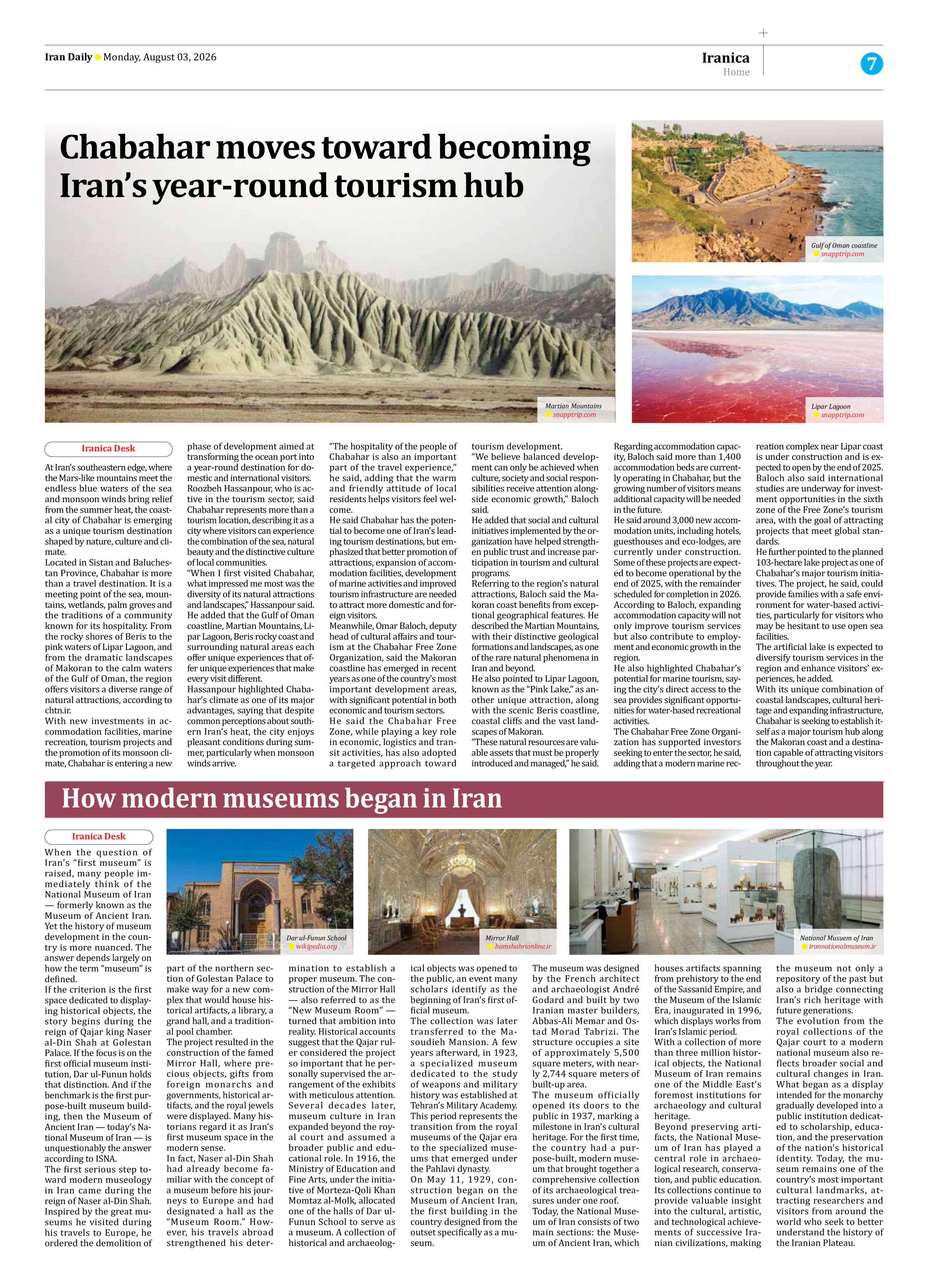
The project resulted in the construction of the famed Mirror Hall, where precious objects, gifts from foreign monarchs and governments, historical artifacts, and the royal jewels were displayed. Many historians regard it as Iran’s first museum space in the modern sense.
In fact, Naser al-Din Shah had already become familiar with the concept of a museum before his journeys to Europe and had designated a hall as the “Museum Room.” However, his travels abroad strengthened his determination to establish a proper museum. The construction of the Mirror Hall — also referred to as the “New Museum Room” — turned that ambition into reality. Historical accounts suggest that the Qajar ruler considered the project so important that he personally supervised the arrangement of the exhibits with meticulous attention.
Several decades later, museum culture in Iran expanded beyond the royal court and assumed a broader public and educational role. In 1916, the Ministry of Education and Fine Arts, under the initiative of Morteza-Qoli Khan Momtaz al-Molk, allocated one of the halls of Dar ul-Funun School to serve as a museum. A collection of historical and archaeological objects was opened to the public, an event many scholars identify as the beginning of Iran’s first official museum.
The collection was later transferred to the Masoudieh Mansion. A few years afterward, in 1923, a specialized museum dedicated to the study of weapons and military history was established at Tehran’s Military Academy. This period represents the transition from the royal museums of the Qajar era to the specialized museums that emerged under the Pahlavi dynasty.
On May 11, 1929, construction began on the Museum of Ancient Iran, the first building in the country designed from the outset specifically as a museum.
The museum was designed by the French architect and archaeologist André Godard and built by two Iranian master builders, Abbas-Ali Memar and Ostad Morad Tabrizi. The structure occupies a site of approximately 5,500 square meters, with nearly 2,744 square meters of built-up area.
The museum officially opened its doors to the public in 1937, marking a milestone in Iran’s cultural heritage. For the first time, the country had a purpose-built, modern museum that brought together a comprehensive collection of its archaeological treasures under one roof.
Today, the National Museum of Iran consists of two main sections: the Museum of Ancient Iran, which houses artifacts spanning from prehistory to the end of the Sassanid Empire, and the Museum of the Islamic Era, inaugurated in 1996, which displays works from Iran’s Islamic period.
With a collection of more than three million historical objects, the National Museum of Iran remains one of the Middle East’s foremost institutions for archaeology and cultural heritage.
Beyond preserving artifacts, the National Museum of Iran has played a central role in archaeological research, conservation, and public education. Its collections continue to provide valuable insight into the cultural, artistic, and technological achievements of successive Iranian civilizations, making the museum not only a repository of the past but also a bridge connecting Iran’s rich heritage with future generations.
The evolution from the royal collections of the Qajar court to a modern national museum also reflects broader social and cultural changes in Iran. What began as a display intended for the monarchy gradually developed into a public institution dedicated to scholarship, education, and the preservation of the nation’s historical identity. Today, the museum remains one of the country’s most important cultural landmarks, attracting researchers and visitors from around the world who seek to better understand the history of the Iranian Plateau.