





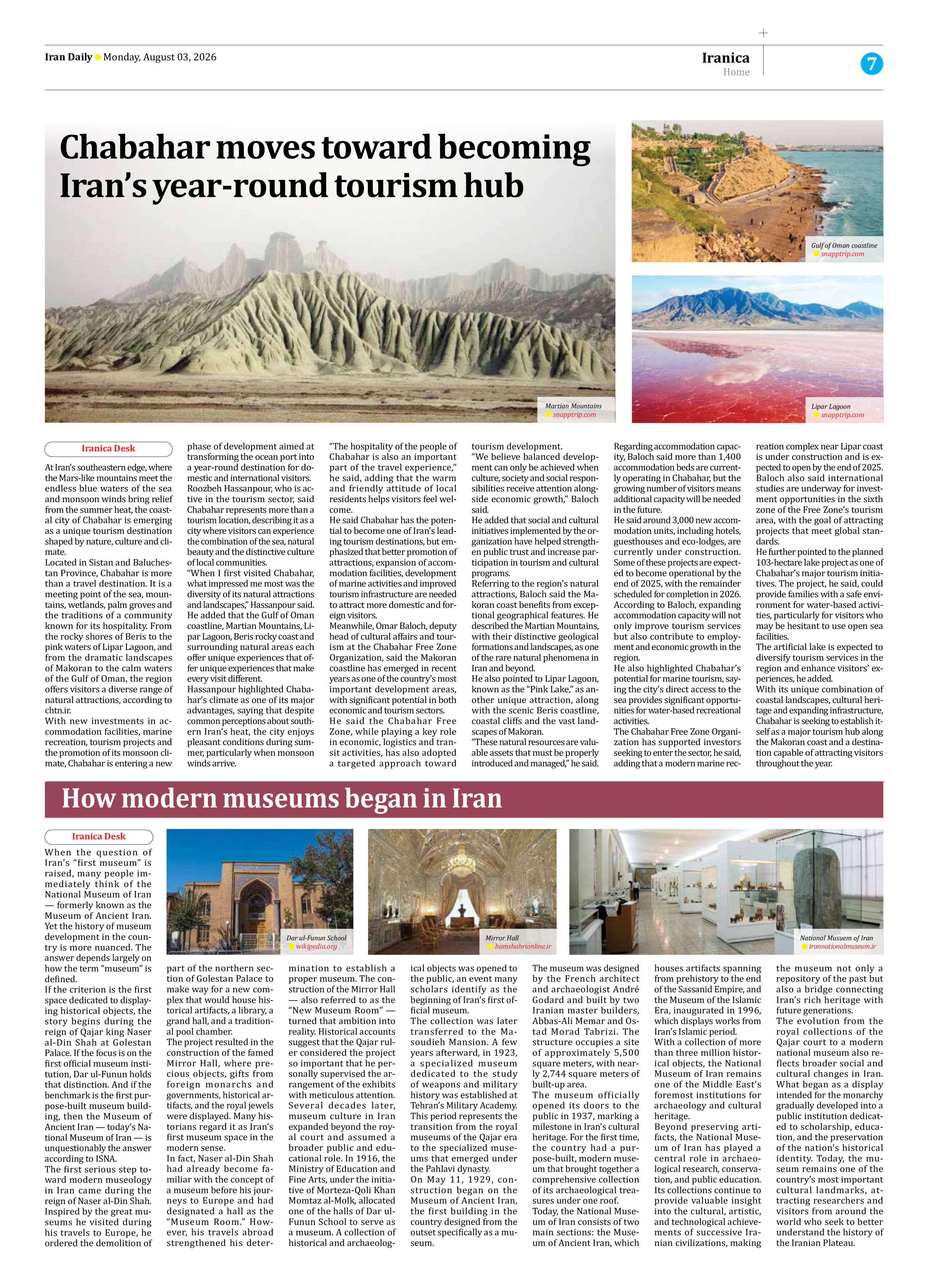


Chabahar moves toward becoming Iran’s year-round tourism hub
At Iran’s southeastern edge, where the Mars-like mountains meet the endless blue waters of the sea and monsoon winds bring relief from the summer heat, the coastal city of Chabahar is emerging as a unique tourism destination shaped by nature, culture and climate.
Located in Sistan and Baluchestan Province, Chabahar is more than a travel destination. It is a meeting point of the sea, mountains, wetlands, palm groves and the traditions of a community known for its hospitality. From the rocky shores of Beris to the pink waters of Lipar Lagoon, and from the dramatic landscapes of Makoran to the calm waters of the Gulf of Oman, the region offers visitors a diverse range of natural attractions, according to chtn.ir.
With new investments in accommodation facilities, marine recreation, tourism projects and the promotion of its monsoon climate, Chabahar is entering a new phase of development aimed at transforming the ocean port into a year-round destination for domestic and international visitors.
Roozbeh Hassanpour, who is active in the tourism sector, said Chabahar represents more than a tourism location, describing it as a city where visitors can experience the combination of the sea, natural beauty and the distinctive culture of local communities.
“When I first visited Chabahar, what impressed me most was the diversity of its natural attractions and landscapes,” Hassanpour said.
He added that the Gulf of Oman coastline, Martian Mountains, Lipar Lagoon, Beris rocky coast and surrounding natural areas each offer unique experiences that offer unique experiences that make every visit different.
Hassanpour highlighted Chabahar’s climate as one of its major advantages, saying that despite common perceptions about southern Iran’s heat, the city enjoys pleasant conditions during summer, particularly when monsoon winds arrive.
“The hospitality of the people of Chabahar is also an important part of the travel experience,” he said, adding that the warm and friendly attitude of local residents helps visitors feel welcome.
He said Chabahar has the potential to become one of Iran’s leading tourism destinations, but emphasized that better promotion of attractions, expansion of accommodation facilities, development of marine activities and improved tourism infrastructure are needed to attract more domestic and foreign visitors.
Meanwhile, Omar Baloch, deputy head of cultural affairs and tourism at the Chabahar Free Zone Organization, said the Makoran coastline has emerged in recent years as one of the country’s most important development areas, with significant potential in both economic and tourism sectors.
He said the Chabahar Free Zone, while playing a key role in economic, logistics and transit activities, has also adopted a targeted approach toward tourism development.
“We believe balanced development can only be achieved when culture, society and social responsibilities receive attention alongside economic growth,” Baloch said.
He added that social and cultural initiatives implemented by the organization have helped strengthen public trust and increase participation in tourism and cultural programs.
Referring to the region’s natural attractions, Baloch said the Makoran coast benefits from exceptional geographical features. He described the Martian Mountains, with their distinctive geological formations and landscapes, as one of the rare natural phenomena in Iran and beyond.
He also pointed to Lipar Lagoon, known as the “Pink Lake,” as another unique attraction, along with the scenic Beris coastline, coastal cliffs and the vast landscapes of Makoran.
“These natural resources are valuable assets that must be properly introduced and managed,” he said.
Regarding accommodation capacity, Baloch said more than 1,400 accommodation beds are currently operating in Chabahar, but the growing number of visitors means additional capacity will be needed in the future.
He said around 3,000 new accommodation units, including hotels, guesthouses and eco-lodges, are currently under construction. Some of these projects are expected to become operational by the end of 2025, with the remainder scheduled for completion in 2026.
According to Baloch, expanding accommodation capacity will not only improve tourism services but also contribute to employment and economic growth in the region.
He also highlighted Chabahar’s potential for marine tourism, saying the city’s direct access to the sea provides significant opportunities for water-based recreational activities.
The Chabahar Free Zone Organization has supported investors seeking to enter the sector, he said, adding that a modern marine recreation complex near Lipar coast is under construction and is expected to open by the end of 2025.
Baloch also said international studies are underway for investment opportunities in the sixth zone of the Free Zone’s tourism area, with the goal of attracting projects that meet global standards.
He further pointed to the planned 103-hectare lake project as one of Chabahar’s major tourism initiatives. The project, he said, could provide families with a safe environment for water-based activities, particularly for visitors who may be hesitant to use open sea facilities.
The artificial lake is expected to diversify tourism services in the region and enhance visitors’ experiences, he added.
With its unique combination of coastal landscapes, cultural heritage and expanding infrastructure, Chabahar is seeking to establish itself as a major tourism hub along the Makoran coast and a destination capable of attracting visitors throughout the year.