





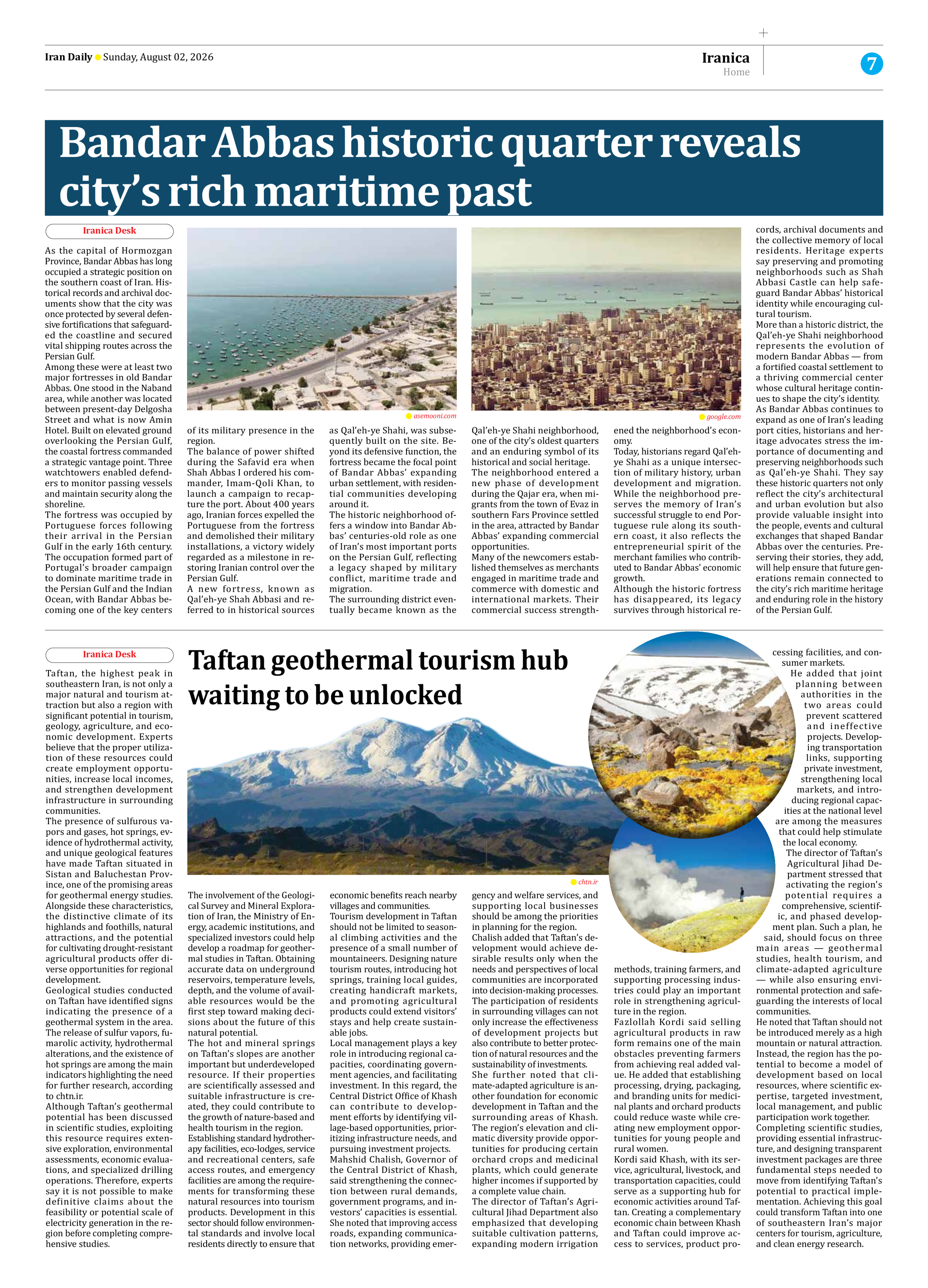


Bandar Abbas historic quarter reveals city’s rich maritime past
As the capital of Hormozgan Province, Bandar Abbas has long occupied a strategic position on the southern coast of Iran. Historical records and archival documents show that the city was once protected by several defensive fortifications that safeguarded the coastline and secured vital shipping routes across the Persian Gulf.
Among these were at least two major fortresses in old Bandar Abbas. One stood in the Naband area, while another was located between present-day Delgosha Street and what is now Amin Hotel. Built on elevated ground overlooking the Persian Gulf, the coastal fortress commanded a strategic vantage point. Three watchtowers enabled defenders to monitor passing vessels and maintain security along the shoreline.
The fortress was occupied by Portuguese forces following their arrival in the Persian Gulf in the early 16th century. The occupation formed part of Portugal’s broader campaign to dominate maritime trade in the Persian Gulf and the Indian Ocean, with Bandar Abbas becoming one of the key centers of its military presence in the region.
The balance of power shifted during the Safavid era when Shah Abbas I ordered his commander, Imam-Qoli Khan, to launch a campaign to recapture the port. About 400 years ago, Iranian forces expelled the Portuguese from the fortress and demolished their military installations, a victory widely regarded as a milestone in restoring Iranian control over the Persian Gulf.
A new fortress, known as Qal’eh-ye Shah Abbasi and referred to in historical sources as Qal’eh-ye Shahi, was subsequently built on the site. Beyond its defensive function, the fortress became the focal point of Bandar Abbas’ expanding urban settlement, with residential communities developing around it.
The historic neighborhood offers a window into Bandar Abbas’ centuries-old role as one of Iran’s most important ports on the Persian Gulf, reflecting a legacy shaped by military conflict, maritime trade and migration.
The surrounding district eventually became known as the Qal’eh-ye Shahi neighborhood, one of the city’s oldest quarters and an enduring symbol of its historical and social heritage.
The neighborhood entered a new phase of development during the Qajar era, when migrants from the town of Evaz in southern Fars Province settled in the area, attracted by Bandar Abbas’ expanding commercial opportunities.
Many of the newcomers established themselves as merchants engaged in maritime trade and commerce with domestic and international markets. Their commercial success strengthened the neighborhood’s economy.
Today, historians regard Qal’eh-ye Shahi as a unique intersection of military history, urban development and migration. While the neighborhood preserves the memory of Iran’s successful struggle to end Portuguese rule along its southern coast, it also reflects the entrepreneurial spirit of the merchant families who contributed to Bandar Abbas’ economic growth.
Although the historic fortress has disappeared, its legacy survives through historical records, archival documents and the collective memory of local residents. Heritage experts say preserving and promoting neighborhoods such as Shah Abbasi Castle can help safeguard Bandar Abbas’ historical identity while encouraging cultural tourism.
More than a historic district, the Qal’eh-ye Shahi neighborhood represents the evolution of modern Bandar Abbas — from a fortified coastal settlement to a thriving commercial center whose cultural heritage continues to shape the city’s identity.
As Bandar Abbas continues to expand as one of Iran’s leading port cities, historians and heritage advocates stress the importance of documenting and preserving neighborhoods such as Qal’eh-ye Shahi. They say these historic quarters not only reflect the city’s architectural and urban evolution but also provide valuable insight into the people, events and cultural exchanges that shaped Bandar Abbas over the centuries. Preserving their stories, they add, will help ensure that future generations remain connected to the city’s rich maritime heritage and enduring role in the history of the Persian Gulf.