







Sistan’s ancient flavors preserve living culinary heritage
The foods and local dishes of Sistan and Baluchestan Province, with a history as long as that of the land itself, are not merely expressions of the creativity and artistry of its people; they are also a vivid reflection of their ingenious adaptation to a harsh natural environment.
Amid the 120-day winds and the relentless heat of the plains, the women of Sistan have, with limited resources and by relying on locally available products such as wheat, barley, dates and animal products, created a colorful table filled with enduring flavors. This culinary tradition is deeply rooted in the region’s agricultural and pastoral culture, according to chtn.ir.
This heritage — ranging from traditional Abgoosht (meat-and-legume stews) and local soups to distinctive breads such as Nan-e Rostam — is not simply a means of satisfying hunger. Rather, it is an inseparable part of Sistan’s historical identity, Nowruz traditions, and ceremonies of celebration and mourning.
“Sistan Yellow Kashk,” regarded as the “gold of this land,” is a remarkable example of the ingenious processing of milk in a hot, dry climate. It continues to be produced using traditional methods and is sold in both domestic and international markets.
The head of the South-East Regional Museum, referring to the diversity of foods in the northern parts of Sistan and Baluchestan Province, stated that in the Sistan region, owing to its several-thousand-year history of animal husbandry and agriculture, the predominant cuisine has developed around meat. Sistani cattle, once recognized as a distinct breed and formerly raised in abundance thanks to the presence of Hamun Lake and its extensive reed beds, together with sheep, local poultry and fish, have formed the main pillars of the local people’s diet.
Mohammad Ali Ebrahimi continued, “Fish has also held a special place in the Sistani diet because of the abundance of water in the Helmand River and the Hamun wetlands, and a wide variety of dishes are prepared using it.”
He explained that these livestock and aquatic animals were not only the main sources of protein but also played a fundamental role in the economy and culture of the region. Among the most notable dishes of the area is Sistani Abgoosht, prepared with either mutton or local chicken. In addition to being a complete and nutritious meal, it is traditionally believed to have medicinal properties for colds and physical weakness, which is why it is particularly popular during the colder months.
He added that Sistan Yellow Kashk, made from Doogh (a yoghurt-based beverage), cracked wheat and distinctive local spices, is one of the region’s characteristic condiments and appetizers.
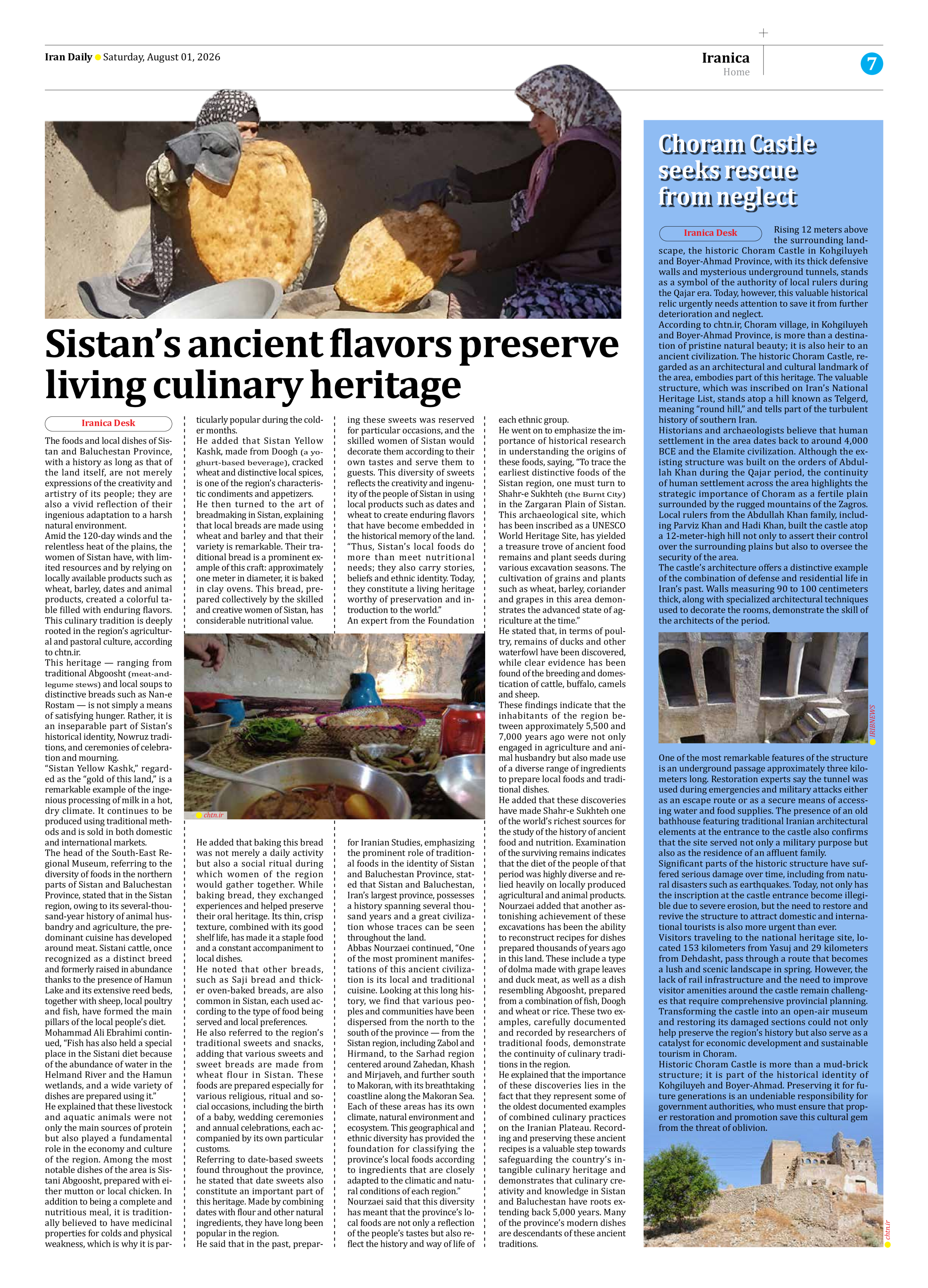
He then turned to the art of breadmaking in Sistan, explaining that local breads are made using wheat and barley and that their variety is remarkable. Their traditional bread is a prominent example of this craft: approximately one meter in diameter, it is baked in clay ovens. This bread, prepared collectively by the skilled and creative women of Sistan, has considerable nutritional value.
He added that baking this bread was not merely a daily activity but also a social ritual during which women of the region would gather together. While baking bread, they exchanged experiences and helped preserve their oral heritage. Its thin, crisp texture, combined with its good shelf life, has made it a staple food and a constant accompaniment to local dishes.
He noted that other breads, such as Saji bread and thicker oven-baked breads, are also common in Sistan, each used according to the type of food being served and local preferences.
He also referred to the region’s traditional sweets and snacks, adding that various sweets and sweet breads are made from wheat flour in Sistan. These foods are prepared especially for various religious, ritual and social occasions, including the birth of a baby, wedding ceremonies and annual celebrations, each accompanied by its own particular customs.
Referring to date-based sweets found throughout the province, he stated that date sweets also constitute an important part of this heritage. Made by combining dates with flour and other natural ingredients, they have long been popular in the region.
He said that in the past, preparing these sweets was reserved for particular occasions, and the skilled women of Sistan would decorate them according to their own tastes and serve them to guests. This diversity of sweets reflects the creativity and ingenuity of the people of Sistan in using local products such as dates and wheat to create enduring flavors that have become embedded in the historical memory of the land.
“Thus, Sistan’s local foods do more than meet nutritional needs; they also carry stories, beliefs and ethnic identity. Today, they constitute a living heritage worthy of preservation and introduction to the world.”
An expert from the Foundation for Iranian Studies, emphasizing the prominent role of traditional foods in the identity of Sistan and Baluchestan Province, stated that Sistan and Baluchestan, Iran’s largest province, possesses a history spanning several thousand years and a great civilization whose traces can be seen throughout the land.
Abbas Nourzaei continued, “One of the most prominent manifestations of this ancient civilization is its local and traditional cuisine. Looking at this long history, we find that various peoples and communities have been dispersed from the north to the south of the province — from the Sistan region, including Zabol and Hirmand, to the Sarhad region centered around Zahedan, Khash and Mirjaveh, and further south to Makoran, with its breathtaking coastline along the Makoran Sea. Each of these areas has its own climate, natural environment and ecosystem. This geographical and ethnic diversity has provided the foundation for classifying the province’s local foods according to ingredients that are closely adapted to the climatic and natural conditions of each region.”
Nourzaei said that this diversity has meant that the province’s local foods are not only a reflection of the people’s tastes but also reflect the history and way of life of each ethnic group.
He went on to emphasize the importance of historical research in understanding the origins of these foods, saying, “To trace the earliest distinctive foods of the Sistan region, one must turn to Shahr-e Sukhteh (the Burnt City) in the Zargaran Plain of Sistan. This archaeological site, which has been inscribed as a UNESCO World Heritage Site, has yielded a treasure trove of ancient food remains and plant seeds during various excavation seasons. The cultivation of grains and plants such as wheat, barley, coriander and grapes in this area demonstrates the advanced state of agriculture at the time.”
He stated that, in terms of poultry, remains of ducks and other waterfowl have been discovered, while clear evidence has been found of the breeding and domestication of cattle, buffalo, camels and sheep.
These findings indicate that the inhabitants of the region between approximately 5,500 and 7,000 years ago were not only engaged in agriculture and animal husbandry but also made use of a diverse range of ingredients to prepare local foods and traditional dishes.
He added that these discoveries have made Shahr-e Sukhteh one of the world’s richest sources for the study of the history of ancient food and nutrition. Examination of the surviving remains indicates that the diet of the people of that period was highly diverse and relied heavily on locally produced agricultural and animal products.
Nourzaei added that another astonishing achievement of these excavations has been the ability to reconstruct recipes for dishes prepared thousands of years ago in this land. These include a type of dolma made with grape leaves and duck meat, as well as a dish resembling Abgoosht, prepared from a combination of fish, Doogh and wheat or rice. These two examples, carefully documented and recorded by researchers of traditional foods, demonstrate the continuity of culinary traditions in the region.
He explained that the importance of these discoveries lies in the fact that they represent some of the oldest documented examples of combined culinary practices on the Iranian Plateau. Recording and preserving these ancient recipes is a valuable step towards safeguarding the country’s intangible culinary heritage and demonstrates that culinary creativity and knowledge in Sistan and Baluchestan have roots extending back 5,000 years. Many of the province’s modern dishes are descendants of these ancient traditions.