





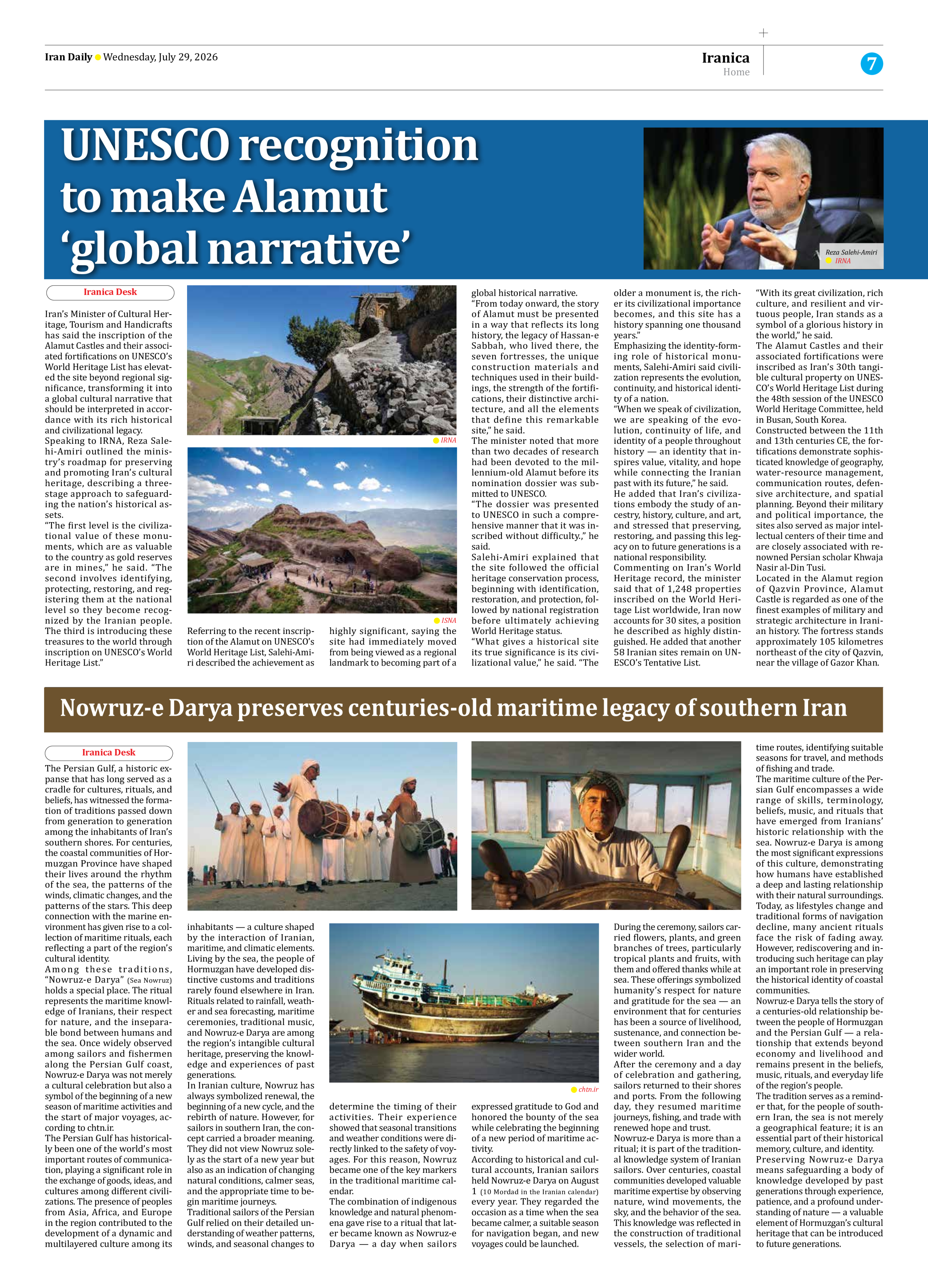


UNESCO recognition to make Alamut ‘global narrative’
Iran’s Minister of Cultural Heritage, Tourism and Handicrafts has said the inscription of the Alamut Castles and their associated fortifications on UNESCO’s World Heritage List has elevated the site beyond regional significance, transforming it into a global cultural narrative that should be interpreted in accordance with its rich historical and civilizational legacy.
Speaking to IRNA, Reza Salehi-Amiri outlined the ministry’s roadmap for preserving and promoting Iran’s cultural heritage, describing a three-stage approach to safeguarding the nation’s historical assets.
“The first level is the civilizational value of these monuments, which are as valuable to the country as gold reserves are in mines,” he said. “The second involves identifying, protecting, restoring, and registering them at the national level so they become recognized by the Iranian people. The third is introducing these treasures to the world through inscription on UNESCO’s World Heritage List.”
Referring to the recent inscription of the Alamut on UNESCO’s World Heritage List, Salehi-Amiri described the achievement as highly significant, saying the site had immediately moved from being viewed as a regional landmark to becoming part of a global historical narrative.
“From today onward, the story of Alamut must be presented in a way that reflects its long history, the legacy of Hassan-e Sabbah, who lived there, the seven fortresses, the unique construction materials and techniques used in their buildings, the strength of the fortifications, their distinctive architecture, and all the elements that define this remarkable site,” he said.
The minister noted that more than two decades of research had been devoted to the millennium-old Alamut before its nomination dossier was submitted to UNESCO.
“The dossier was presented to UNESCO in such a comprehensive manner that it was inscribed without difficulty.,” he said.
Salehi-Amiri explained that the site followed the official heritage conservation process, beginning with identification, restoration, and protection, followed by national registration before ultimately achieving World Heritage status.
“What gives a historical site its true significance is its civilizational value,” he said. “The older a monument is, the richer its civilizational importance becomes, and this site has a history spanning one thousand years.”
Emphasizing the identity-forming role of historical monuments, Salehi-Amiri said civilization represents the evolution, continuity, and historical identity of a nation.
“When we speak of civilization, we are speaking of the evolution, continuity of life, and identity of a people throughout history — an identity that inspires value, vitality, and hope while connecting the Iranian past with its future,” he said.
He added that Iran’s civilizations embody the study of ancestry, history, culture, and art, and stressed that preserving, restoring, and passing this legacy on to future generations is a national responsibility.
Commenting on Iran’s World Heritage record, the minister said that of 1,248 properties inscribed on the World Heritage List worldwide, Iran now accounts for 30 sites, a position he described as highly distinguished. He added that another 58 Iranian sites remain on UNESCO’s Tentative List.
“With its great civilization, rich culture, and resilient and virtuous people, Iran stands as a symbol of a glorious history in the world,” he said.
The Alamut Castles and their associated fortifications were inscribed as Iran’s 30th tangible cultural property on UNESCO’s World Heritage List during the 48th session of the UNESCO World Heritage Committee, held in Busan, South Korea.
Constructed between the 11th and 13th centuries CE, the fortifications demonstrate sophisticated knowledge of geography, water-resource management, communication routes, defensive architecture, and spatial planning. Beyond their military and political importance, the sites also served as major intellectual centers of their time and are closely associated with renowned Persian scholar Khwaja Nasir al-Din Tusi.
Located in the Alamut region of Qazvin Province, Alamut Castle is regarded as one of the finest examples of military and strategic architecture in Iranian history. The fortress stands approximately 105 kilometres northeast of the city of Qazvin, near the village of Gazor Khan.