







Copy in clipboard...
Oman presents regional mechanism for Strait of Hormuz to Iran: Report
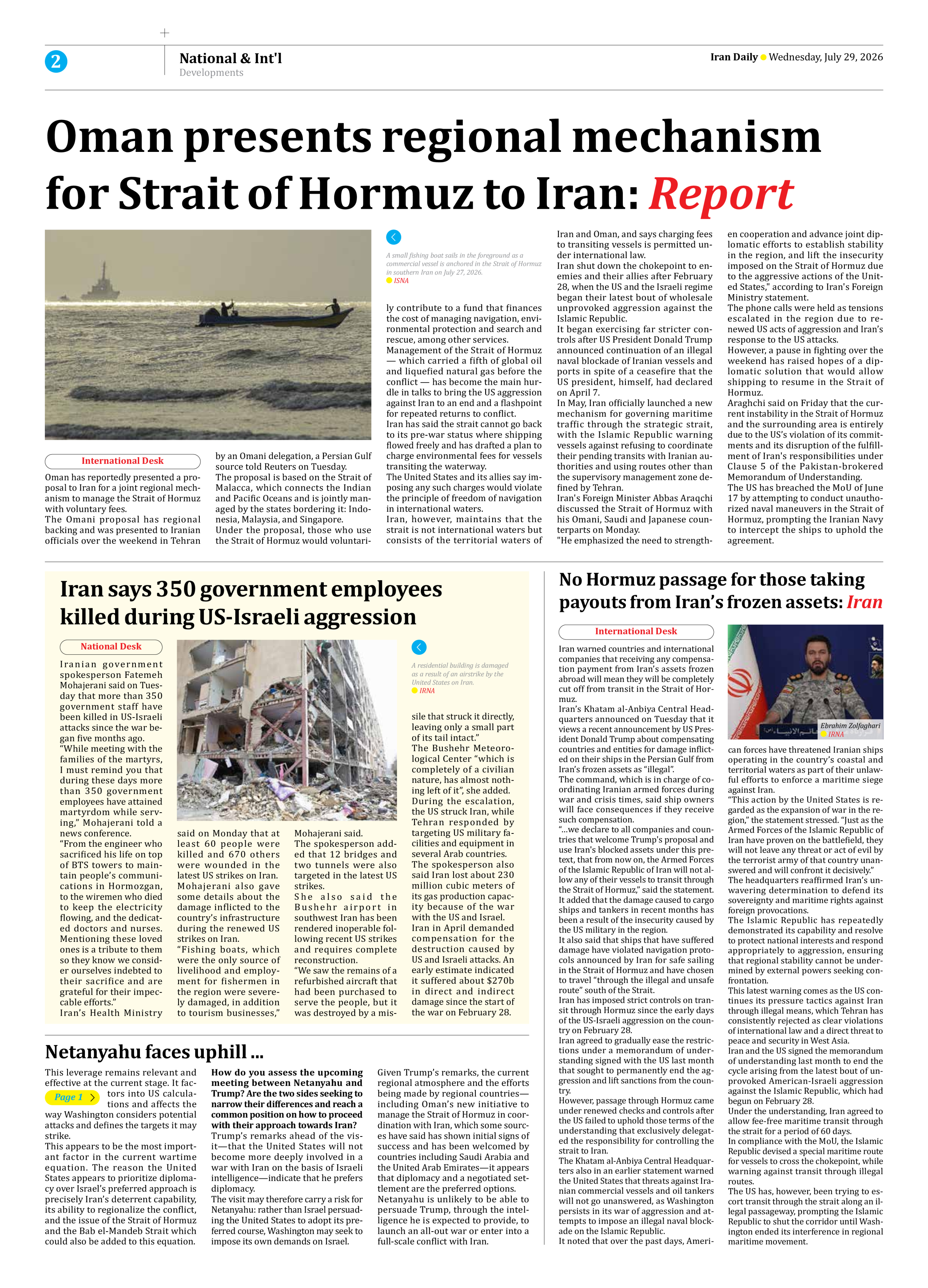
Oman has reportedly presented a proposal to Iran for a joint regional mechanism to manage the Strait of Hormuz with voluntary fees.
The Omani proposal has regional backing and was presented to Iranian officials over the weekend in Tehran by an Omani delegation, a Persian Gulf source told Reuters on Tuesday.
The proposal is based on the Strait of Malacca, which connects the Indian and Pacific Oceans and is jointly managed by the states bordering it: Indonesia, Malaysia, and Singapore.
Under the proposal, those who use the Strait of Hormuz would voluntarily contribute to a fund that finances the cost of managing navigation, environmental protection and search and rescue, among other services.
Management of the Strait of Hormuz — which carried a fifth of global oil and liquefied natural gas before the conflict — has become the main hurdle in talks to bring the US aggression against Iran to an end and a flashpoint for repeated returns to conflict.
Iran has said the strait cannot go back to its pre-war status where shipping flowed freely and has drafted a plan to charge environmental fees for vessels transiting the waterway.
The United States and its allies say imposing any such charges would violate the principle of freedom of navigation in international waters.
Iran, however, maintains that the strait is not international waters but consists of the territorial waters of Iran and Oman, and says charging fees to transiting vessels is permitted under international law.
Iran shut down the chokepoint to enemies and their allies after February 28, when the US and the Israeli regime began their latest bout of wholesale unprovoked aggression against the Islamic Republic.
It began exercising far stricter controls after US President Donald Trump announced continuation of an illegal naval blockade of Iranian vessels and ports in spite of a ceasefire that the US president, himself, had declared on April 7.
In May, Iran officially launched a new mechanism for governing maritime traffic through the strategic strait, with the Islamic Republic warning vessels against refusing to coordinate their pending transits with Iranian authorities and using routes other than the supervisory management zone defined by Tehran.
Iran's Foreign Minister Abbas Araqchi discussed the Strait of Hormuz with his Omani, Saudi and Japanese counterparts on Monday.
"He emphasized the need to strengthen cooperation and advance joint diplomatic efforts to establish stability in the region, and lift the insecurity imposed on the Strait of Hormuz due to the aggressive actions of the United States," according to Iran's Foreign Ministry statement.
The phone calls were held as tensions escalated in the region due to renewed US acts of aggression and Iran’s response to the US attacks.
However, a pause in fighting over the weekend has raised hopes of a diplomatic solution that would allow shipping to resume in the Strait of Hormuz.
Araghchi said on Friday that the current instability in the Strait of Hormuz and the surrounding area is entirely due to the US’s violation of its commitments and its disruption of the fulfillment of Iran's responsibilities under Clause 5 of the Pakistan-brokered Memorandum of Understanding.
The US has breached the MoU of June 17 by attempting to conduct unauthorized naval maneuvers in the Strait of Hormuz, prompting the Iranian Navy to intercept the ships to uphold the agreement.