







World has turned its back on Persian carpets
By Alireza Sepahvand
Journalist
Taher Sabahi, Iranian-Italian scholar who has spent six decades studying Persian carpets, warns that one of the world's greatest artistic traditions is facing its deepest crisis.
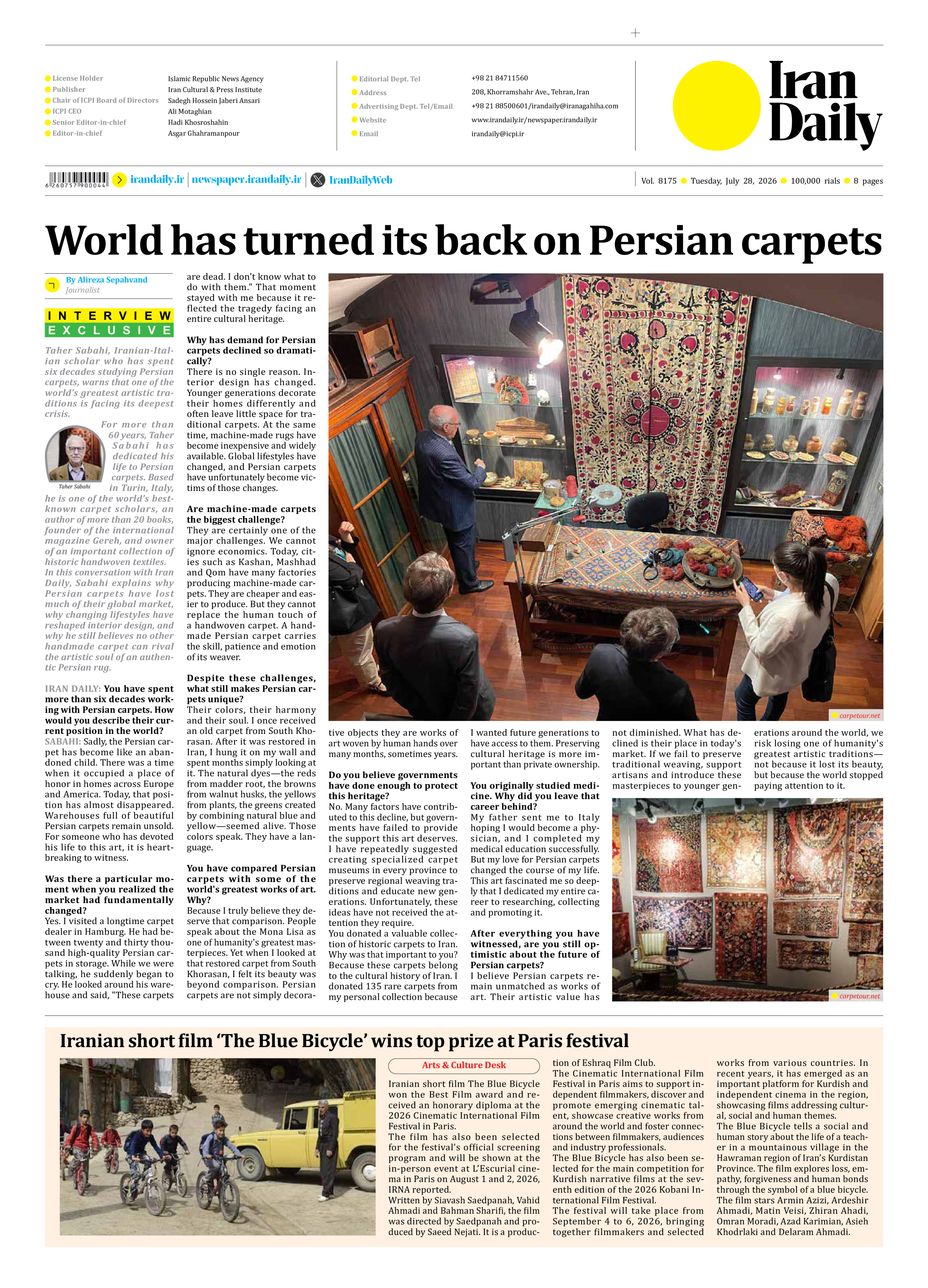
For more than 60 years, Taher Sabahi has dedicated his life to Persian carpets. Based in Turin, Italy, he is one of the world's best-known carpet scholars, an author of more than 20 books, founder of the international magazine Gereh, and owner of an important collection of historic handwoven textiles.
In this conversation with Iran Daily, Sabahi explains why Persian carpets have lost much of their global market, why changing lifestyles have reshaped interior design, and why he still believes no other handmade carpet can rival the artistic soul of an authentic Persian rug.
IRAN DAILY: You have spent more than six decades working with Persian carpets. How would you describe their current position in the world?
SABAHI: Sadly, the Persian carpet has become like an abandoned child. There was a time when it occupied a place of honor in homes across Europe and America. Today, that position has almost disappeared. Warehouses full of beautiful Persian carpets remain unsold. For someone who has devoted his life to this art, it is heartbreaking to witness.
Was there a particular moment when you realized the market had fundamentally changed?
Yes. I visited a longtime carpet dealer in Hamburg. He had between twenty and thirty thousand high-quality Persian carpets in storage. While we were talking, he suddenly began to cry. He looked around his warehouse and said, "These carpets are dead. I don't know what to do with them." That moment stayed with me because it reflected the tragedy facing an entire cultural heritage.
Why has demand for Persian carpets declined so dramatically?
There is no single reason. Interior design has changed. Younger generations decorate their homes differently and often leave little space for traditional carpets. At the same time, machine-made rugs have become inexpensive and widely available. Global lifestyles have changed, and Persian carpets have unfortunately become victims of those changes.
Are machine-made carpets the biggest challenge?
They are certainly one of the major challenges. We cannot ignore economics. Today, cities such as Kashan, Mashhad and Qom have many factories producing machine-made carpets. They are cheaper and easier to produce. But they cannot replace the human touch of a handwoven carpet. A handmade Persian carpet carries the skill, patience and emotion of its weaver.
Despite these challenges, what still makes Persian carpets unique?
Their colors, their harmony and their soul. I once received an old carpet from South Khorasan. After it was restored in Iran, I hung it on my wall and spent months simply looking at it. The natural dyes—the reds from madder root, the browns from walnut husks, the yellows from plants, the greens created by combining natural blue and yellow—seemed alive. Those colors speak. They have a language.
You have compared Persian carpets with some of the world's greatest works of art. Why?
Because I truly believe they deserve that comparison. People speak about the Mona Lisa as one of humanity's greatest masterpieces. Yet when I looked at that restored carpet from South Khorasan, I felt its beauty was beyond comparison. Persian carpets are not simply decorative objects they are works of art woven by human hands over many months, sometimes years.
Do you believe governments have done enough to protect this heritage?
No. Many factors have contributed to this decline, but governments have failed to provide the support this art deserves. I have repeatedly suggested creating specialized carpet museums in every province to preserve regional weaving traditions and educate new generations. Unfortunately, these ideas have not received the attention they require.
You donated a valuable collection of historic carpets to Iran. Why was that important to you?
Because these carpets belong to the cultural history of Iran. I donated 135 rare carpets from my personal collection because I wanted future generations to have access to them. Preserving cultural heritage is more important than private ownership.
You originally studied medicine. Why did you leave that career behind?
My father sent me to Italy hoping I would become a physician, and I completed my medical education successfully. But my love for Persian carpets changed the course of my life. This art fascinated me so deeply that I dedicated my entire career to researching, collecting and promoting it.
After everything you have witnessed, are you still optimistic about the future of Persian carpets?
I believe Persian carpets remain unmatched as works of art. Their artistic value has not diminished. What has declined is their place in today's market. If we fail to preserve traditional weaving, support artisans and introduce these masterpieces to younger generations around the world, we risk losing one of humanity's greatest artistic traditions—not because it lost its beauty, but because the world stopped paying attention to it.