







Chamber chief urges Pakistan to set up special mechanism to speed up customs at Karachi
President of the Chamber of Commerce Samad Hassanzadeh on Monday voiced dismay at the prolonged period of Iranian containers being stuck at Pakistan’s Karachi port, calling for a mechanism to be established to speed up the process.
Karachi has become as a key gateway for sustaining Iranian imports after a US naval blockade of Iranian ports and a decline in Iran’s trade with the United Arab Emirates following a war the United States and Israel waged against Iran in late February.
However, Iranian officials, according to IRNA, say thousands of containers belonging to Iranian businesspeople have remained stranded in Karachi customs for nearly three months without being cleared.
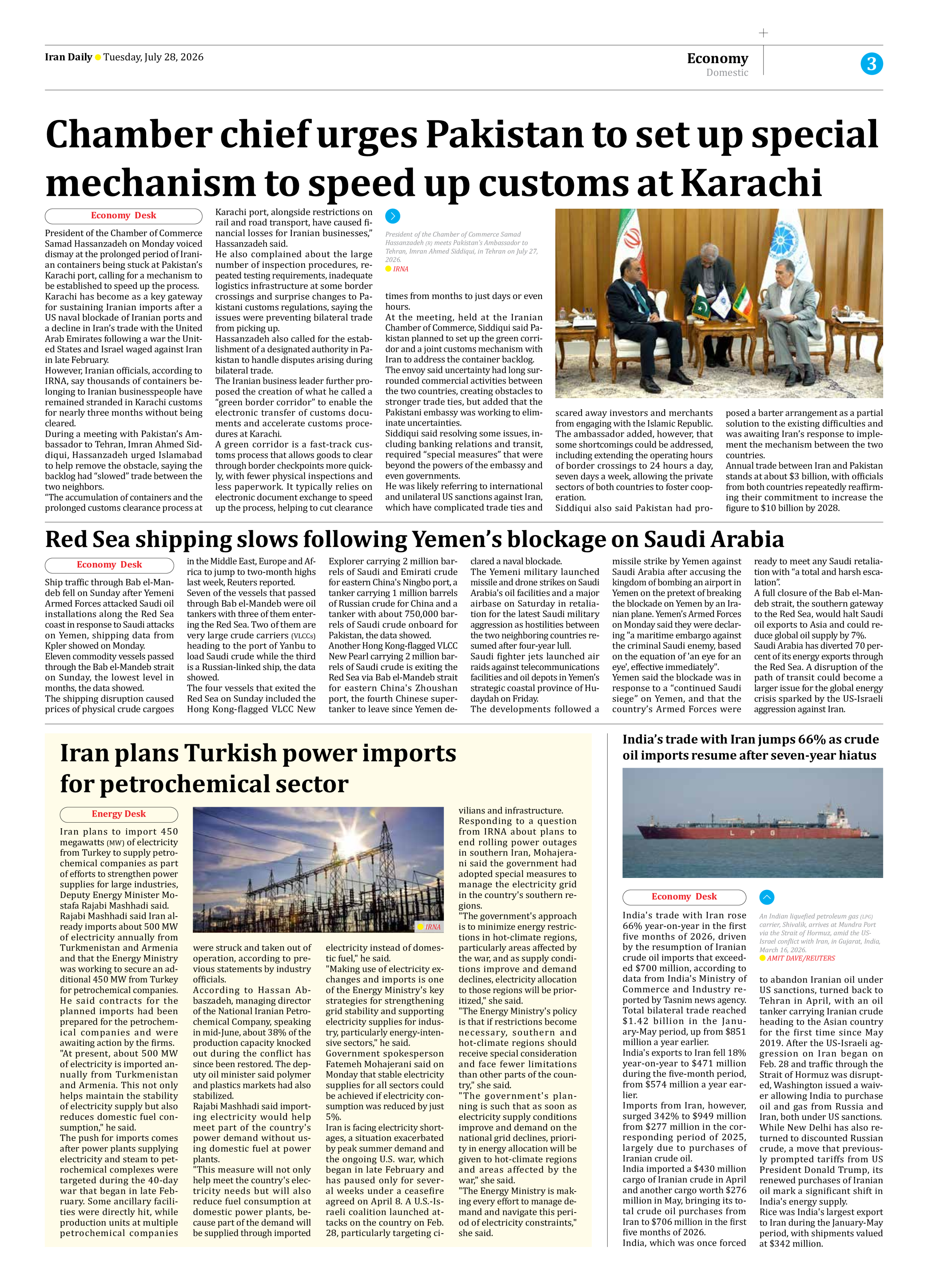
During a meeting with Pakistan’s Ambassador to Tehran, Imran Ahmed Siddiqui, Hassanzadeh urged Islamabad to help remove the obstacle, saying the backlog had “slowed” trade between the two neighbors.
“The accumulation of containers and the prolonged customs clearance process at Karachi port, alongside restrictions on rail and road transport, have caused financial losses for Iranian businesses,” Hassanzadeh said.
He also complained about the large number of inspection procedures, repeated testing requirements, inadequate logistics infrastructure at some border crossings and surprise changes to Pakistani customs regulations, saying the issues were preventing bilateral trade from picking up.
Hassanzadeh also called for the establishment of a designated authority in Pakistan to handle disputes arising during bilateral trade.
The Iranian business leader further proposed the creation of what he called a “green border corridor” to enable the electronic transfer of customs documents and accelerate customs procedures at Karachi.
A green corridor is a fast-track customs process that allows goods to clear through border checkpoints more quickly, with fewer physical inspections and less paperwork. It typically relies on electronic document exchange to speed up the process, helping to cut clearance times from months to just days or even hours.
At the meeting, held at the Iranian Chamber of Commerce, Siddiqui said Pakistan planned to set up the green corridor and a joint customs mechanism with Iran to address the container backlog.
The envoy said uncertainty had long surrounded commercial activities between the two countries, creating obstacles to stronger trade ties, but added that the Pakistani embassy was working to eliminate uncertainties.
Siddiqui said resolving some issues, including banking relations and transit, required “special measures” that were beyond the powers of the embassy and even governments.
He was likely referring to international and unilateral US sanctions against Iran, which have complicated trade ties and scared away investors and merchants from engaging with the Islamic Republic.
The ambassador added, however, that some shortcomings could be addressed, including extending the operating hours of border crossings to 24 hours a day, seven days a week, allowing the private sectors of both countries to foster cooperation.
Siddiqui also said Pakistan had proposed a barter arrangement as a partial solution to the existing difficulties and was awaiting Iran’s response to implement the mechanism between the two countries.
Annual trade between Iran and Pakistan stands at about $3 billion, with officials from both countries repeatedly reaffirming their commitment to increase the figure to $10 billion by 2028.