





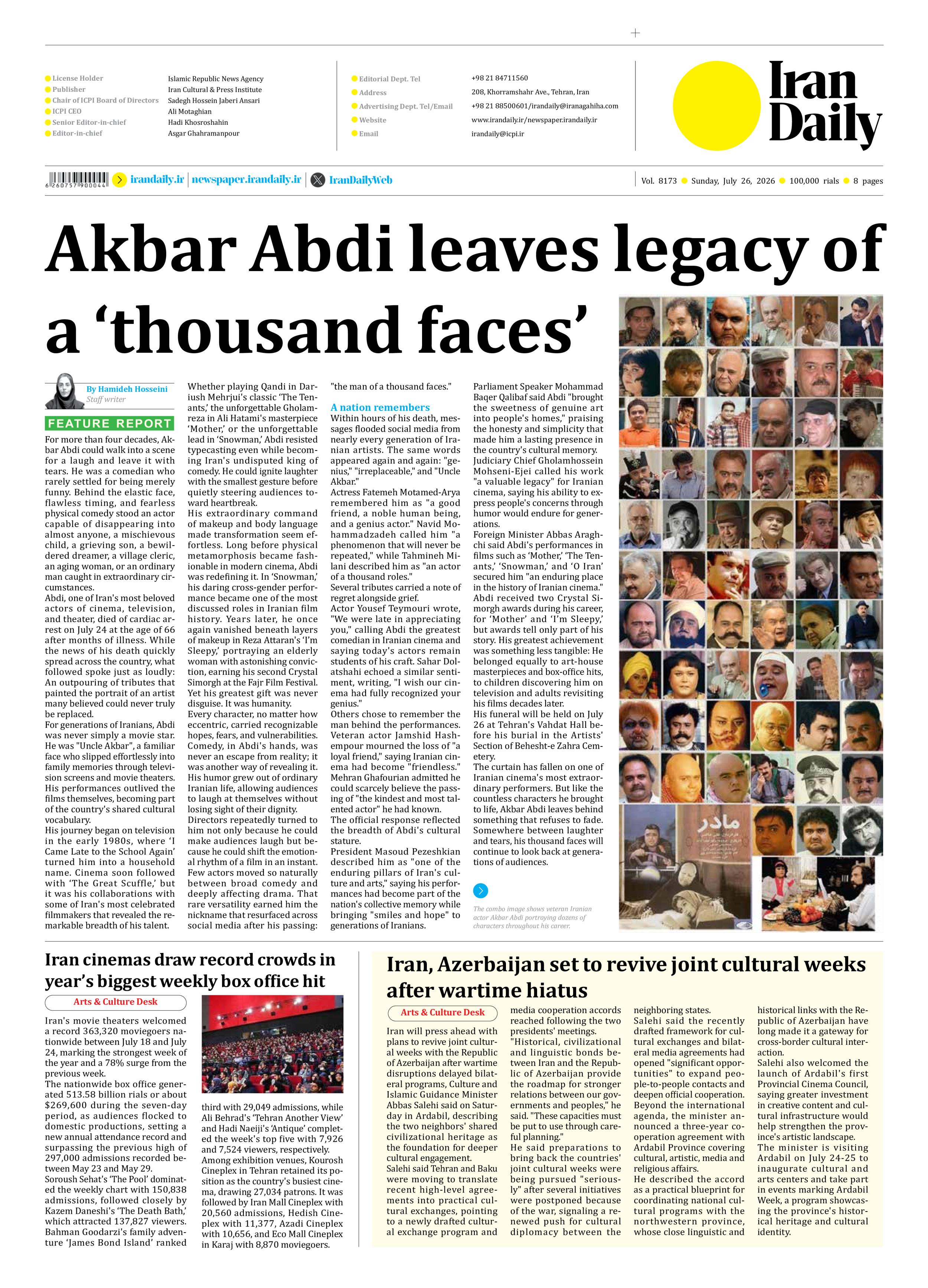


Akbar Abdi leaves legacy of a ‘thousand faces’
By Hamideh Hosseini
Staff writer
For more than four decades, Akbar Abdi could walk into a scene for a laugh and leave it with tears. He was a comedian who rarely settled for being merely funny. Behind the elastic face, flawless timing, and fearless physical comedy stood an actor capable of disappearing into almost anyone, a mischievous child, a grieving son, a bewildered dreamer, a village cleric, an aging woman, or an ordinary man caught in extraordinary circumstances.
Abdi, one of Iran's most beloved actors of cinema, television, and theater, died of cardiac arrest on July 24 at the age of 66 after months of illness. While the news of his death quickly spread across the country, what followed spoke just as loudly: An outpouring of tributes that painted the portrait of an artist many believed could never truly be replaced.
For generations of Iranians, Abdi was never simply a movie star. He was "Uncle Akbar", a familiar face who slipped effortlessly into family memories through television screens and movie theaters. His performances outlived the films themselves, becoming part of the country's shared cultural vocabulary.
His journey began on television in the early 1980s, where ‘I Came Late to the School Again’ turned him into a household name. Cinema soon followed with ‘The Great Scuffle,’ but it was his collaborations with some of Iran's most celebrated filmmakers that revealed the remarkable breadth of his talent.
Whether playing Qandi in Dariush Mehrjui's classic ‘The Tenants,’ the unforgettable Gholamreza in Ali Hatami's masterpiece ‘Mother,’ or the unforgettable lead in ‘Snowman,’ Abdi resisted typecasting even while becoming Iran's undisputed king of comedy. He could ignite laughter with the smallest gesture before quietly steering audiences toward heartbreak.
His extraordinary command of makeup and body language made transformation seem effortless. Long before physical metamorphosis became fashionable in modern cinema, Abdi was redefining it. In ‘Snowman,’ his daring cross-gender performance became one of the most discussed roles in Iranian film history. Years later, he once again vanished beneath layers of makeup in Reza Attaran's ‘I’m Sleepy,’ portraying an elderly woman with astonishing conviction, earning his second Crystal Simorgh at the Fajr Film Festival.
Yet his greatest gift was never disguise. It was humanity.
Every character, no matter how eccentric, carried recognizable hopes, fears, and vulnerabilities. Comedy, in Abdi's hands, was never an escape from reality; it was another way of revealing it. His humor grew out of ordinary Iranian life, allowing audiences to laugh at themselves without losing sight of their dignity.
Directors repeatedly turned to him not only because he could make audiences laugh but because he could shift the emotional rhythm of a film in an instant. Few actors moved so naturally between broad comedy and deeply affecting drama. That rare versatility earned him the nickname that resurfaced across social media after his passing: "the man of a thousand faces."
A nation remembers
Within hours of his death, messages flooded social media from nearly every generation of Iranian artists. The same words appeared again and again: "genius," "irreplaceable," and "Uncle Akbar."
Actress Fatemeh Motamed-Arya remembered him as "a good friend, a noble human being, and a genius actor." Navid Mohammadzadeh called him "a phenomenon that will never be repeated," while Tahmineh Milani described him as "an actor of a thousand roles."
Several tributes carried a note of regret alongside grief.
Actor Yousef Teymouri wrote, "We were late in appreciating you," calling Abdi the greatest comedian in Iranian cinema and saying today's actors remain students of his craft. Sahar Dolatshahi echoed a similar sentiment, writing, "I wish our cinema had fully recognized your genius."
Others chose to remember the man behind the performances. Veteran actor Jamshid Hashempour mourned the loss of "a loyal friend," saying Iranian cinema had become "friendless." Mehran Ghafourian admitted he could scarcely believe the passing of "the kindest and most talented actor" he had known.
The official response reflected the breadth of Abdi's cultural stature.
President Masoud Pezeshkian described him as "one of the enduring pillars of Iran's culture and arts," saying his performances had become part of the nation's collective memory while bringing "smiles and hope" to generations of Iranians.
Parliament Speaker Mohammad Baqer Qalibaf said Abdi "brought the sweetness of genuine art into people's homes," praising the honesty and simplicity that made him a lasting presence in the country's cultural memory.
Judiciary Chief Gholamhossein Mohseni-Ejei called his work "a valuable legacy" for Iranian cinema, saying his ability to express people's concerns through humor would endure for generations.
Foreign Minister Abbas Araghchi said Abdi's performances in films such as ‘Mother,’ ‘The Tenants,’ ‘Snowman,’ and ‘O Iran’ secured him "an enduring place in the history of Iranian cinema."
Abdi received two Crystal Simorgh awards during his career, for ‘Mother’ and ‘I’m Sleepy,’ but awards tell only part of his story. His greatest achievement was something less tangible: He belonged equally to art-house masterpieces and box-office hits, to children discovering him on television and adults revisiting his films decades later.
His funeral will be held on July 26 at Tehran's Vahdat Hall before his burial in the Artists' Section of Behesht-e Zahra Cemetery.
The curtain has fallen on one of Iranian cinema's most extraordinary performers. But like the countless characters he brought to life, Akbar Abdi leaves behind something that refuses to fade. Somewhere between laughter and tears, his thousand faces will continue to look back at generations of audiences.