







Tehran, Yerevan agree to joint energy task force, discuss new gas trade model
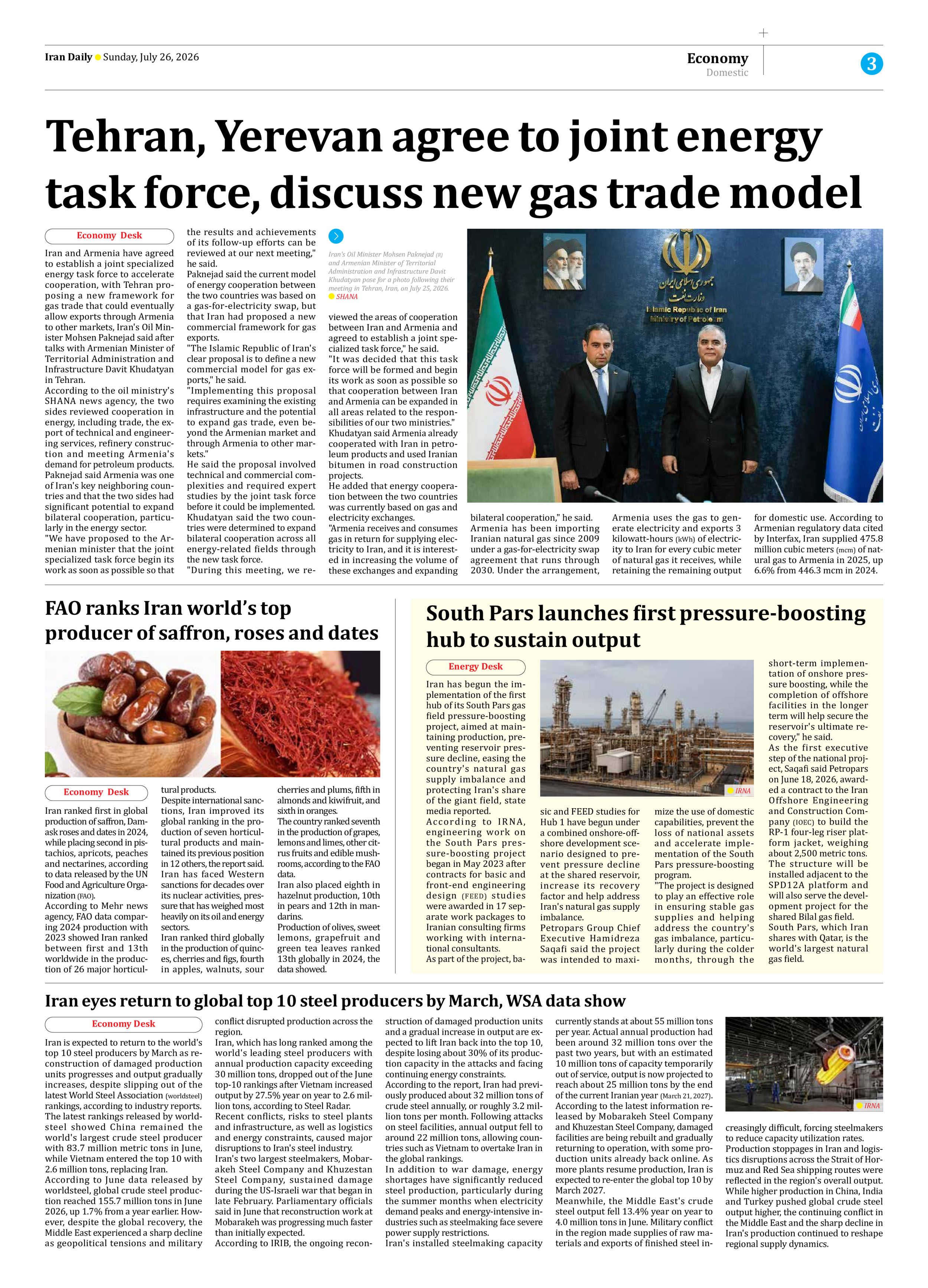
Iran and Armenia have agreed to establish a joint specialized energy task force to accelerate cooperation, with Tehran proposing a new framework for gas trade that could eventually allow exports through Armenia to other markets, Iran's Oil Minister Mohsen Paknejad said after talks with Armenian Minister of Territorial Administration and Infrastructure Davit Khudatyan in Tehran.
According to the oil ministry's SHANA news agency, the two sides reviewed cooperation in energy, including trade, the export of technical and engineering services, refinery construction and meeting Armenia's demand for petroleum products.
Paknejad said Armenia was one of Iran's key neighboring countries and that the two sides had significant potential to expand bilateral cooperation, particularly in the energy sector.
"We have proposed to the Armenian minister that the joint specialized task force begin its work as soon as possible so that the results and achievements of its follow-up efforts can be reviewed at our next meeting," he said.
Paknejad said the current model of energy cooperation between the two countries was based on a gas-for-electricity swap, but that Iran had proposed a new commercial framework for gas exports.
"The Islamic Republic of Iran's clear proposal is to define a new commercial model for gas exports," he said.
"Implementing this proposal requires examining the existing infrastructure and the potential to expand gas trade, even beyond the Armenian market and through Armenia to other markets."
He said the proposal involved technical and commercial complexities and required expert studies by the joint task force before it could be implemented.
Khudatyan said the two countries were determined to expand bilateral cooperation across all energy-related fields through the new task force.
"During this meeting, we reviewed the areas of cooperation between Iran and Armenia and agreed to establish a joint specialized task force," he said.
"It was decided that this task force will be formed and begin its work as soon as possible so that cooperation between Iran and Armenia can be expanded in all areas related to the responsibilities of our two ministries."
Khudatyan said Armenia already cooperated with Iran in petroleum products and used Iranian bitumen in road construction projects.
He added that energy cooperation between the two countries was currently based on gas and electricity exchanges.
"Armenia receives and consumes gas in return for supplying electricity to Iran, and it is interested in increasing the volume of these exchanges and expanding bilateral cooperation," he said.
Armenia has been importing Iranian natural gas since 2009 under a gas-for-electricity swap agreement that runs through 2030. Under the arrangement, Armenia uses the gas to generate electricity and exports 3 kilowatt-hours (kWh) of electricity to Iran for every cubic meter of natural gas it receives, while retaining the remaining output for domestic use. According to Armenian regulatory data cited by Interfax, Iran supplied 475.8 million cubic meters (mcm) of natural gas to Armenia in 2025, up 6.6% from 446.3 mcm in 2024.