







When the breath of donali fell silent
A farewell to Balochestan’s musical voice
By Alireza Sepahvand
Journalist
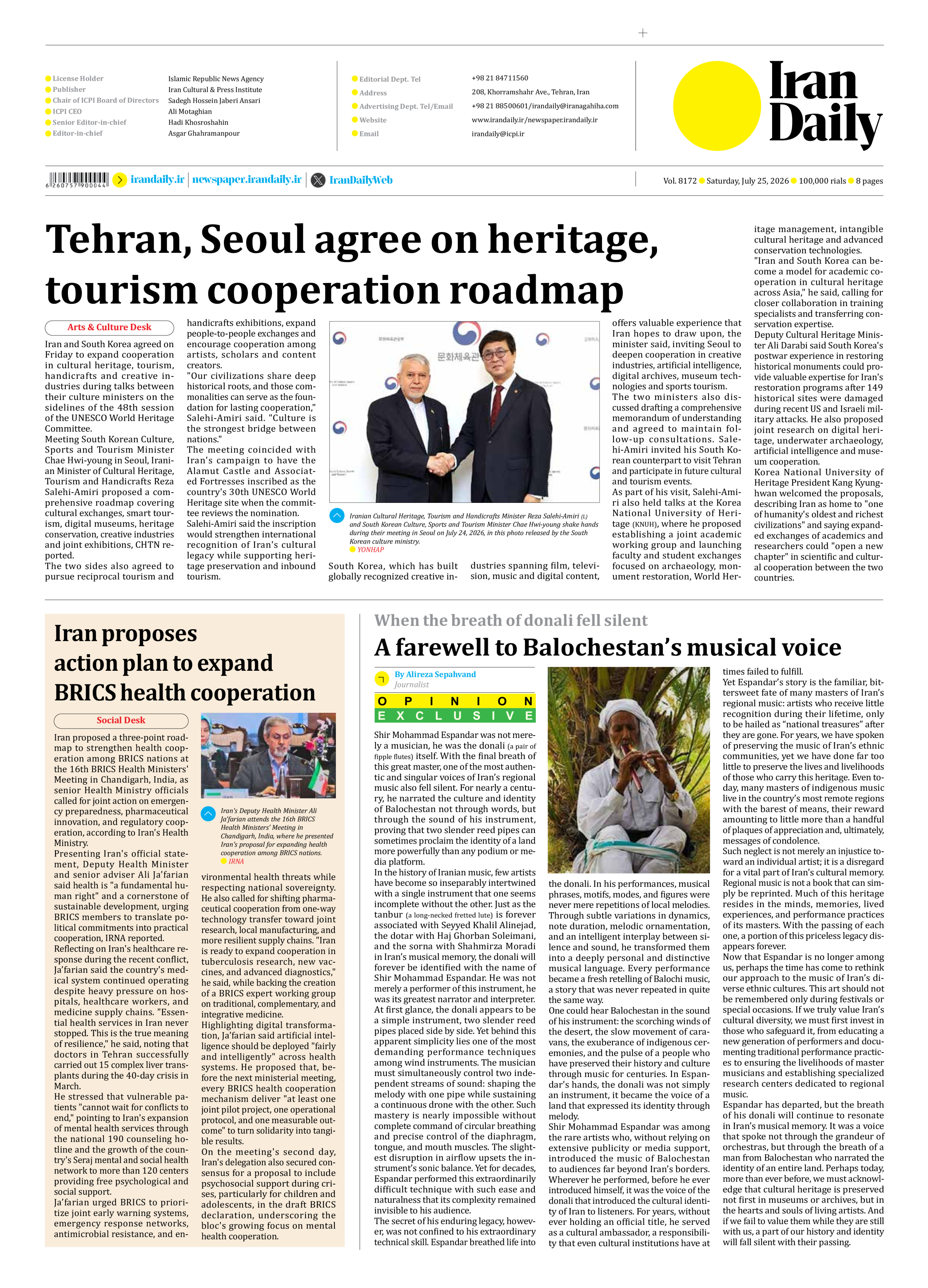
Shir Mohammad Espandar was not merely a musician, he was the donali (a pair of fipple flutes) itself. With the final breath of this great master, one of the most authentic and singular voices of Iran’s regional music also fell silent. For nearly a century, he narrated the culture and identity of Balochestan not through words, but through the sound of his instrument, proving that two slender reed pipes can sometimes proclaim the identity of a land more powerfully than any podium or media platform.
In the history of Iranian music, few artists have become so inseparably intertwined with a single instrument that one seems incomplete without the other. Just as the tanbur (a long-necked fretted lute) is forever associated with Seyyed Khalil Alinejad, the dotar with Haj Ghorban Soleimani, and the sorna with Shahmirza Moradi in Iran’s musical memory, the donali will forever be identified with the name of Shir Mohammad Espandar. He was not merely a performer of this instrument, he was its greatest narrator and interpreter.
At first glance, the donali appears to be a simple instrument, two slender reed pipes placed side by side. Yet behind this apparent simplicity lies one of the most demanding performance techniques among wind instruments. The musician must simultaneously control two independent streams of sound: shaping the melody with one pipe while sustaining a continuous drone with the other. Such mastery is nearly impossible without complete command of circular breathing and precise control of the diaphragm, tongue, and mouth muscles. The slightest disruption in airflow upsets the instrument’s sonic balance. Yet for decades, Espandar performed this extraordinarily difficult technique with such ease and naturalness that its complexity remained invisible to his audience.
The secret of his enduring legacy, however, was not confined to his extraordinary technical skill. Espandar breathed life into the donali. In his performances, musical phrases, motifs, modes, and figures were never mere repetitions of local melodies. Through subtle variations in dynamics, note duration, melodic ornamentation, and an intelligent interplay between silence and sound, he transformed them into a deeply personal and distinctive musical language. Every performance became a fresh retelling of Balochi music, a story that was never repeated in quite the same way.
One could hear Balochestan in the sound of his instrument: the scorching winds of the desert, the slow movement of caravans, the exuberance of indigenous ceremonies, and the pulse of a people who have preserved their history and culture through music for centuries. In Espandar’s hands, the donali was not simply an instrument, it became the voice of a land that expressed its identity through melody.
Shir Mohammad Espandar was among the rare artists who, without relying on extensive publicity or media support, introduced the music of Balochestan to audiences far beyond Iran’s borders. Wherever he performed, before he ever introduced himself, it was the voice of the donali that introduced the cultural identity of Iran to listeners. For years, without ever holding an official title, he served as a cultural ambassador, a responsibility that even cultural institutions have at times failed to fulfill.
Yet Espandar’s story is the familiar, bittersweet fate of many masters of Iran’s regional music: artists who receive little recognition during their lifetime, only to be hailed as “national treasures” after they are gone. For years, we have spoken of preserving the music of Iran’s ethnic communities, yet we have done far too little to preserve the lives and livelihoods of those who carry this heritage. Even today, many masters of indigenous music live in the country’s most remote regions with the barest of means, their reward amounting to little more than a handful of plaques of appreciation and, ultimately, messages of condolence.
Such neglect is not merely an injustice toward an individual artist; it is a disregard for a vital part of Iran’s cultural memory. Regional music is not a book that can simply be reprinted. Much of this heritage resides in the minds, memories, lived experiences, and performance practices of its masters. With the passing of each one, a portion of this priceless legacy disappears forever.
Now that Espandar is no longer among us, perhaps the time has come to rethink our approach to the music of Iran’s diverse ethnic cultures. This art should not be remembered only during festivals or special occasions. If we truly value Iran’s cultural diversity, we must first invest in those who safeguard it, from educating a new generation of performers and documenting traditional performance practices to ensuring the livelihoods of master musicians and establishing specialized research centers dedicated to regional music.
Espandar has departed, but the breath of his donali will continue to resonate in Iran’s musical memory. It was a voice that spoke not through the grandeur of orchestras, but through the breath of a man from Balochestan who narrated the identity of an entire land. Perhaps today, more than ever before, we must acknowledge that cultural heritage is preserved not first in museums or archives, but in the hearts and souls of living artists. And if we fail to value them while they are still with us, a part of our history and identity will fall silent with their passing.