







Hormozgan’s women preserve a centuries-old embroidery art
Hormozgan Province, with its long history of seafaring and trade with the lands surrounding the Persian Gulf and the Indian Ocean, has always been a meeting point of diverse cultures and artistic traditions. This cultural exchange, combined with the creativity and talent of local women, has given rise to a collection of unique handicrafts, among which traditional embroidery holds a prominent place. Among these arts, Khos Bafi and Shak Bafi (also known as Khos Duzi and Shak Duzi) occupy a special position; crafts that, despite changes in lifestyle, have remained alive in many parts of Hormozgan and continue to be an inseparable part of the region’s traditional women’s clothing.
In fact, in corners of old houses across Hormozgan, the gentle sound of spools of thread and the shimmer of silver and gold ribbons still tell the story of an art that has survived for generations in the hands of the women of this land. An art shaped not by machines, but by memory, experience, patience, and creativity, it is now recognized as one of the most valuable forms of traditional embroidery in southern Iran. Khos Bafi and Shak Bafi are not merely methods of decorating garments; they are part of the cultural memory and identity of women along the shores of the Persian Gulf. Woven into every strand of these crafts are traces of history, maritime trade, local aesthetics, and women’s artistry.
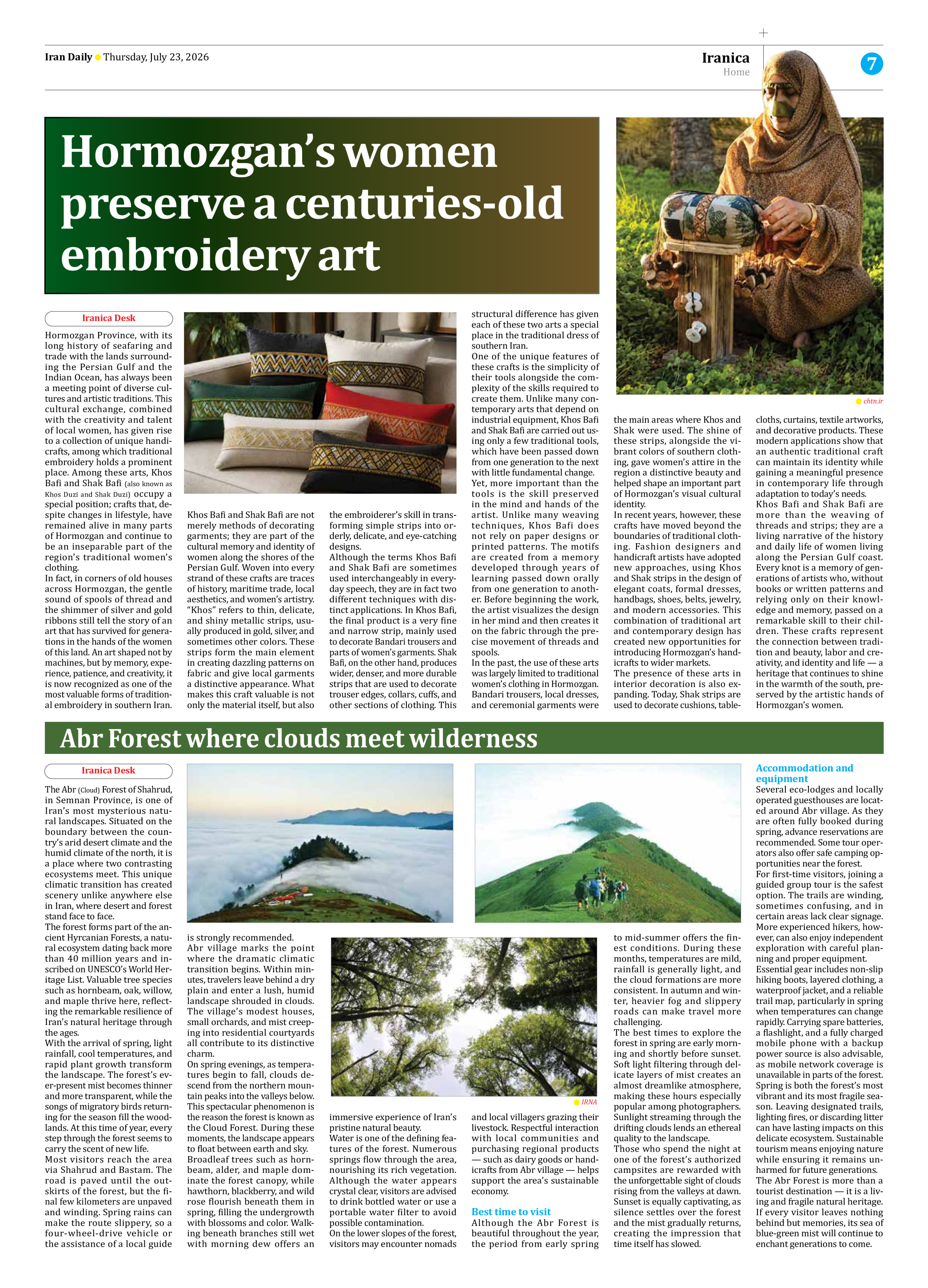
“Khos” refers to thin, delicate, and shiny metallic strips, usually produced in gold, silver, and sometimes other colors. These strips form the main element in creating dazzling patterns on fabric and give local garments a distinctive appearance. What makes this craft valuable is not only the material itself, but also the embroiderer’s skill in transforming simple strips into orderly, delicate, and eye-catching designs.
Although the terms Khos Bafi and Shak Bafi are sometimes used interchangeably in everyday speech, they are in fact two different techniques with distinct applications. In Khos Bafi, the final product is a very fine and narrow strip, mainly used to decorate Bandari trousers and parts of women’s garments. Shak Bafi, on the other hand, produces wider, denser, and more durable strips that are used to decorate trouser edges, collars, cuffs, and other sections of clothing. This structural difference has given each of these two arts a special place in the traditional dress of southern Iran.
One of the unique features of these crafts is the simplicity of their tools alongside the complexity of the skills required to create them. Unlike many contemporary arts that depend on industrial equipment, Khos Bafi and Shak Bafi are carried out using only a few traditional tools, which have been passed down from one generation to the next with little fundamental change.
Yet, more important than the tools is the skill preserved in the mind and hands of the artist. Unlike many weaving techniques, Khos Bafi does not rely on paper designs or printed patterns. The motifs are created from a memory developed through years of learning passed down orally from one generation to another. Before beginning the work, the artist visualizes the design in her mind and then creates it on the fabric through the precise movement of threads and spools.
In the past, the use of these arts was largely limited to traditional women’s clothing in Hormozgan. Bandari trousers, local dresses, and ceremonial garments were the main areas where Khos and Shak were used. The shine of these strips, alongside the vibrant colors of southern clothing, gave women’s attire in the region a distinctive beauty and helped shape an important part of Hormozgan’s visual cultural identity.
In recent years, however, these crafts have moved beyond the boundaries of traditional clothing. Fashion designers and handicraft artists have adopted new approaches, using Khos and Shak strips in the design of elegant coats, formal dresses, handbags, shoes, belts, jewelry, and modern accessories. This combination of traditional art and contemporary design has created new opportunities for introducing Hormozgan’s handicrafts to wider markets.
The presence of these arts in interior decoration is also expanding. Today, Shak strips are used to decorate cushions, tablecloths, curtains, textile artworks, and decorative products. These modern applications show that an authentic traditional craft can maintain its identity while gaining a meaningful presence in contemporary life through adaptation to today’s needs.
Khos Bafi and Shak Bafi are more than the weaving of threads and strips; they are a living narrative of the history and daily life of women living along the Persian Gulf coast. Every knot is a memory of generations of artists who, without books or written patterns and relying only on their knowledge and memory, passed on a remarkable skill to their children. These crafts represent the connection between tradition and beauty, labor and creativity, and identity and life — a heritage that continues to shine in the warmth of the south, preserved by the artistic hands of Hormozgan’s women.