







Reading Room
Mohammad Shams Langeroudi
Ancient Persian literature continues to offer contemporary readers fresh narratives and thought-provoking ideas. The book Patient as a Winter Seed, a selection of stories from Al-Faraj ba‘da al-Shiddah (Relief After Hardship) by Qazi Abu Ali Mohsen al-Tanukhi, seeks to build a connection between today’s readers and one of the valuable works of classical literature.
Mohammad Shams Langeroudi, the compiler of the volume, and Farshid Parsikia, the book’s illustrator, discussed the collection, the importance of revisiting classical literature, and the process of illustration in an interview with IRNA.
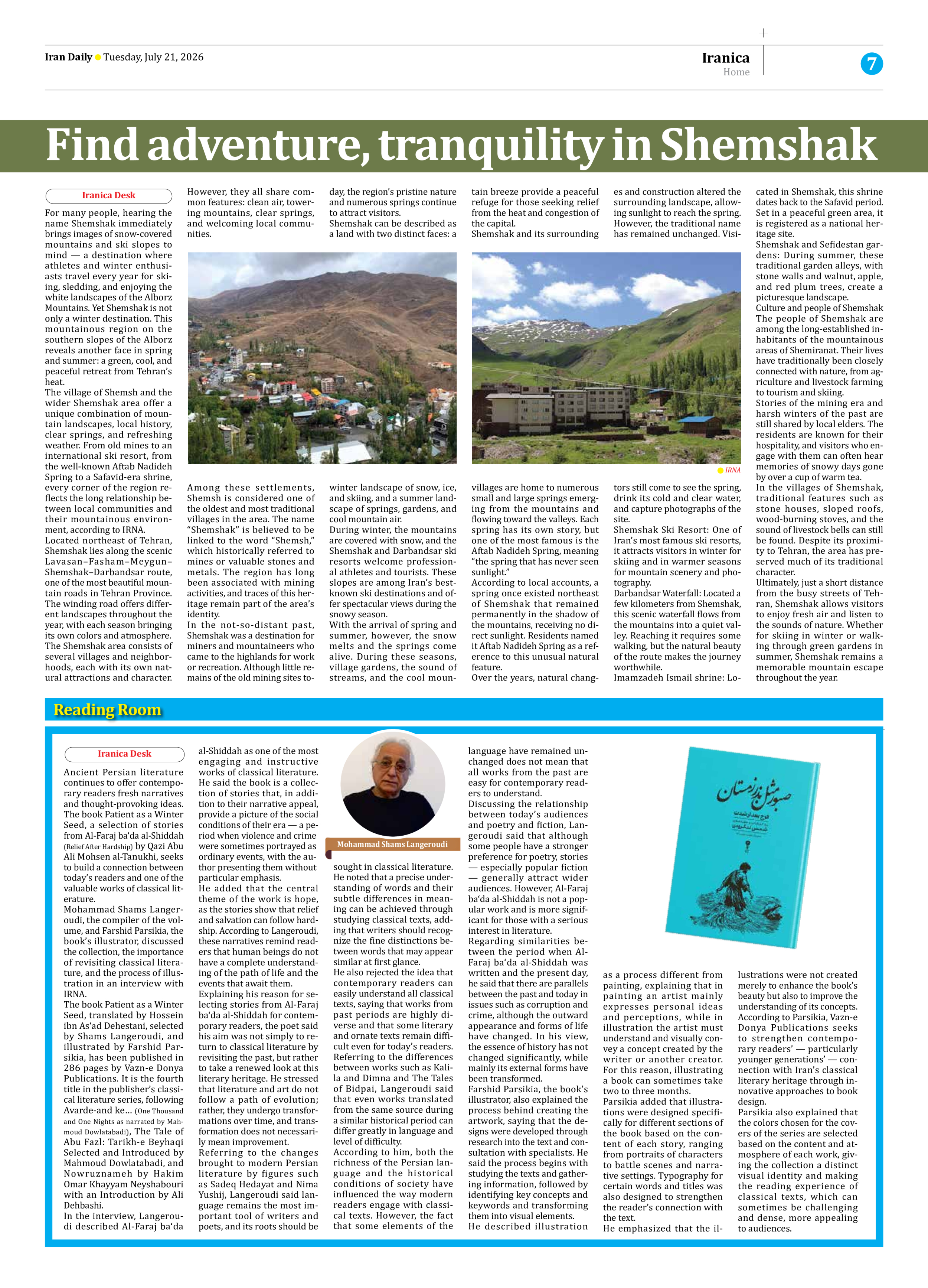
The book Patient as a Winter Seed, translated by Hossein ibn As‘ad Dehestani, selected by Shams Langeroudi, and illustrated by Farshid Parsikia, has been published in 286 pages by Vazn-e Donya Publications. It is the fourth title in the publisher’s classical literature series, following Avarde-and ke… (One Thousand and One Nights as narrated by Mahmoud Dowlatabadi), The Tale of Abu Fazl: Tarikh-e Beyhaqi Selected and Introduced by Mahmoud Dowlatabadi, and Nowruznameh by Hakim Omar Khayyam Neyshabouri with an Introduction by Ali Dehbashi.
In the interview, Langeroudi described Al-Faraj ba‘da al-Shiddah as one of the most engaging and instructive works of classical literature. He said the book is a collection of stories that, in addition to their narrative appeal, provide a picture of the social conditions of their era — a period when violence and crime were sometimes portrayed as ordinary events, with the author presenting them without particular emphasis.
He added that the central theme of the work is hope, as the stories show that relief and salvation can follow hardship. According to Langeroudi, these narratives remind readers that human beings do not have a complete understanding of the path of life and the events that await them.
Explaining his reason for selecting stories from Al-Faraj ba‘da al-Shiddah for contemporary readers, the poet said his aim was not simply to return to classical literature by revisiting the past, but rather to take a renewed look at this literary heritage. He stressed that literature and art do not follow a path of evolution; rather, they undergo transformations over time, and transformation does not necessarily mean improvement.
Referring to the changes brought to modern Persian literature by figures such as Sadeq Hedayat and Nima Yushij, Langeroudi said language remains the most important tool of writers and poets, and its roots should be sought in classical literature. He noted that a precise understanding of words and their subtle differences in meaning can be achieved through studying classical texts, adding that writers should recognize the fine distinctions between words that may appear similar at first glance.
He also rejected the idea that contemporary readers can easily understand all classical texts, saying that works from past periods are highly diverse and that some literary and ornate texts remain difficult even for today’s readers. Referring to the differences between works such as Kalila and Dimna and The Tales of Bidpai, Langeroudi said that even works translated from the same source during a similar historical period can differ greatly in language and level of difficulty.
According to him, both the richness of the Persian language and the historical conditions of society have influenced the way modern readers engage with classical texts. However, the fact that some elements of the language have remained unchanged does not mean that all works from the past are easy for contemporary readers to understand.
Discussing the relationship between today’s audiences and poetry and fiction, Langeroudi said that although some people have a stronger preference for poetry, stories — especially popular fiction — generally attract wider audiences. However, Al-Faraj ba‘da al-Shiddah is not a popular work and is more significant for those with a serious interest in literature.
Regarding similarities between the period when Al-Faraj ba‘da al-Shiddah was written and the present day, he said that there are parallels between the past and today in issues such as corruption and crime, although the outward appearance and forms of life have changed. In his view, the essence of history has not changed significantly, while mainly its external forms have been transformed.
Farshid Parsikia, the book’s illustrator, also explained the process behind creating the artwork, saying that the designs were developed through research into the text and consultation with specialists. He said the process begins with studying the texts and gathering information, followed by identifying key concepts and keywords and transforming them into visual elements.
He described illustration as a process different from painting, explaining that in painting an artist mainly expresses personal ideas and perceptions, while in illustration the artist must understand and visually convey a concept created by the writer or another creator. For this reason, illustrating a book can sometimes take two to three months.
Parsikia added that illustrations were designed specifically for different sections of the book based on the content of each story, ranging from portraits of characters to battle scenes and narrative settings. Typography for certain words and titles was also designed to strengthen the reader’s connection with the text.
He emphasized that the illustrations were not created merely to enhance the book’s beauty but also to improve the understanding of its concepts. According to Parsikia, Vazn-e Donya Publications seeks to strengthen contemporary readers’ — particularly younger generations’ — connection with Iran’s classical literary heritage through innovative approaches to book design.
Parsikia also explained that the colors chosen for the covers of the series are selected based on the content and atmosphere of each work, giving the collection a distinct visual identity and making the reading experience of classical texts, which can sometimes be challenging and dense, more appealing to audiences.