







Copy in clipboard...
Soltaniyeh Dome displays grandeur of Ilkhanid era architecture
Among Iran’s UNESCO World Heritage sites, the Soltaniyeh Dome holds a distinguished place as one of the finest achievements of Ilkhanid architecture and one of the most remarkable examples of structural engineering, architectural design, and decorative art in the Islamic world. At its 29th session in 2005, UNESCO’s World Heritage Committee inscribed the Soltaniyeh Dome as Iran’s seventh World Heritage property, recognizing its Outstanding Universal Value and securing its place among the world’s most important historic monuments, according to chtn.ir.
Built between 1302 and 1312 CE (702–712 AH), the monument was one of the most ambitious architectural projects of its time. Drawing upon the expertise of Iranian architects and craftsmen, it became a lasting milestone in the history of world architecture.
The monument’s most striking feature is its monumental double-shelled dome, rising approximately 48 meters high with a span of nearly 25 meters. It remains the largest brick dome in the world and is widely regarded as a masterpiece of medieval engineering.
Its innovative double-shell design, advanced structural load distribution, precise geometric proportions, and masterful use of brickwork have made the monument one of the greatest engineering achievements of the Middle Ages.
Architectural historians believe that the engineering techniques employed in the construction of the Soltaniyeh Dome influenced the development of later large domed structures, including several landmark buildings of the Renaissance.
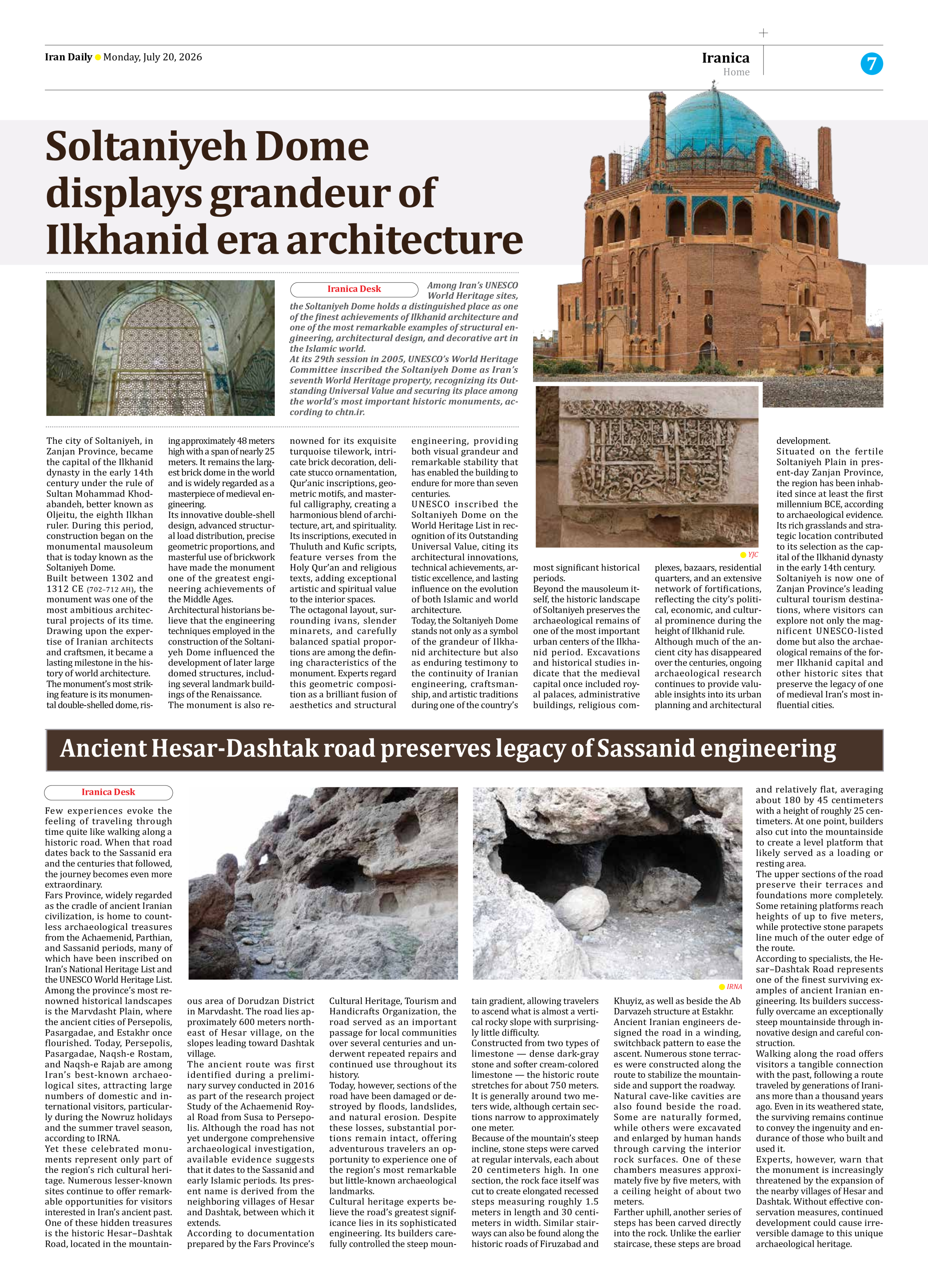
The monument is also renowned for its exquisite turquoise tilework, intricate brick decoration, delicate stucco ornamentation, Qur’anic inscriptions, geometric motifs, and masterful calligraphy, creating a harmonious blend of architecture, art, and spirituality.
Its inscriptions, executed in Thuluth and Kufic scripts, feature verses from the Holy Qur’an and religious texts, adding exceptional artistic and spiritual value to the interior spaces.
The octagonal layout, surrounding ivans, slender minarets, and carefully balanced spatial proportions are among the defining characteristics of the monument. Experts regard this geometric composition as a brilliant fusion of aesthetics and structural engineering, providing both visual grandeur and remarkable stability that has enabled the building to endure for more than seven centuries.
UNESCO inscribed the Soltaniyeh Dome on the World Heritage List in recognition of its Outstanding Universal Value, citing its architectural innovations, technical achievements, artistic excellence, and lasting influence on the evolution of both Islamic and world architecture.
Today, the Soltaniyeh Dome stands not only as a symbol of the grandeur of Ilkhanid architecture but also as enduring testimony to the continuity of Iranian engineering, craftsmanship, and artistic traditions during one of the country’s most significant historical periods.
Beyond the mausoleum itself, the historic landscape of Soltaniyeh preserves the archaeological remains of one of the most important urban centers of the Ilkhanid period. Excavations and historical studies indicate that the medieval capital once included royal palaces, administrative buildings, religious complexes, bazaars, residential quarters, and an extensive network of fortifications, reflecting the city’s political, economic, and cultural prominence during the height of Ilkhanid rule.
Although much of the ancient city has disappeared over the centuries, ongoing archaeological research continues to provide valuable insights into its urban planning and architectural development.
Situated on the fertile Soltaniyeh Plain in present-day Zanjan Province, the region has been inhabited since at least the first millennium BCE, according to archaeological evidence. Its rich grasslands and strategic location contributed to its selection as the capital of the Ilkhanid dynasty in the early 14th century.
Soltaniyeh is now one of Zanjan Province’s leading cultural tourism destinations, where visitors can explore not only the magnificent UNESCO-listed dome but also the archaeological remains of the former Ilkhanid capital and other historic sites that preserve the legacy of one of medieval Iran’s most influential cities.