







West Azarbaijan’s archaeological treasures trace Iran’s ancient past
Scattered across the landscapes of West Azarbaijan Province, ancient archaeological hills stand as enduring symbols of the region’s rich history, preserving the legacy of civilizations that flourished thousands of years ago. Each site tells a unique story of Iran’s past, offering invaluable insights into the cultural, political, and social development of one of the country’s oldest inhabited regions.
These archaeological hills have yielded remarkable discoveries over decades of excavation, many of which have transformed scholars’ understanding of the ancient Near East. While numerous sites remain only partially explored, they continue to hold the promise of revealing new chapters in Iran’s long history, according to IRNA.
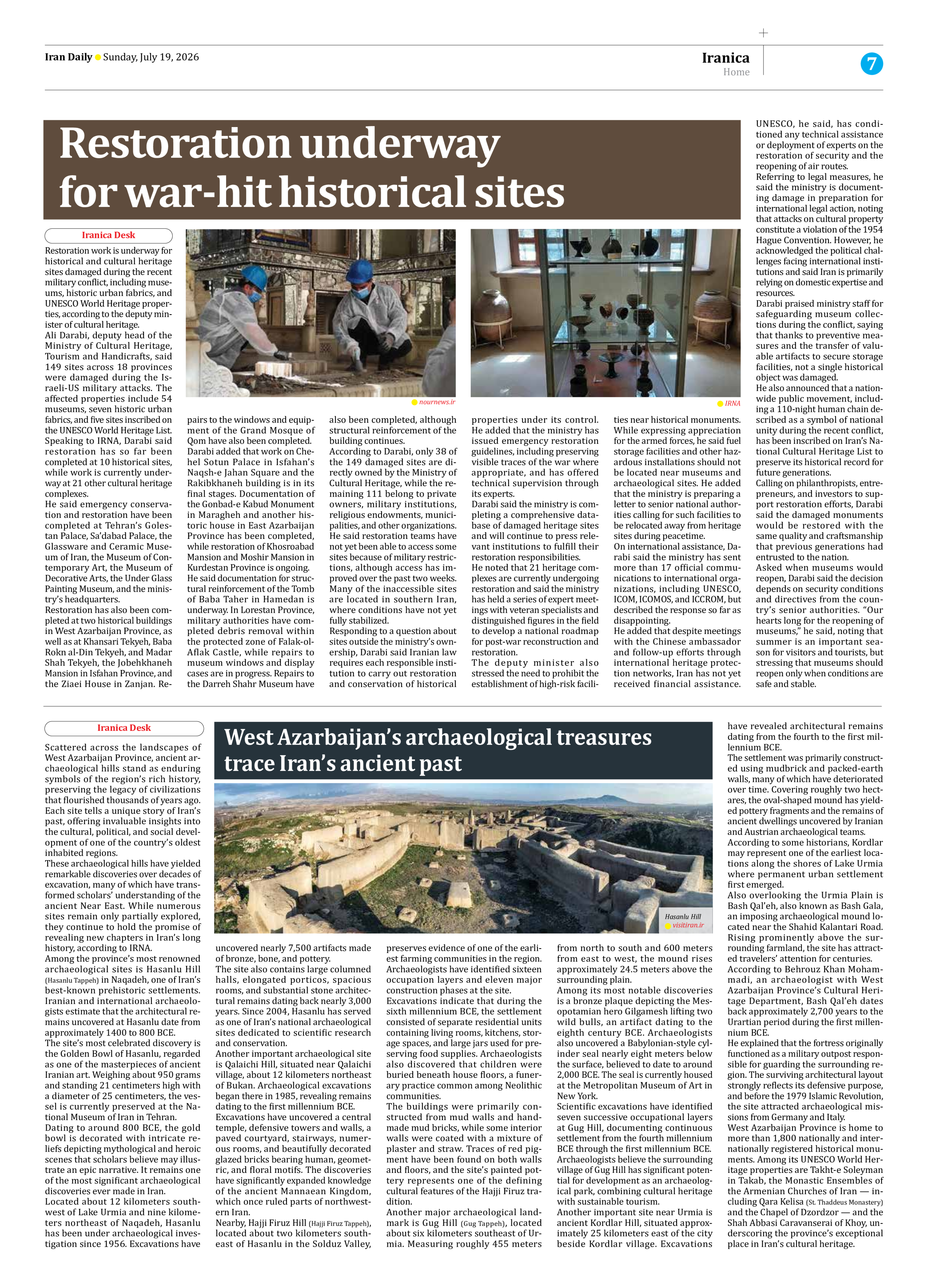
Among the province’s most renowned archaeological sites is Hasanlu Hill (Hasanlu Tappeh) in Naqadeh, one of Iran’s best-known prehistoric settlements. Iranian and international archaeologists estimate that the architectural remains uncovered at Hasanlu date from approximately 1400 to 800 BCE.
The site’s most celebrated discovery is the Golden Bowl of Hasanlu, regarded as one of the masterpieces of ancient Iranian art. Weighing about 950 grams and standing 21 centimeters high with a diameter of 25 centimeters, the vessel is currently preserved at the National Museum of Iran in Tehran.
Dating to around 800 BCE, the gold bowl is decorated with intricate reliefs depicting mythological and heroic scenes that scholars believe may illustrate an epic narrative. It remains one of the most significant archaeological discoveries ever made in Iran.
Located about 12 kilometers southwest of Lake Urmia and nine kilometers northeast of Naqadeh, Hasanlu has been under archaeological investigation since 1956. Excavations have uncovered nearly 7,500 artifacts made of bronze, bone, and pottery.
The site also contains large columned halls, elongated porticos, spacious rooms, and substantial stone architectural remains dating back nearly 3,000 years. Since 2004, Hasanlu has served as one of Iran’s national archaeological sites dedicated to scientific research and conservation.
Another important archaeological site is Qalaichi Hill, situated near Qalaichi village, about 12 kilometers northeast of Bukan. Archaeological excavations began there in 1985, revealing remains dating to the first millennium BCE.
Excavations have uncovered a central temple, defensive towers and walls, a paved courtyard, stairways, numerous rooms, and beautifully decorated glazed bricks bearing human, geometric, and floral motifs. The discoveries have significantly expanded knowledge of the ancient Mannaean Kingdom, which once ruled parts of northwestern Iran.
Nearby, Hajji Firuz Hill (Hajji Firuz Tappeh), located about two kilometers southeast of Hasanlu in the Solduz Valley, preserves evidence of one of the earliest farming communities in the region. Archaeologists have identified sixteen occupation layers and eleven major construction phases at the site.
Excavations indicate that during the sixth millennium BCE, the settlement consisted of separate residential units containing living rooms, kitchens, storage spaces, and large jars used for preserving food supplies. Archaeologists also discovered that children were buried beneath house floors, a funerary practice common among Neolithic communities.
The buildings were primarily constructed from mud walls and handmade mud bricks, while some interior walls were coated with a mixture of plaster and straw. Traces of red pigment have been found on both walls and floors, and the site’s painted pottery represents one of the defining cultural features of the Hajji Firuz tradition.
Another major archaeological landmark is Gug Hill (Gug Tappeh), located about six kilometers southeast of Urmia. Measuring roughly 455 meters from north to south and 600 meters from east to west, the mound rises approximately 24.5 meters above the surrounding plain.
Among its most notable discoveries is a bronze plaque depicting the Mesopotamian hero Gilgamesh lifting two wild bulls, an artifact dating to the eighth century BCE. Archaeologists also uncovered a Babylonian-style cylinder seal nearly eight meters below the surface, believed to date to around 2,000 BCE. The seal is currently housed at the Metropolitan Museum of Art in New York.
Scientific excavations have identified seven successive occupational layers at Gug Hill, documenting continuous settlement from the fourth millennium BCE through the first millennium BCE.
Archaeologists believe the surrounding village of Gug Hill has significant potential for development as an archaeological park, combining cultural heritage with sustainable tourism.
Another important site near Urmia is ancient Kordlar Hill, situated approximately 25 kilometers east of the city beside Kordlar village. Excavations have revealed architectural remains dating from the fourth to the first millennium BCE.
The settlement was primarily constructed using mudbrick and packed-earth walls, many of which have deteriorated over time. Covering roughly two hectares, the oval-shaped mound has yielded pottery fragments and the remains of ancient dwellings uncovered by Iranian and Austrian archaeological teams.
According to some historians, Kordlar may represent one of the earliest locations along the shores of Lake Urmia where permanent urban settlement first emerged.
Also overlooking the Urmia Plain is Bash Qal’eh, also known as Bash Gala, an imposing archaeological mound located near the Shahid Kalantari Road. Rising prominently above the surrounding farmland, the site has attracted travelers’ attention for centuries.
According to Behrouz Khan Mohammadi, an archaeologist with West Azarbaijan Province’s Cultural Heritage Department, Bash Qal’eh dates back approximately 2,700 years to the Urartian period during the first millennium BCE.
He explained that the fortress originally functioned as a military outpost responsible for guarding the surrounding region. The surviving architectural layout strongly reflects its defensive purpose, and before the 1979 Islamic Revolution, the site attracted archaeological missions from Germany and Italy.
West Azarbaijan Province is home to more than 1,800 nationally and internationally registered historical monuments. Among its UNESCO World Heritage properties are Takht-e Soleyman in Takab, the Monastic Ensembles of the Armenian Churches of Iran — including Qara Kelisa (St. Thaddeus Monastery) and the Chapel of Dzordzor — and the Shah Abbasi Caravanserai of Khoy, underscoring the province’s exceptional place in Iran’s cultural heritage.