





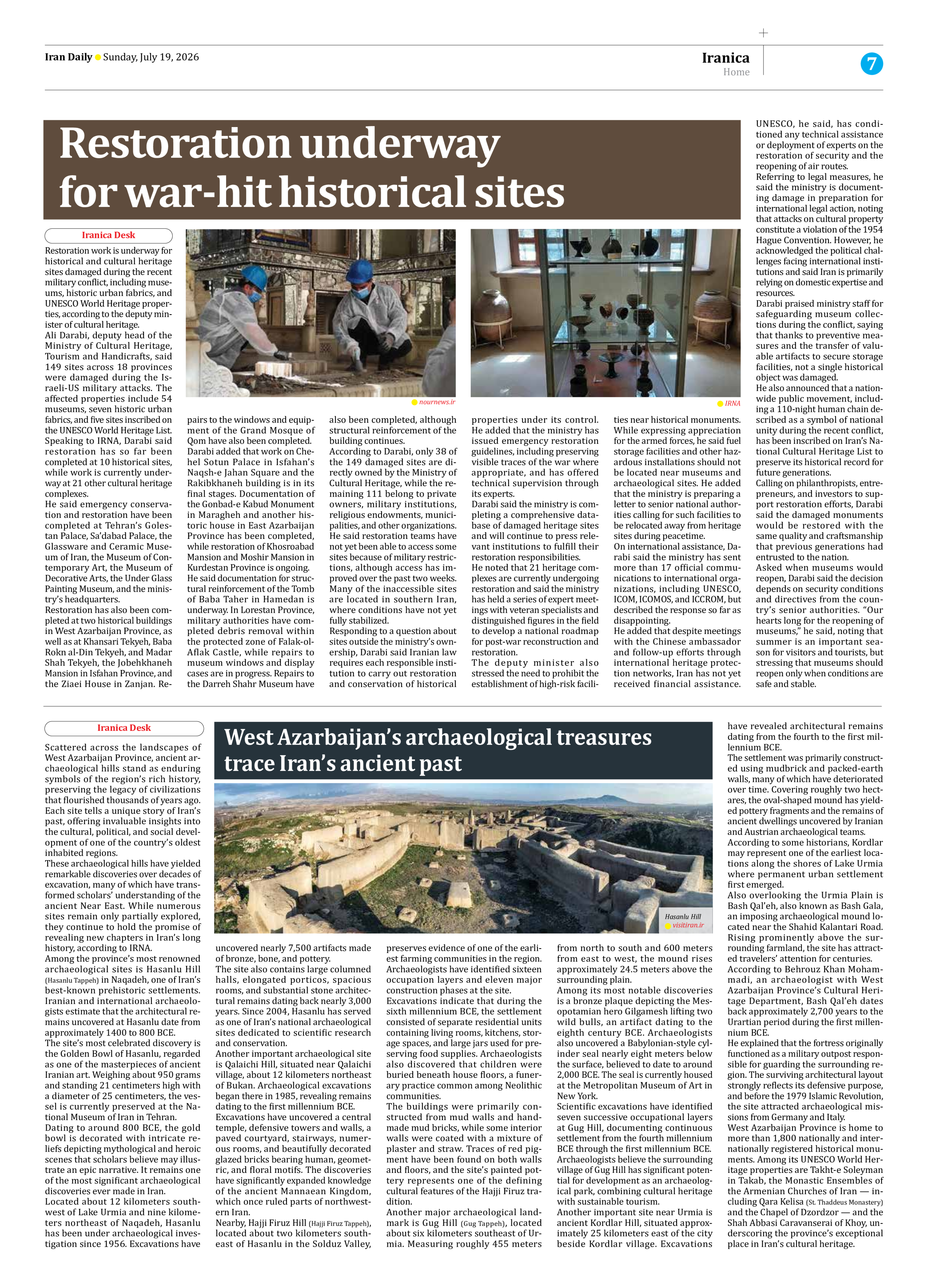


Restoration underway for war-hit historical sites
Restoration work is underway for historical and cultural heritage sites damaged during the recent military conflict, including museums, historic urban fabrics, and UNESCO World Heritage properties, according to the deputy minister of cultural heritage.
Ali Darabi, deputy head of the Ministry of Cultural Heritage, Tourism and Handicrafts, said 149 sites across 18 provinces were damaged during the Israeli-US military attacks. The affected properties include 54 museums, seven historic urban fabrics, and five sites inscribed on the UNESCO World Heritage List.
Speaking to IRNA, Darabi said restoration has so far been completed at 10 historical sites, while work is currently underway at 21 other cultural heritage complexes.
He said emergency conservation and restoration have been completed at Tehran’s Golestan Palace, Sa’dabad Palace, the Glassware and Ceramic Museum of Iran, the Museum of Contemporary Art, the Museum of Decorative Arts, the Under Glass Painting Museum, and the ministry’s headquarters.
Restoration has also been completed at two historical buildings in West Azarbaijan Province, as well as at Khansari Tekyeh, Baba Rokn al-Din Tekyeh, and Madar Shah Tekyeh, the Jobehkhaneh Mansion in Isfahan Province, and the Ziaei House in Zanjan. Repairs to the windows and equipment of the Grand Mosque of Qom have also been completed.
Darabi added that work on Chehel Sotun Palace in Isfahan’s Naqsh-e Jahan Square and the Rakibkhaneh building is in its final stages. Documentation of the Gonbad-e Kabud Monument in Maragheh and another historic house in East Azarbaijan Province has been completed, while restoration of Khosroabad Mansion and Moshir Mansion in Kurdestan Province is ongoing.
He said documentation for structural reinforcement of the Tomb of Baba Taher in Hamedan is underway. In Lorestan Province, military authorities have completed debris removal within the protected zone of Falak-ol-Aflak Castle, while repairs to museum windows and display cases are in progress. Repairs to the Darreh Shahr Museum have also been completed, although structural reinforcement of the building continues.
According to Darabi, only 38 of the 149 damaged sites are directly owned by the Ministry of Cultural Heritage, while the remaining 111 belong to private owners, military institutions, religious endowments, municipalities, and other organizations.
He said restoration teams have not yet been able to access some sites because of military restrictions, although access has improved over the past two weeks. Many of the inaccessible sites are located in southern Iran, where conditions have not yet fully stabilized.
Responding to a question about sites outside the ministry’s ownership, Darabi said Iranian law requires each responsible institution to carry out restoration and conservation of historical properties under its control. He added that the ministry has issued emergency restoration guidelines, including preserving visible traces of the war where appropriate, and has offered technical supervision through its experts.
Darabi said the ministry is completing a comprehensive database of damaged heritage sites and will continue to press relevant institutions to fulfill their restoration responsibilities.
He noted that 21 heritage complexes are currently undergoing restoration and said the ministry has held a series of expert meetings with veteran specialists and distinguished figures in the field to develop a national roadmap for post-war reconstruction and restoration.
The deputy minister also stressed the need to prohibit the establishment of high-risk facilities near historical monuments. While expressing appreciation for the armed forces, he said fuel storage facilities and other hazardous installations should not be located near museums and archaeological sites. He added that the ministry is preparing a letter to senior national authorities calling for such facilities to be relocated away from heritage sites during peacetime.
On international assistance, Darabi said the ministry has sent more than 17 official communications to international organizations, including UNESCO, ICOM, ICOMOS, and ICCROM, but described the response so far as disappointing.
He added that despite meetings with the Chinese ambassador and follow-up efforts through international heritage protection networks, Iran has not yet received financial assistance. UNESCO, he said, has conditioned any technical assistance or deployment of experts on the restoration of security and the reopening of air routes.
Referring to legal measures, he said the ministry is documenting damage in preparation for international legal action, noting that attacks on cultural property constitute a violation of the 1954 Hague Convention. However, he acknowledged the political challenges facing international institutions and said Iran is primarily relying on domestic expertise and resources.
Darabi praised ministry staff for safeguarding museum collections during the conflict, saying that thanks to preventive measures and the transfer of valuable artifacts to secure storage facilities, not a single historical object was damaged.
He also announced that a nationwide public movement, including a 110-night human chain described as a symbol of national unity during the recent conflict, has been inscribed on Iran’s National Cultural Heritage List to preserve its historical record for future generations.
Calling on philanthropists, entrepreneurs, and investors to support restoration efforts, Darabi said the damaged monuments would be restored with the same quality and craftsmanship that previous generations had entrusted to the nation.
Asked when museums would reopen, Darabi said the decision depends on security conditions and directives from the country’s senior authorities. “Our hearts long for the reopening of museums,” he said, noting that summer is an important season for visitors and tourists, but stressing that museums should reopen only when conditions are safe and stable.