







Nature, architecture merge at Kamiz Castle
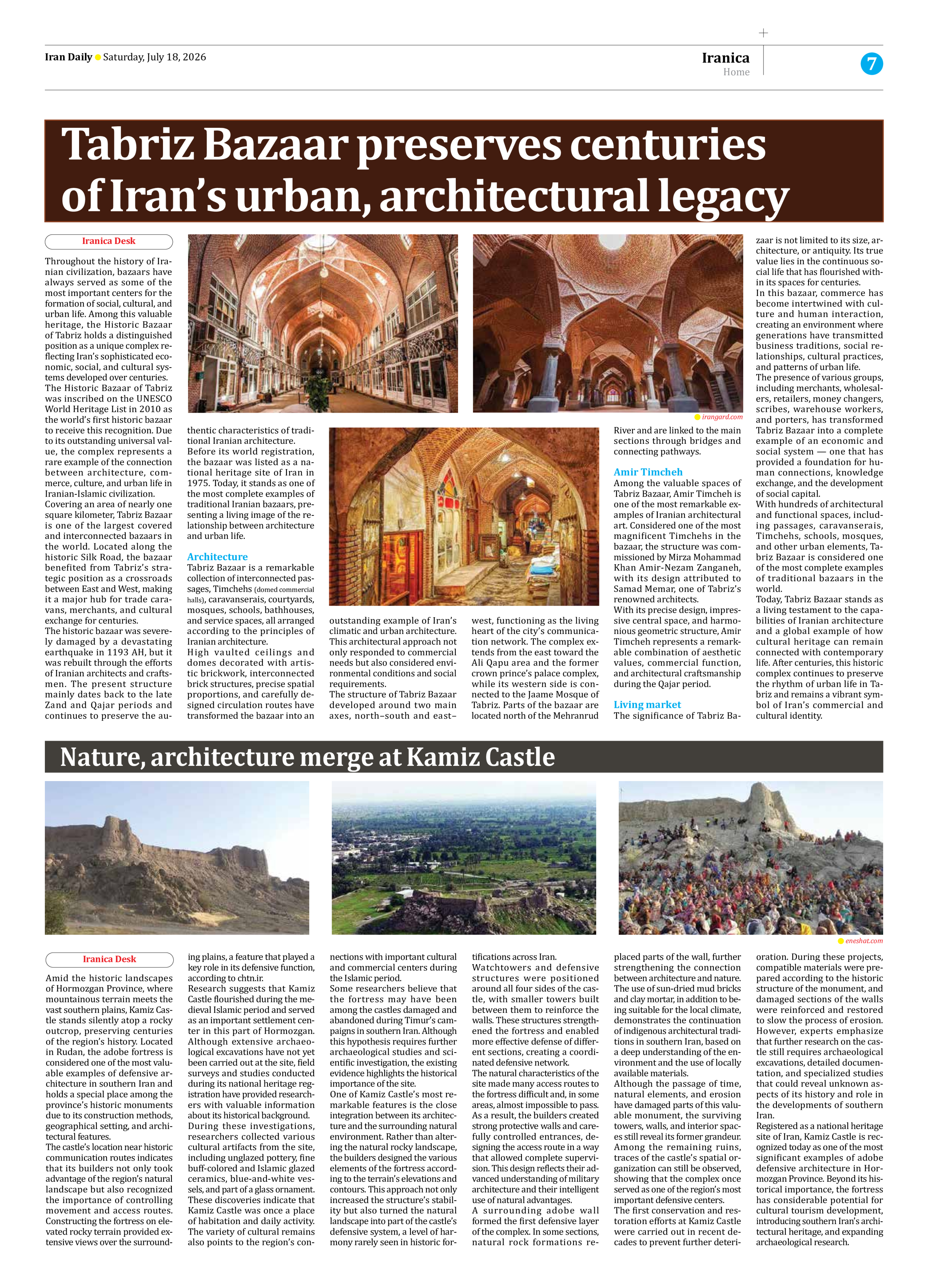
Amid the historic landscapes of Hormozgan Province, where mountainous terrain meets the vast southern plains, Kamiz Castle stands silently atop a rocky outcrop, preserving centuries of the region’s history. Located in Rudan, the adobe fortress is considered one of the most valuable examples of defensive architecture in southern Iran and holds a special place among the province’s historic monuments due to its construction methods, geographical setting, and architectural features.
The castle’s location near historic communication routes indicates that its builders not only took advantage of the region’s natural landscape but also recognized the importance of controlling movement and access routes. Constructing the fortress on elevated rocky terrain provided extensive views over the surrounding plains, a feature that played a key role in its defensive function, according to chtn.ir.
Research suggests that Kamiz Castle flourished during the medieval Islamic period and served as an important settlement center in this part of Hormozgan. Although extensive archaeological excavations have not yet been carried out at the site, field surveys and studies conducted during its national heritage registration have provided researchers with valuable information about its historical background.
During these investigations, researchers collected various cultural artifacts from the site, including unglazed pottery, fine buff-colored and Islamic glazed ceramics, blue-and-white vessels, and part of a glass ornament. These discoveries indicate that Kamiz Castle was once a place of habitation and daily activity. The variety of cultural remains also points to the region’s connections with important cultural and commercial centers during the Islamic period.
Some researchers believe that the fortress may have been among the castles damaged and abandoned during Timur’s campaigns in southern Iran. Although this hypothesis requires further archaeological studies and scientific investigation, the existing evidence highlights the historical importance of the site.
One of Kamiz Castle’s most remarkable features is the close integration between its architecture and the surrounding natural environment. Rather than altering the natural rocky landscape, the builders designed the various elements of the fortress according to the terrain’s elevations and contours. This approach not only increased the structure’s stability but also turned the natural landscape into part of the castle’s defensive system, a level of harmony rarely seen in historic fortifications across Iran.
Watchtowers and defensive structures were positioned around all four sides of the castle, with smaller towers built between them to reinforce the walls. These structures strengthened the fortress and enabled more effective defense of different sections, creating a coordinated defensive network.
The natural characteristics of the site made many access routes to the fortress difficult and, in some areas, almost impossible to pass. As a result, the builders created strong protective walls and carefully controlled entrances, designing the access route in a way that allowed complete supervision. This design reflects their advanced understanding of military architecture and their intelligent use of natural advantages.
A surrounding adobe wall formed the first defensive layer of the complex. In some sections, natural rock formations replaced parts of the wall, further strengthening the connection between architecture and nature. The use of sun-dried mud bricks and clay mortar, in addition to being suitable for the local climate, demonstrates the continuation of indigenous architectural traditions in southern Iran, based on a deep understanding of the environment and the use of locally available materials.
Although the passage of time, natural elements, and erosion have damaged parts of this valuable monument, the surviving towers, walls, and interior spaces still reveal its former grandeur. Among the remaining ruins, traces of the castle’s spatial organization can still be observed, showing that the complex once served as one of the region’s most important defensive centers.
The first conservation and restoration efforts at Kamiz Castle were carried out in recent decades to prevent further deterioration. During these projects, compatible materials were prepared according to the historic structure of the monument, and damaged sections of the walls were reinforced and restored to slow the process of erosion. However, experts emphasize that further research on the castle still requires archaeological excavations, detailed documentation, and specialized studies that could reveal unknown aspects of its history and role in the developments of southern Iran.
Registered as a national heritage site of Iran, Kamiz Castle is recognized today as one of the most significant examples of adobe defensive architecture in Hormozgan Province. Beyond its historical importance, the fortress has considerable potential for cultural tourism development, introducing southern Iran’s architectural heritage, and expanding archaeological research.