







Tabriz Bazaar preserves centuries of Iran’s urban, architectural legacy
Throughout the history of Iranian civilization, bazaars have always served as some of the most important centers for the formation of social, cultural, and urban life. Among this valuable heritage, the Historic Bazaar of Tabriz holds a distinguished position as a unique complex reflecting Iran’s sophisticated economic, social, and cultural systems developed over centuries.
The Historic Bazaar of Tabriz was inscribed on the UNESCO World Heritage List in 2010 as the world’s first historic bazaar to receive this recognition. Due to its outstanding universal value, the complex represents a rare example of the connection between architecture, commerce, culture, and urban life in Iranian-Islamic civilization.
Covering an area of nearly one square kilometer, Tabriz Bazaar is one of the largest covered and interconnected bazaars in the world. Located along the historic Silk Road, the bazaar benefited from Tabriz’s strategic position as a crossroads between East and West, making it a major hub for trade caravans, merchants, and cultural exchange for centuries.
The historic bazaar was severely damaged by a devastating earthquake in 1193 AH, but it was rebuilt through the efforts of Iranian architects and craftsmen. The present structure mainly dates back to the late Zand and Qajar periods and continues to preserve the authentic characteristics of traditional Iranian architecture.
Before its world registration, the bazaar was listed as a national heritage site of Iran in 1975. Today, it stands as one of the most complete examples of traditional Iranian bazaars, presenting a living image of the relationship between architecture and urban life.
Architecture
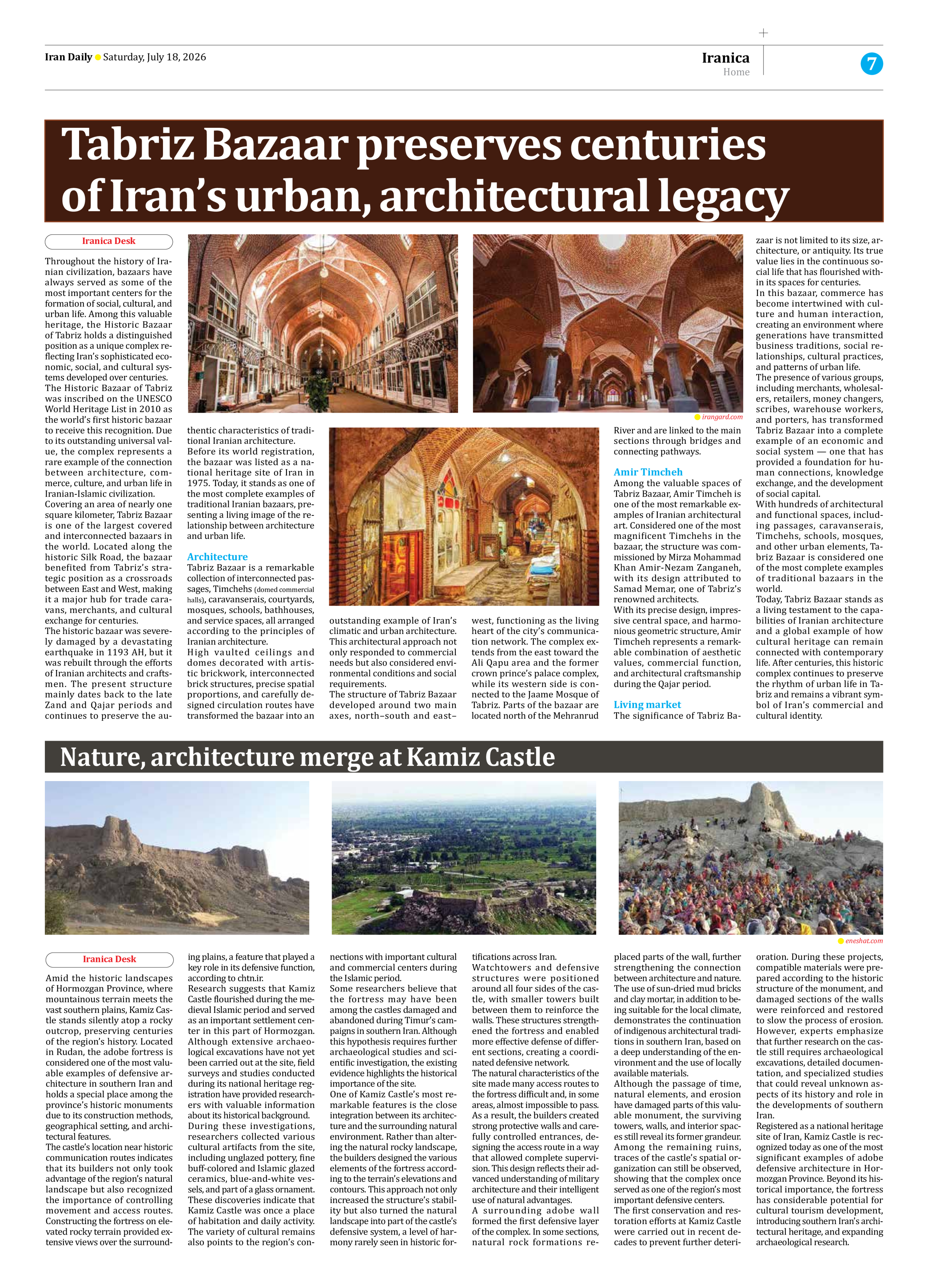
Tabriz Bazaar is a remarkable collection of interconnected passages, Timchehs (domed commercial halls), caravanserais, courtyards, mosques, schools, bathhouses, and service spaces, all arranged according to the principles of Iranian architecture.
High vaulted ceilings and domes decorated with artistic brickwork, interconnected brick structures, precise spatial proportions, and carefully designed circulation routes have transformed the bazaar into an outstanding example of Iran’s climatic and urban architecture. This architectural approach not only responded to commercial needs but also considered environmental conditions and social requirements.
The structure of Tabriz Bazaar developed around two main axes, north–south and east–west, functioning as the living heart of the city’s communication network. The complex extends from the east toward the Ali Qapu area and the former crown prince’s palace complex, while its western side is connected to the Jaame Mosque of Tabriz. Parts of the bazaar are located north of the Mehranrud River and are linked to the main sections through bridges and connecting pathways.
Amir Timcheh
Among the valuable spaces of Tabriz Bazaar, Amir Timcheh is one of the most remarkable examples of Iranian architectural art. Considered one of the most magnificent Timchehs in the bazaar, the structure was commissioned by Mirza Mohammad Khan Amir-Nezam Zanganeh, with its design attributed to Samad Memar, one of Tabriz’s renowned architects.
With its precise design, impressive central space, and harmonious geometric structure, Amir Timcheh represents a remarkable combination of aesthetic values, commercial function, and architectural craftsmanship during the Qajar period.
Living market
The significance of Tabriz Bazaar is not limited to its size, architecture, or antiquity. Its true value lies in the continuous social life that has flourished within its spaces for centuries.
In this bazaar, commerce has become intertwined with culture and human interaction, creating an environment where generations have transmitted business traditions, social relationships, cultural practices, and patterns of urban life.
The presence of various groups, including merchants, wholesalers, retailers, money changers, scribes, warehouse workers, and porters, has transformed Tabriz Bazaar into a complete example of an economic and social system — one that has provided a foundation for human connections, knowledge exchange, and the development of social capital.
With hundreds of architectural and functional spaces, including passages, caravanserais, Timchehs, schools, mosques, and other urban elements, Tabriz Bazaar is considered one of the most complete examples of traditional bazaars in the world.
Today, Tabriz Bazaar stands as a living testament to the capabilities of Iranian architecture and a global example of how cultural heritage can remain connected with contemporary life. After centuries, this historic complex continues to preserve the rhythm of urban life in Tabriz and remains a vibrant symbol of Iran’s commercial and cultural identity.