







ISA: Nahid-3 project in progress; Soleimani constellation’s 1st phase planned
Iran plans to continue expanding its space program through 2026, including the first phase of the Shahid Soleimani satellite constellation and the unveiling of its first domestically developed radar satellite, Press TV reported.
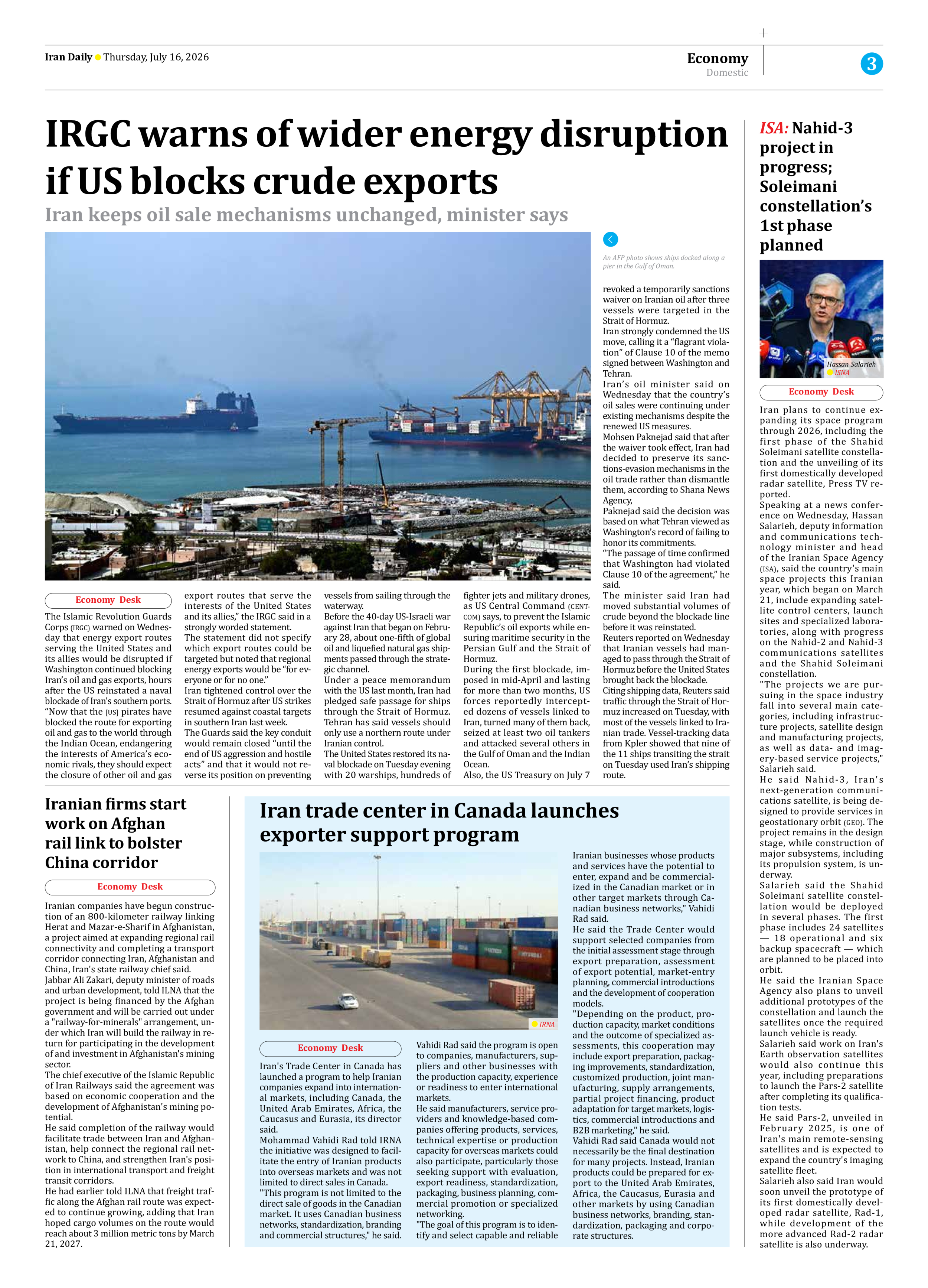
Speaking at a news conference on Wednesday, Hassan Salarieh, deputy information and communications technology minister and head of the Iranian Space Agency (ISA), said the country's main space projects this Iranian year, which began on March 21, include expanding satellite control centers, launch sites and specialized laboratories, along with progress on the Nahid-2 and Nahid-3 communications satellites and the Shahid Soleimani constellation.
"The projects we are pursuing in the space industry fall into several main categories, including infrastructure projects, satellite design and manufacturing projects, as well as data- and imagery-based service projects," Salarieh said.
He said Nahid-3, Iran's next-generation communications satellite, is being designed to provide services in geostationary orbit (GEO). The project remains in the design stage, while construction of major subsystems, including its propulsion system, is underway.
Salarieh said the Shahid Soleimani satellite constellation would be deployed in several phases. The first phase includes 24 satellites — 18 operational and six backup spacecraft — which are planned to be placed into orbit.
He said the Iranian Space Agency also plans to unveil additional prototypes of the constellation and launch the satellites once the required launch vehicle is ready.
Salarieh said work on Iran's Earth observation satellites would also continue this year, including preparations to launch the Pars-2 satellite after completing its qualification tests.
He said Pars-2, unveiled in February 2025, is one of Iran's main remote-sensing satellites and is expected to expand the country's imaging satellite fleet.
Salarieh also said Iran would soon unveil the prototype of its first domestically developed radar satellite, Rad-1, while development of the more advanced Rad-2 radar satellite is also underway.