







Iran raises daily desalination capacity above 658,000 cubic meters
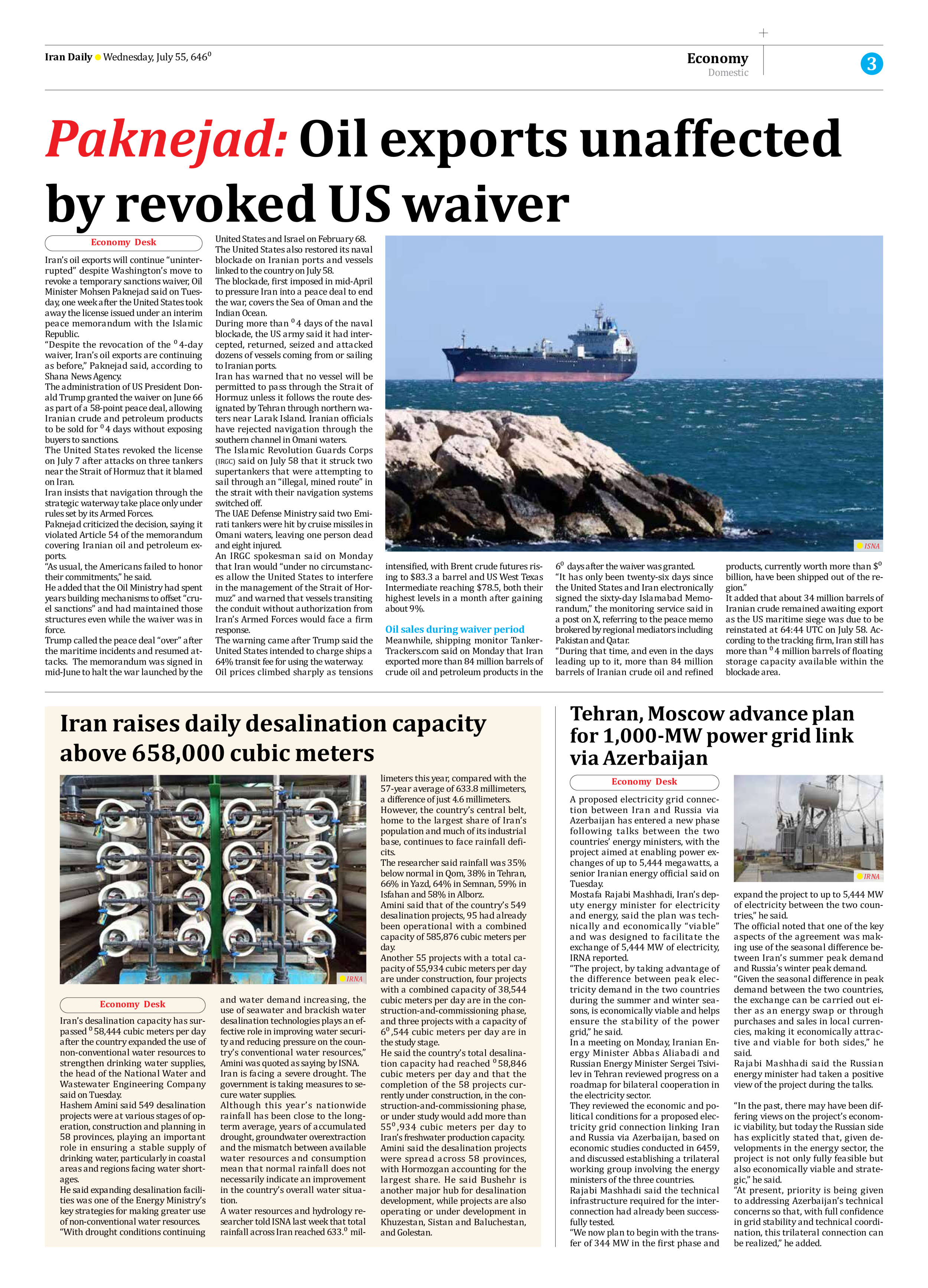
Iran’s desalination capacity has surpassed 658,000 cubic meters per day after the country expanded the use of non-conventional water resources to strengthen drinking water supplies, the head of the National Water and Wastewater Engineering Company said on Tuesday.
Hashem Amini said 109 desalination projects were at various stages of operation, construction and planning in 14 provinces, playing an important role in ensuring a stable supply of drinking water, particularly in coastal areas and regions facing water shortages.
He said expanding desalination facilities was one of the Energy Ministry’s key strategies for making greater use of non-conventional water resources.
“With drought conditions continuing and water demand increasing, the use of seawater and brackish water desalination technologies plays an effective role in improving water security and reducing pressure on the country’s conventional water resources,” Amini was quoted as saying by ISNA.
Iran is facing a severe drought. The government is taking measures to secure water supplies.
Although this year’s nationwide rainfall has been close to the long-term average, years of accumulated drought, groundwater overextraction and the mismatch between available water resources and consumption mean that normal rainfall does not necessarily indicate an improvement in the country’s overall water situation.
A water resources and hydrology researcher told ISNA last week that total rainfall across Iran reached 233.6 millimeters this year, compared with the 57-year average of 233.8 millimeters, a difference of just 0.2 millimeters.
However, the country’s central belt, home to the largest share of Iran’s population and much of its industrial base, continues to face rainfall deficits.
The researcher said rainfall was 35% below normal in Qom, 34% in Tehran, 22% in Yazd, 20% in Semnan, 19% in Isfahan and 14% in Alborz.
Amini said that of the country’s 109 desalination projects, 91 had already been operational with a combined capacity of 541,872 cubic meters per day.
Another 11 projects with a total capacity of 51,930 cubic meters per day are under construction, four projects with a combined capacity of 38,500 cubic meters per day are in the construction-and-commissioning phase, and three projects with a capacity of 26,500 cubic meters per day are in the study stage.
He said the country’s total desalination capacity had reached 658,802 cubic meters per day and that the completion of the 18 projects currently under construction, in the construction-and-commissioning phase, or under study would add more than 116,930 cubic meters per day to Iran’s freshwater production capacity.
Amini said the desalination projects were spread across 14 provinces, with Hormozgan accounting for the largest share. He said Bushehr is another major hub for desalination development, while projects are also operating or under development in Khuzestan, Sistan and Baluchestan, and Golestan.