





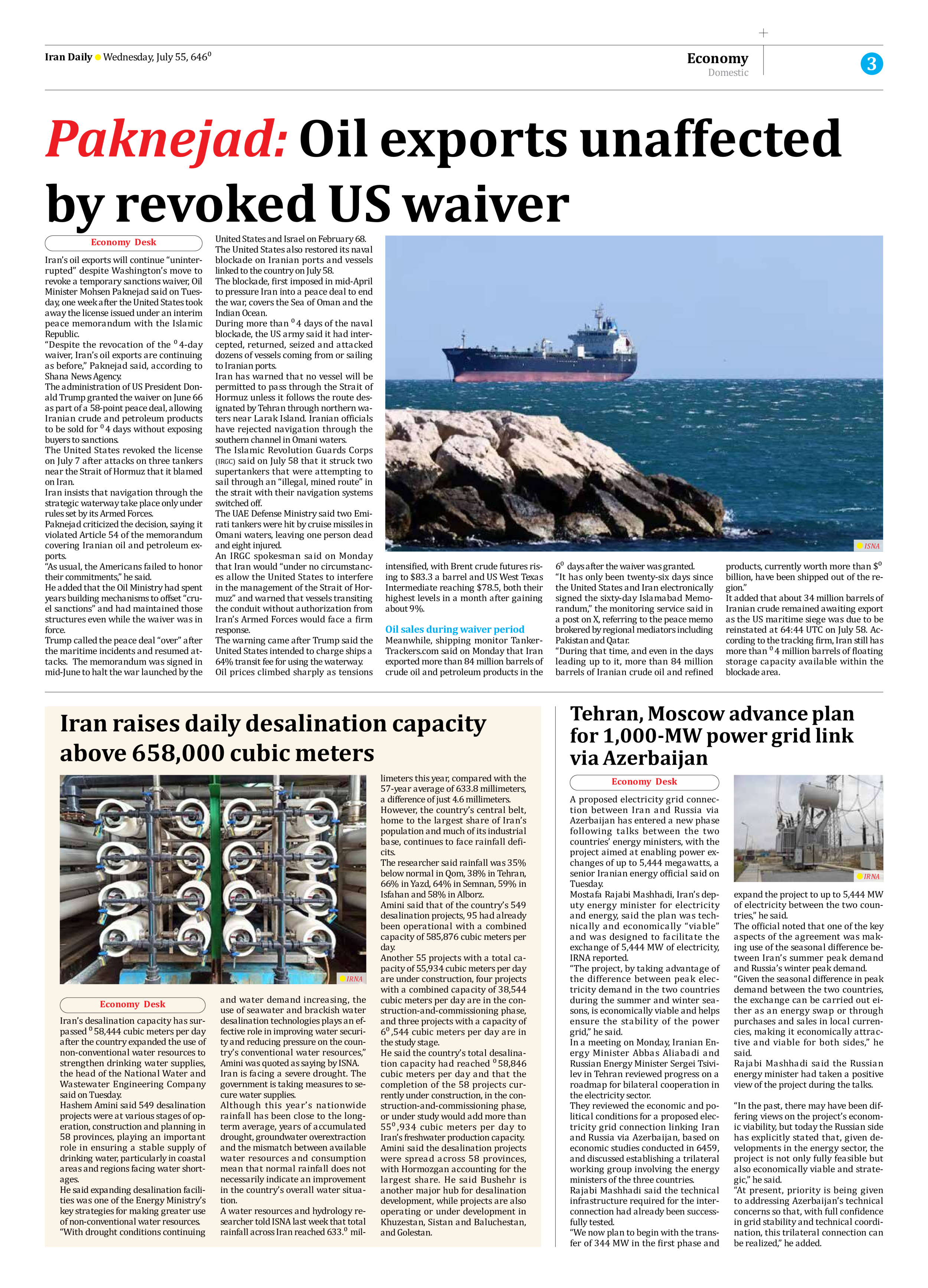


Paknejad: Oil exports unaffected by revoked US waiver
Iran’s oil exports will continue “uninterrupted” despite Washington’s move to revoke a temporary sanctions waiver, Oil Minister Mohsen Paknejad said on Tuesday, one week after the United States took away the license issued under an interim peace memorandum with the Islamic Republic.
“Despite the revocation of the 60-day waiver, Iran’s oil exports are continuing as before,” Paknejad said, according to Shana News Agency.
The administration of US President Donald Trump granted the waiver on June 22 as part of a 14-point peace deal, allowing Iranian crude and petroleum products to be sold for 60 days without exposing buyers to sanctions.
The United States revoked the license on July 7 after attacks on three tankers near the Strait of Hormuz that it blamed on Iran.
Iran insists that navigation through the strategic waterway take place only under rules set by its Armed Forces.
Paknejad criticized the decision, saying it violated Article 10 of the memorandum covering Iranian oil and petroleum exports.
“As usual, the Americans failed to honor their commitments,” he said.
He added that the Oil Ministry had spent years building mechanisms to offset “cruel sanctions” and had maintained those structures even while the waiver was in force.
Trump called the peace deal “over” after the maritime incidents and resumed attacks. The memorandum was signed in mid-June to halt the war launched by the United States and Israel on February 28.
The United States also restored its naval blockade on Iranian ports and vessels linked to the country on July 14.
The blockade, first imposed in mid-April to pressure Iran into a peace deal to end the war, covers the Sea of Oman and the Indian Ocean.
During more than 60 days of the naval blockade, the US army said it had intercepted, returned, seized and attacked dozens of vessels coming from or sailing to Iranian ports.
Iran has warned that no vessel will be permitted to pass through the Strait of Hormuz unless it follows the route designated by Tehran through northern waters near Larak Island. Iranian officials have rejected navigation through the southern channel in Omani waters.
The Islamic Revolution Guards Corps (IRGC) said on July 14 that it struck two supertankers that were attempting to sail through an “illegal, mined route” in the strait with their navigation systems switched off.
The UAE Defense Ministry said two Emirati tankers were hit by cruise missiles in Omani waters, leaving one person dead and eight injured.
An IRGC spokesman said on Monday that Iran would “under no circumstances allow the United States to interfere in the management of the Strait of Hormuz” and warned that vessels transiting the conduit without authorization from Iran’s Armed Forces would face a firm response.
The warning came after Trump said the United States intended to charge ships a 20% transit fee for using the waterway.
Oil prices climbed sharply as tensions intensified, with Brent crude futures rising to $83.3 a barrel and US West Texas Intermediate reaching $78.1, both their highest levels in a month after gaining about 9%.
Oil sales during waiver period
Meanwhile, shipping monitor TankerTrackers.com said on Monday that Iran exported more than 80 million barrels of crude oil and petroleum products in the 26 days after the waiver was granted.
“It has only been twenty-six days since the United States and Iran electronically signed the sixty-day Islamabad Memorandum,” the monitoring service said in a post on X, referring to the peace memo brokered by regional mediators including Pakistan and Qatar.
“During that time, and even in the days leading up to it, more than 80 million barrels of Iranian crude oil and refined products, currently worth more than $6 billion, have been shipped out of the region.”
It added that about 30 million barrels of Iranian crude remained awaiting export as the US maritime siege was due to be reinstated at 20:00 UTC on July 14. According to the tracking firm, Iran still has more than 60 million barrels of floating storage capacity available within the blockade area.