







A book revisited through martyred Leader’s annotations
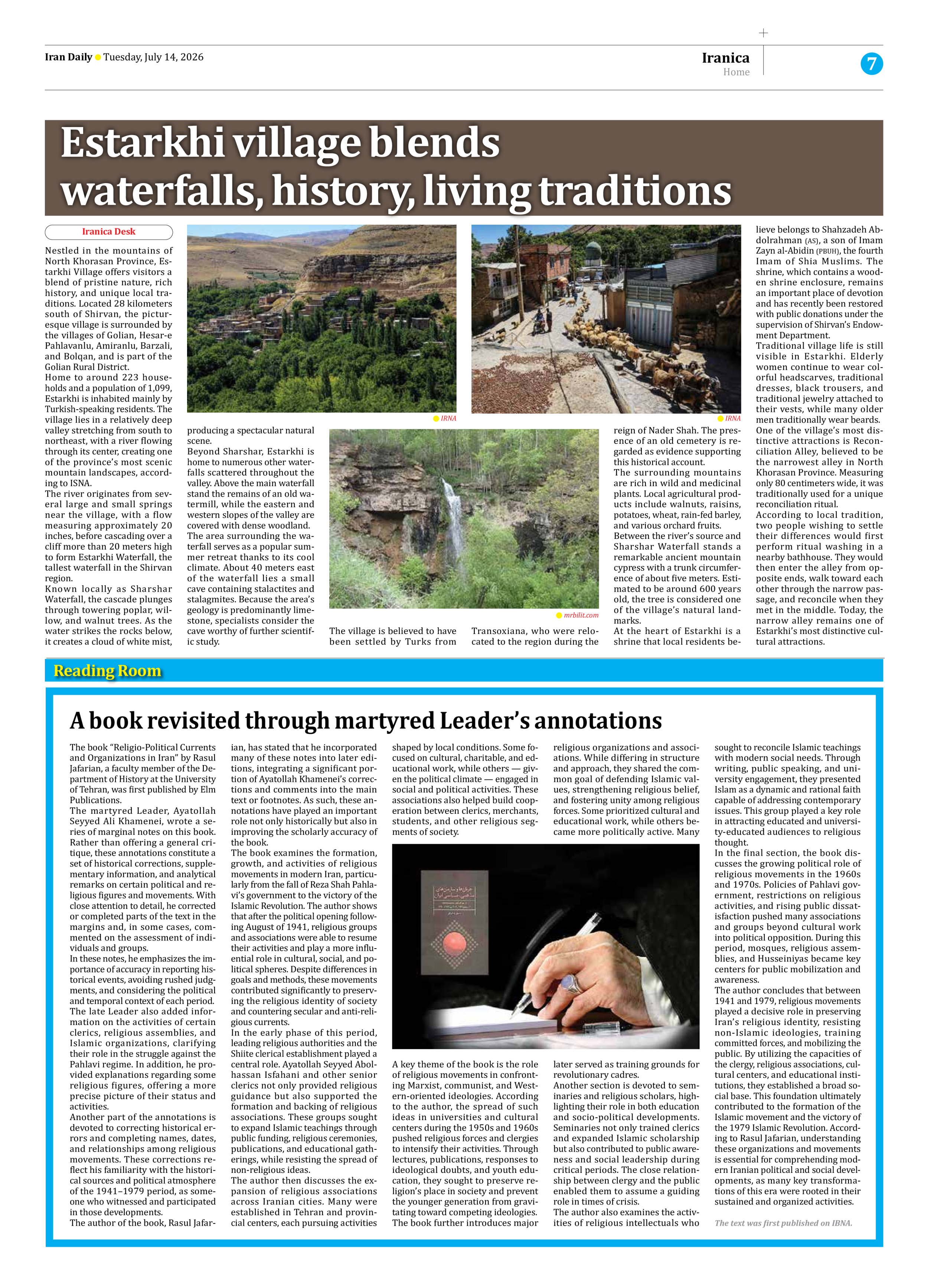
The book “Religio-Political Currents and Organizations in Iran” by Rasul Jafarian, a faculty member of the Department of History at the University of Tehran, was first published by Elm Publications.
The martyred Leader, Ayatollah Seyyed Ali Khamenei, wrote a series of marginal notes on this book. Rather than offering a general critique, these annotations constitute a set of historical corrections, supplementary information, and analytical remarks on certain political and religious figures and movements. With close attention to detail, he corrected or completed parts of the text in the margins and, in some cases, commented on the assessment of individuals and groups.
In these notes, he emphasizes the importance of accuracy in reporting historical events, avoiding rushed judgments, and considering the political and temporal context of each period.
The late Leader also added information on the activities of certain clerics, religious assemblies, and Islamic organizations, clarifying their role in the struggle against the Pahlavi regime. In addition, he provided explanations regarding some religious figures, offering a more precise picture of their status and activities.
Another part of the annotations is devoted to correcting historical errors and completing names, dates, and relationships among religious movements. These corrections reflect his familiarity with the historical sources and political atmosphere of the 1941–1979 period, as someone who witnessed and participated in those developments.
The author of the book, Rasul Jafarian, has stated that he incorporated many of these notes into later editions, integrating a significant portion of Ayatollah Khamenei’s corrections and comments into the main text or footnotes. As such, these annotations have played an important role not only historically but also in improving the scholarly accuracy of the book.
The book examines the formation, growth, and activities of religious movements in modern Iran, particularly from the fall of Reza Shah Pahlavi’s government to the victory of the Islamic Revolution. The author shows that after the political opening following August of 1941, religious groups and associations were able to resume their activities and play a more influential role in cultural, social, and political spheres. Despite differences in goals and methods, these movements contributed significantly to preserving the religious identity of society and countering secular and anti-religious currents.
In the early phase of this period, leading religious authorities and the Shiite clerical establishment played a central role. Ayatollah Seyyed Abolhassan Isfahani and other senior clerics not only provided religious guidance but also supported the formation and backing of religious associations. These groups sought to expand Islamic teachings through public funding, religious ceremonies, publications, and educational gatherings, while resisting the spread of non-religious ideas.
The author then discusses the expansion of religious associations across Iranian cities. Many were established in Tehran and provincial centers, each pursuing activities shaped by local conditions. Some focused on cultural, charitable, and educational work, while others — given the political climate — engaged in social and political activities. These associations also helped build cooperation between clerics, merchants, students, and other religious segments of society.
A key theme of the book is the role of religious movements in confronting Marxist, communist, and Western-oriented ideologies. According to the author, the spread of such ideas in universities and cultural centers during the 1950s and 1960s pushed religious forces and clergies to intensify their activities. Through lectures, publications, responses to ideological doubts, and youth education, they sought to preserve religion’s place in society and prevent the younger generation from gravitating toward competing ideologies.
The book further introduces major religious organizations and associations. While differing in structure and approach, they shared the common goal of defending Islamic values, strengthening religious belief, and fostering unity among religious forces. Some prioritized cultural and educational work, while others became more politically active. Many later served as training grounds for revolutionary cadres.
Another section is devoted to seminaries and religious scholars, highlighting their role in both education and socio-political developments. Seminaries not only trained clerics and expanded Islamic scholarship but also contributed to public awareness and social leadership during critical periods. The close relationship between clergy and the public enabled them to assume a guiding role in times of crisis.
The author also examines the activities of religious intellectuals who sought to reconcile Islamic teachings with modern social needs. Through writing, public speaking, and university engagement, they presented Islam as a dynamic and rational faith capable of addressing contemporary issues. This group played a key role in attracting educated and university-educated audiences to religious thought.
In the final section, the book discusses the growing political role of religious movements in the 1960s and 1970s. Policies of Pahlavi government, restrictions on religious activities, and rising public dissatisfaction pushed many associations and groups beyond cultural work into political opposition. During this period, mosques, religious assemblies, and Husseiniyas became key centers for public mobilization and awareness.
The author concludes that between 1941 and 1979, religious movements played a decisive role in preserving Iran’s religious identity, resisting non-Islamic ideologies, training committed forces, and mobilizing the public. By utilizing the capacities of the clergy, religious associations, cultural centers, and educational institutions, they established a broad social base. This foundation ultimately contributed to the formation of the Islamic movement and the victory of the 1979 Islamic Revolution. According to Rasul Jafarian, understanding these organizations and movements is essential for comprehending modern Iranian political and social developments, as many key transformations of this era were rooted in their sustained and organized activities.
The text was first published on IBNA.