







Estarkhi village blends waterfalls, history, living traditions
Nestled in the mountains of North Khorasan Province, Estarkhi Village offers visitors a blend of pristine nature, rich history, and unique local traditions. Located 28 kilometers south of Shirvan, the picturesque village is surrounded by the villages of Golian, Hesar-e Pahlavanlu, Amiranlu, Barzali, and Bolqan, and is part of the Golian Rural District.
Home to around 223 households and a population of 1,099, Estarkhi is inhabited mainly by Turkish-speaking residents. The village lies in a relatively deep valley stretching from south to northeast, with a river flowing through its center, creating one of the province’s most scenic mountain landscapes, according to ISNA.
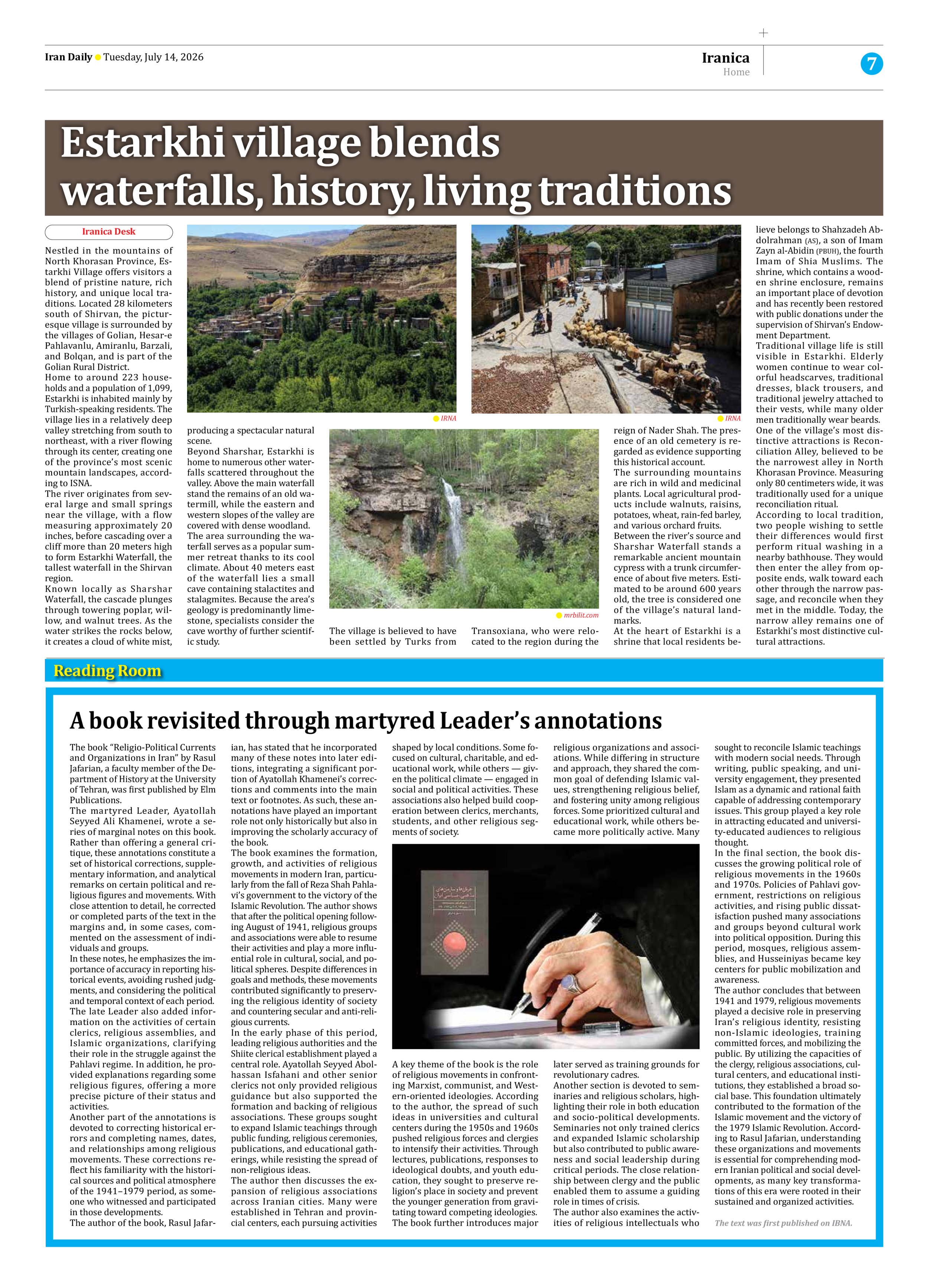
The river originates from several large and small springs near the village, with a flow measuring approximately 20 inches, before cascading over a cliff more than 20 meters high to form Estarkhi Waterfall, the tallest waterfall in the Shirvan region.
Known locally as Sharshar Waterfall, the cascade plunges through towering poplar, willow, and walnut trees. As the water strikes the rocks below, it creates a cloud of white mist, producing a spectacular natural scene.
Beyond Sharshar, Estarkhi is home to numerous other waterfalls scattered throughout the valley. Above the main waterfall stand the remains of an old watermill, while the eastern and western slopes of the valley are covered with dense woodland.
The area surrounding the waterfall serves as a popular summer retreat thanks to its cool climate. About 40 meters east of the waterfall lies a small cave containing stalactites and stalagmites. Because the area’s geology is predominantly limestone, specialists consider the cave worthy of further scientific study.
The village is believed to have been settled by Turks from Transoxiana, who were relocated to the region during the reign of Nader Shah. The presence of an old cemetery is regarded as evidence supporting this historical account.
The surrounding mountains are rich in wild and medicinal plants. Local agricultural products include walnuts, raisins, potatoes, wheat, rain-fed barley, and various orchard fruits.
Between the river’s source and Sharshar Waterfall stands a remarkable ancient mountain cypress with a trunk circumference of about five meters. Estimated to be around 600 years old, the tree is considered one of the village’s natural landmarks.
At the heart of Estarkhi is a shrine that local residents believe belongs to Shahzadeh Abdolrahman (AS), a son of Imam Zayn al-Abidin (PBUH), the fourth Imam of Shia Muslims. The shrine, which contains a wooden shrine enclosure, remains an important place of devotion and has recently been restored with public donations under the supervision of Shirvan’s Endowment Department.
Traditional village life is still visible in Estarkhi. Elderly women continue to wear colorful headscarves, traditional dresses, black trousers, and traditional jewelry attached to their vests, while many older men traditionally wear beards.
One of the village’s most distinctive attractions is Reconciliation Alley, believed to be the narrowest alley in North Khorasan Province. Measuring only 80 centimeters wide, it was traditionally used for a unique reconciliation ritual.
According to local tradition, two people wishing to settle their differences would first perform ritual washing in a nearby bathhouse. They would then enter the alley from opposite ends, walk toward each other through the narrow passage, and reconcile when they met in the middle. Today, the narrow alley remains one of Estarkhi’s most distinctive cultural attractions.