







Minister says key terms of Russian gas trade deal agreed, finalization planned
Roadmap reviewed for power cooperation
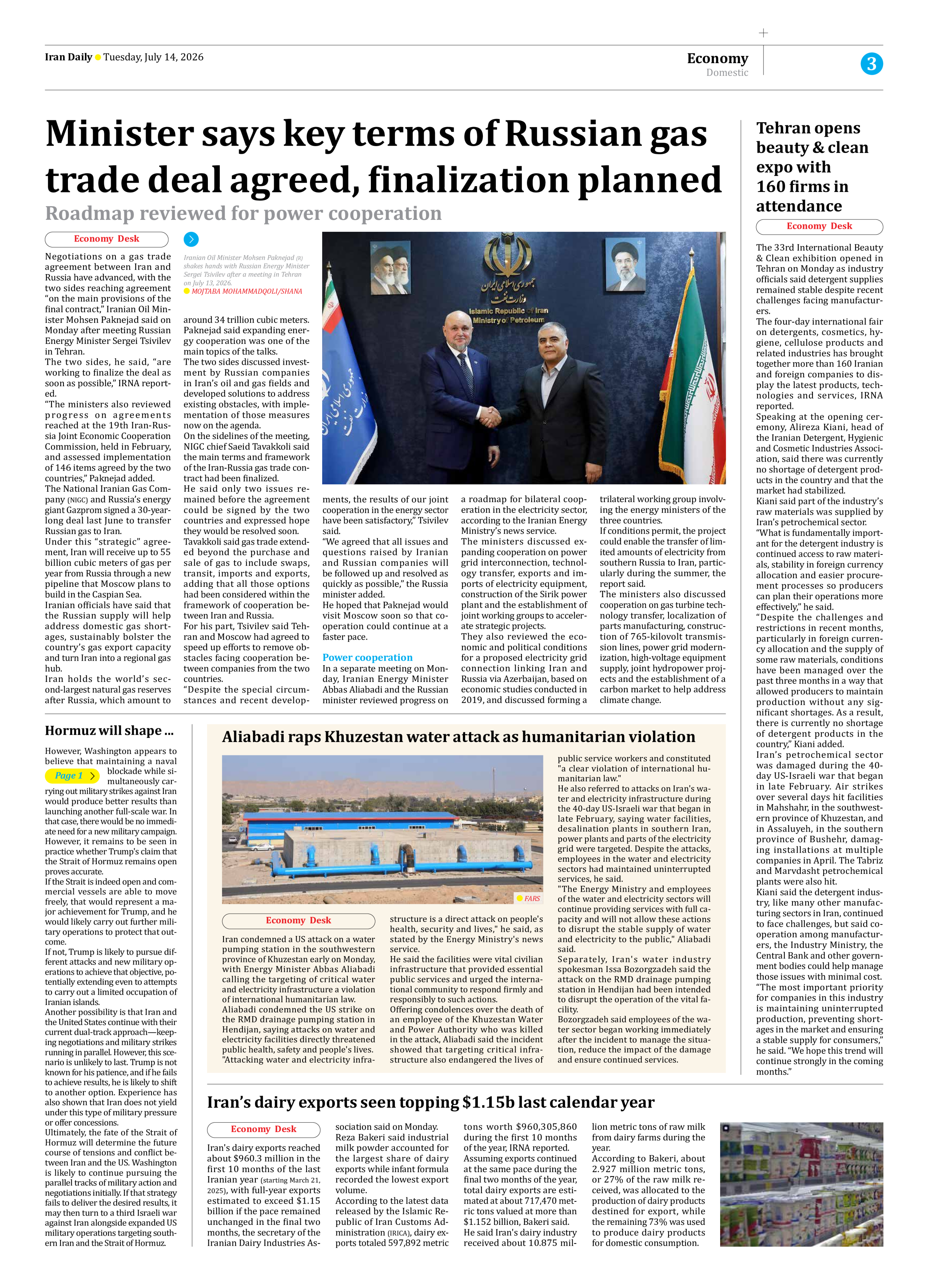
Negotiations on a gas trade agreement between Iran and Russia have advanced, with the two sides reaching agreement “on the main provisions of the final contract,” Iranian Oil Minister Mohsen Paknejad said on Monday after meeting Russian Energy Minister Sergei Tsivilev in Tehran.
The two sides, he said, “are working to finalize the deal as soon as possible,” IRNA reported.
“The ministers also reviewed progress on agreements reached at the 19th Iran-Russia Joint Economic Cooperation Commission, held in February, and assessed implementation of 146 items agreed by the two countries,” Paknejad added.
The National Iranian Gas Company (NIGC) and Russia’s energy giant Gazprom signed a 30-year-long deal last June to transfer Russian gas to Iran.
Under this “strategic” agreement, Iran will receive up to 55 billion cubic meters of gas per year from Russia through a new pipeline that Moscow plans to build in the Caspian Sea.
Iranian officials have said that the Russian supply will help address domestic gas shortages, sustainably bolster the country’s gas export capacity and turn Iran into a regional gas hub.
Iran holds the world’s second-largest natural gas reserves after Russia, which amount to around 34 trillion cubic meters.
Paknejad said expanding energy cooperation was one of the main topics of the talks.
The two sides discussed investment by Russian companies in Iran’s oil and gas fields and developed solutions to address existing obstacles, with implementation of those measures now on the agenda.
On the sidelines of the meeting, NIGC chief Saeid Tavakkoli said the main terms and framework of the Iran-Russia gas trade contract had been finalized.
He said only two issues remained before the agreement could be signed by the two countries and expressed hope they would be resolved soon.
Tavakkoli said gas trade extended beyond the purchase and sale of gas to include swaps, transit, imports and exports, adding that all those options had been considered within the framework of cooperation between Iran and Russia.
For his part, Tsivilev said Tehran and Moscow had agreed to speed up efforts to remove obstacles facing cooperation between companies from the two countries.
“Despite the special circumstances and recent developments, the results of our joint cooperation in the energy sector have been satisfactory,” Tsivilev said.
“We agreed that all issues and questions raised by Iranian and Russian companies will be followed up and resolved as quickly as possible,” the Russia minister added.
He hoped that Paknejad would visit Moscow soon so that cooperation could continue at a faster pace.
Power cooperation
In a separate meeting on Monday, Iranian Energy Minister Abbas Aliabadi and the Russian minister reviewed progress on a roadmap for bilateral cooperation in the electricity sector, according to the Iranian Energy Ministry’s news service.
The ministers discussed expanding cooperation on power grid interconnection, technology transfer, exports and imports of electricity equipment, construction of the Sirik power plant and the establishment of joint working groups to accelerate strategic projects.
They also reviewed the economic and political conditions for a proposed electricity grid connection linking Iran and Russia via Azerbaijan, based on economic studies conducted in 2019, and discussed forming a trilateral working group involving the energy ministers of the three countries.
If conditions permit, the project could enable the transfer of limited amounts of electricity from southern Russia to Iran, particularly during the summer, the report said.
The ministers also discussed cooperation on gas turbine technology transfer, localization of parts manufacturing, construction of 765-kilovolt transmission lines, power grid modernization, high-voltage equipment supply, joint hydropower projects and the establishment of a carbon market to help address climate change.