







Copy in clipboard...
Alamut fortress complex clears key ICOMOS review ahead of UNESCO decision
Iran's nomination of the Alamut Castle and its related fortifications cleared a major hurdle on the path to UNESCO World Heritage inscription, with the International Council on Monuments and Sites (ICOMOS) endorsing the property's Outstanding Universal Value, authenticity, integrity, and management framework ahead of the upcoming World Heritage Committee meeting in Busan, South Korea, according to the director of the nomination dossier.
Mohammad Hassan Talebian, who leads the UNESCO nomination, said ICOMOS had recommended the property under Criterion (iii) of the World Heritage Convention, recognizing the serial site as an exceptional testimony to the cultural traditions of the Nizari Ismaili state between the 11th and 13th centuries.
He said the technical evaluation also endorsed the site's conservation plans, restoration methods, monitoring system, tourism strategy, and community participation, significantly strengthening its prospects for inscription.
The nomination brings together seven interconnected castles and fortifications: Alamut Castle, Lambsar, Ilan, Shirkuh, Navizar Shah, Qostin Lar, and Shams Kalayeh. Although physically separate, Talebian said they functioned as an integrated mountain defense and governance network linked through visual, structural, and operational connections across the Alamut Valley.
"Comparative studies found virtually no parallel for the Alamut fortification network," Talebian said, adding that the ensemble preserves a rare combination of military engineering, territorial defense, water management, agriculture, governance, and cultural life within a single cultural landscape.
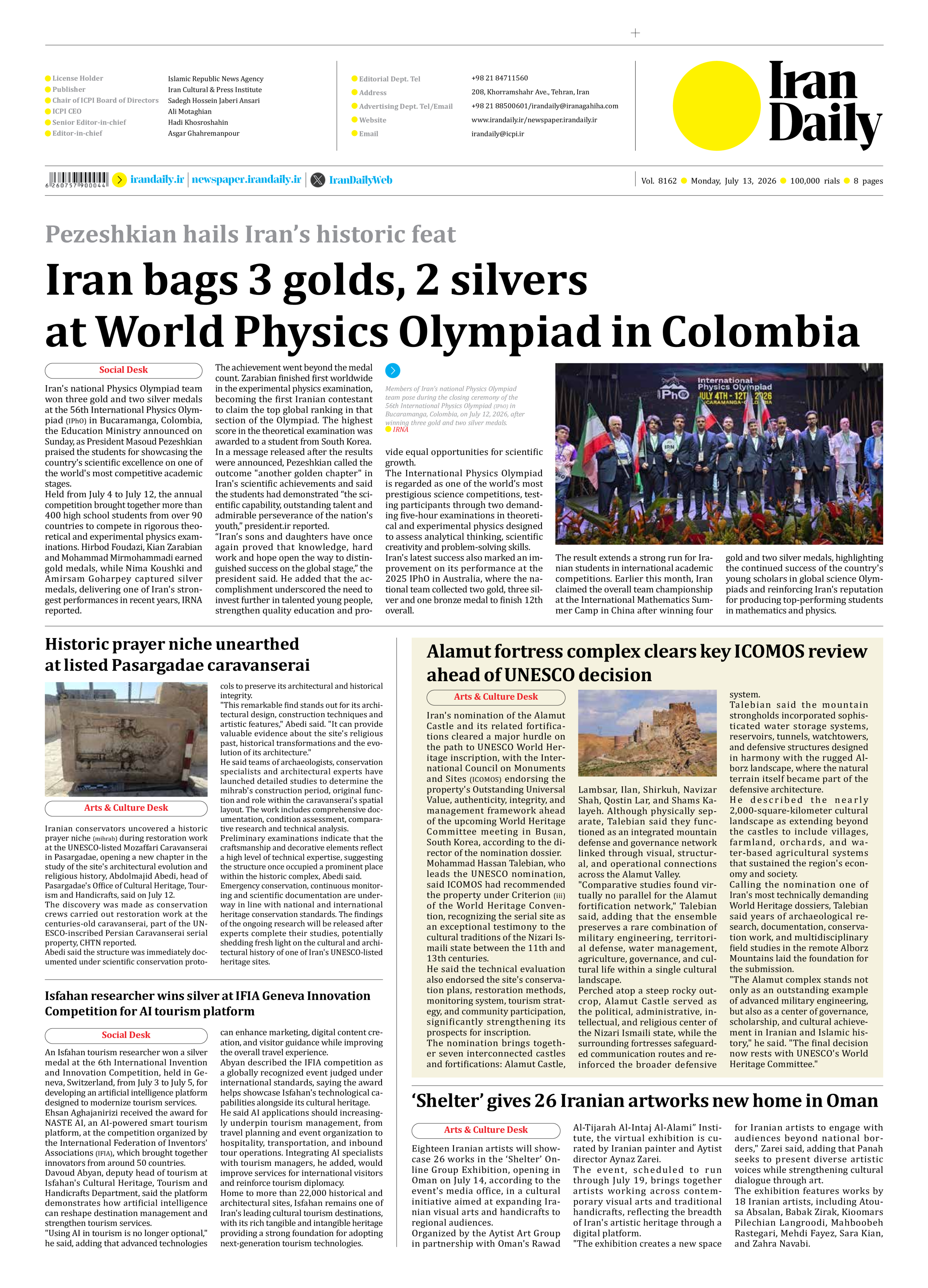
Perched atop a steep rocky outcrop, Alamut Castle served as the political, administrative, intellectual, and religious center of the Nizari Ismaili state, while the surrounding fortresses safeguarded communication routes and reinforced the broader defensive system.
Talebian said the mountain strongholds incorporated sophisticated water storage systems, reservoirs, tunnels, watchtowers, and defensive structures designed in harmony with the rugged Alborz landscape, where the natural terrain itself became part of the defensive architecture.
He described the nearly 2,000-square-kilometer cultural landscape as extending beyond the castles to include villages, farmland, orchards, and water-based agricultural systems that sustained the region's economy and society.
Calling the nomination one of Iran's most technically demanding World Heritage dossiers, Talebian said years of archaeological research, documentation, conservation work, and multidisciplinary field studies in the remote Alborz Mountains laid the foundation for the submission.
"The Alamut complex stands not only as an outstanding example of advanced military engineering, but also as a center of governance, scholarship, and cultural achievement in Iranian and Islamic history," he said. "The final decision now rests with UNESCO's World Heritage Committee."