







Iran, US trade more strikes as Hormuz clashes escalate
PGSA announces halt to traffic through strategic waterway
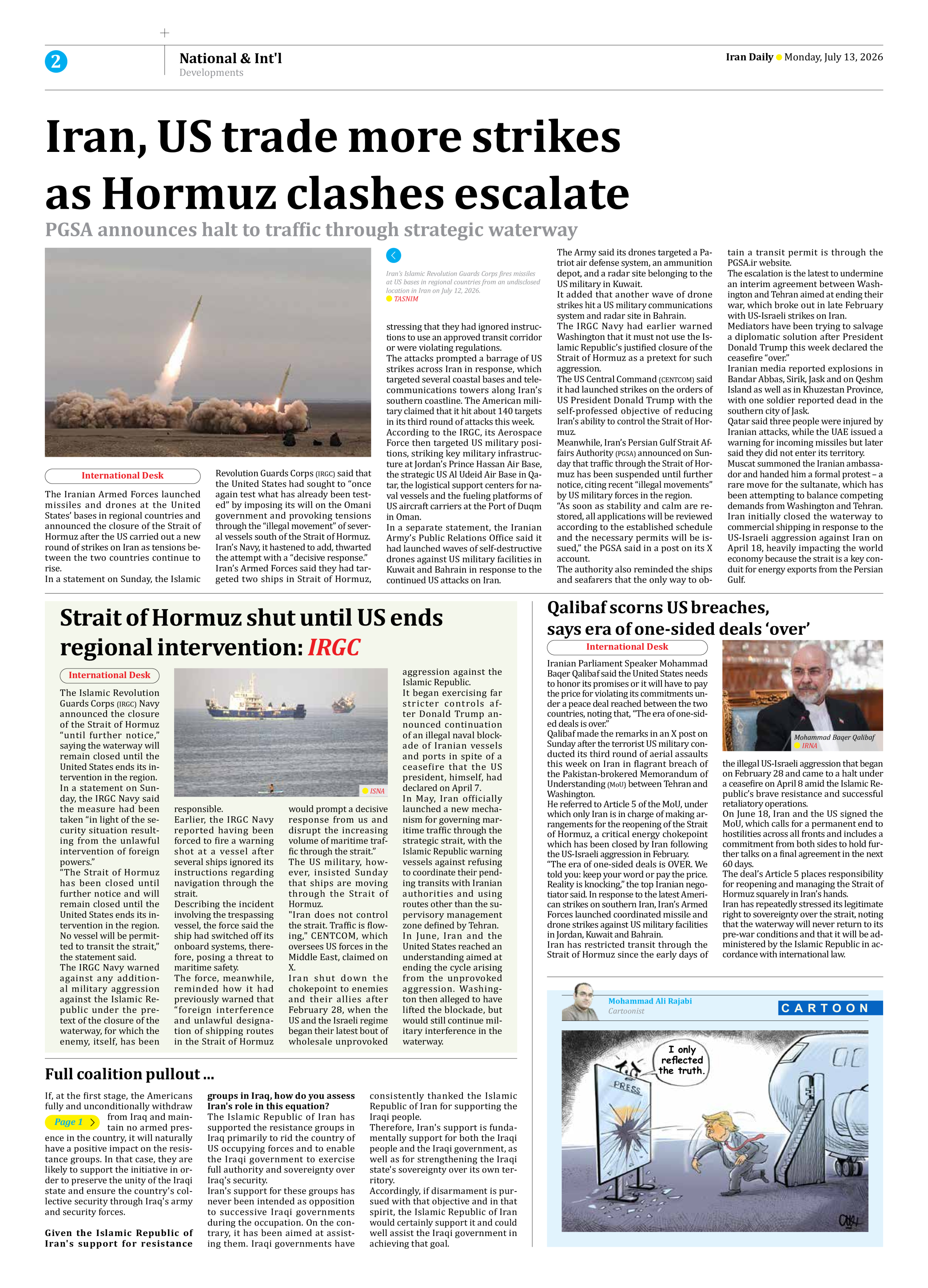
The Iranian Armed Forces launched missiles and drones at the United States’ bases in regional countries and announced the closure of the Strait of Hormuz after the US carried out a new round of strikes on Iran as tensions between the two countries continue to rise.
In a statement on Sunday, the Islamic Revolution Guards Corps (IRGC) said that the United States had sought to “once again test what has already been tested” by imposing its will on the Omani government and provoking tensions through the “illegal movement” of several vessels south of the Strait of Hormuz.
Iran’s Navy, it hastened to add, thwarted the attempt with a “decisive response.”
Iran’s Armed Forces said they had targeted two ships in Strait of Hormuz, stressing that they had ignored instructions to use an approved transit corridor or were violating regulations.
The attacks prompted a barrage of US strikes across Iran in response, which targeted several coastal bases and telecommunications towers along Iran’s southern coastline. The American military claimed that it hit about 140 targets in its third round of attacks this week.
According to the IRGC, its Aerospace Force then targeted US military positions, striking key military infrastructure at Jordan’s Prince Hassan Air Base, the strategic US Al Udeid Air Base in Qatar, the logistical support centers for naval vessels and the fueling platforms of US aircraft carriers at the Port of Duqm in Oman.
In a separate statement, the Iranian Army’s Public Relations Office said it had launched waves of self-destructive drones against US military facilities in Kuwait and Bahrain in response to the continued US attacks on Iran.
The Army said its drones targeted a Patriot air defense system, an ammunition depot, and a radar site belonging to the US military in Kuwait.
It added that another wave of drone strikes hit a US military communications system and radar site in Bahrain.
The IRGC Navy had earlier warned Washington that it must not use the Islamic Republic’s justified closure of the Strait of Hormuz as a pretext for such aggression.
The US Central Command (CENTCOM) said it had launched strikes on the orders of US President Donald Trump with the self-professed objective of reducing Iran’s ability to control the Strait of Hormuz.
Meanwhile, Iran’s Persian Gulf Strait Affairs Authority (PGSA) announced on Sunday that traffic through the Strait of Hormuz has been suspended until further notice, citing recent “illegal movements” by US military forces in the region.
“As soon as stability and calm are restored, all applications will be reviewed according to the established schedule and the necessary permits will be issued,” the PGSA said in a post on its X account.
The authority also reminded the ships and seafarers that the only way to obtain a transit permit is through the PGSA.ir website.
The escalation is the latest to undermine an interim agreement between Washington and Tehran aimed at ending their war, which broke out in late February with US-Israeli strikes on Iran.
Mediators have been trying to salvage a diplomatic solution after President Donald Trump this week declared the ceasefire “over.”
Iranian media reported explosions in Bandar Abbas, Sirik, Jask and on Qeshm Island as well as in Khuzestan Province, with one soldier reported dead in the southern city of Jask.
Qatar said three people were injured by Iranian attacks, while the UAE issued a warning for incoming missiles but later said they did not enter its territory.
Muscat summoned the Iranian ambassador and handed him a formal protest – a rare move for the sultanate, which has been attempting to balance competing demands from Washington and Tehran.
Iran initially closed the waterway to commercial shipping in response to the US-Israeli aggression against Iran on April 18, heavily impacting the world economy because the strait is a key conduit for energy exports from the Persian Gulf.