







Copy in clipboard...
Iran strikes regional US bases in response to new assault
Any source of support for US army ‘legitimate target’: Armed Forces
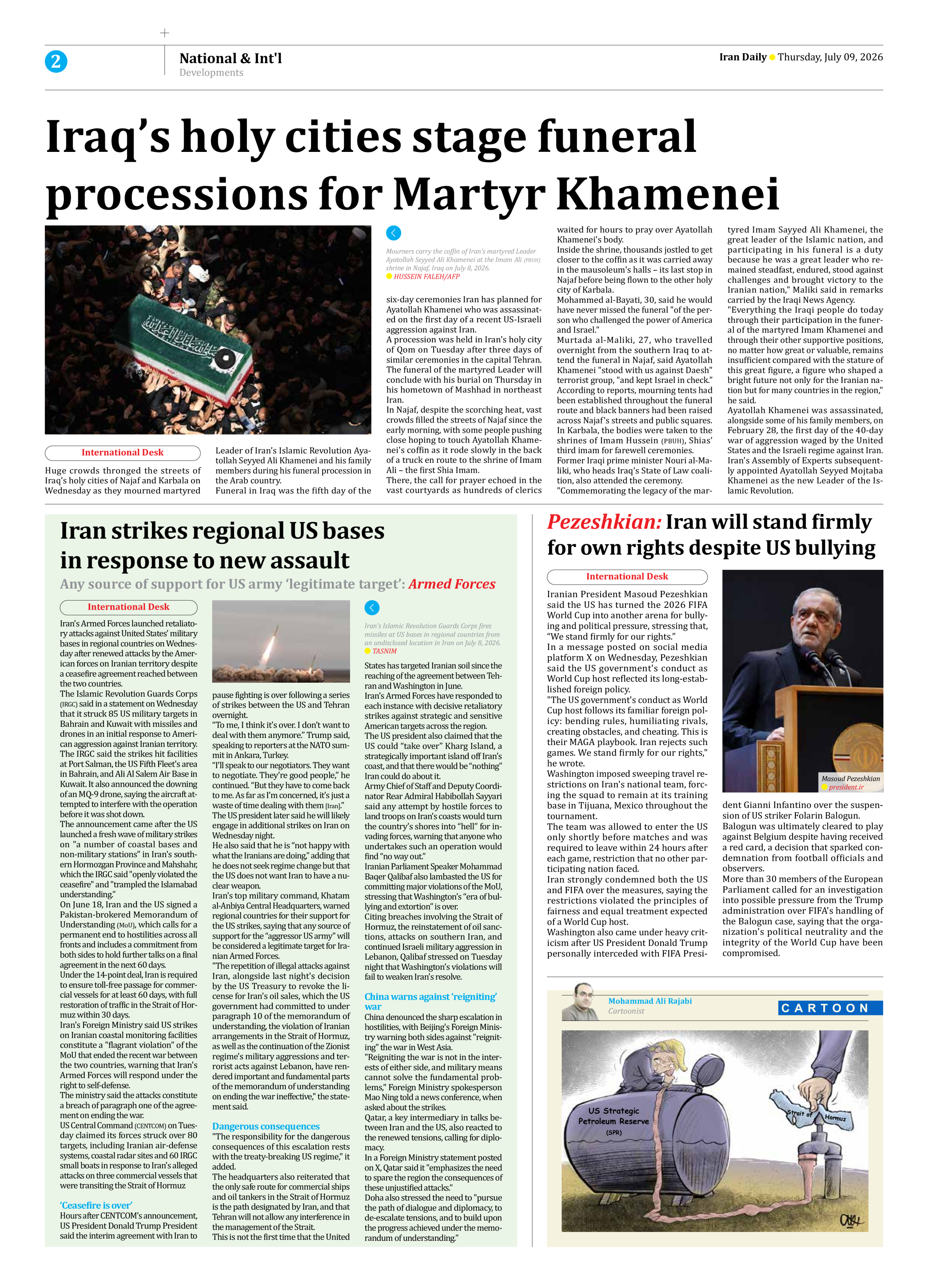
Iran’s Armed Forces launched retaliatory attacks against United States’ military bases in regional countries on Wednesday after renewed attacks by the American forces on Iranian territory despite a ceasefire agreement reached between the two countries.
The Islamic Revolution Guards Corps (IRGC) said in a statement on Wednesday that it struck 85 US military targets in Bahrain and Kuwait with missiles and drones in an initial response to American aggression against Iranian territory.
The IRGC said the strikes hit facilities at Port Salman, the US Fifth Fleet's area in Bahrain, and Ali Al Salem Air Base in Kuwait. It also announced the downing of an MQ-9 drone, saying the aircraft attempted to interfere with the operation before it was shot down.
The announcement came after the US launched a fresh wave of military strikes on "a number of coastal bases and non-military stations" in Iran's southern Hormozgan Province and Mahshahr, which the IRGC said "openly violated the ceasefire" and "trampled the Islamabad understanding.”
On June 18, Iran and the US signed a Pakistan-brokered Memorandum of Understanding (MoU), which calls for a permanent end to hostilities across all fronts and includes a commitment from both sides to hold further talks on a final agreement in the next 60 days.
Under the 14-point deal, Iran is required to ensure toll-free passage for commercial vessels for at least 60 days, with full restoration of traffic in the Strait of Hormuz within 30 days.
Iran's Foreign Ministry said US strikes on Iranian coastal monitoring facilities constitute a "flagrant violation" of the MoU that ended the recent war between the two countries, warning that Iran's Armed Forces will respond under the right to self-defense.
The ministry said the attacks constitute a breach of paragraph one of the agreement on ending the war.
US Central Command (CENTCOM) on Tuesday claimed its forces struck over 80 targets, including Iranian air-defense systems, coastal radar sites and 60 IRGC small boats in response to Iran’s alleged attacks on three commercial vessels that were transiting the Strait of Hormuz
‘Ceasefire is over’
Hours after CENTCOM’s announcement, US President Donald Trump President said the interim agreement with Iran to pause fighting is over following a series of strikes between the US and Tehran overnight.
“To me, I think it’s over. I don’t want to deal with them anymore.” Trump said, speaking to reporters at the NATO summit in Ankara, Turkey.
“I’ll speak to our negotiators. They want to negotiate. They’re good people,” he continued. “But they have to come back to me. As far as I’m concerned, it’s just a waste of time dealing with them [Iran].”
The US president later said he will likely engage in additional strikes on Iran on Wednesday night.
He also said that he is “not happy with what the Iranians are doing,” adding that he does not seek regime change but that the US does not want Iran to have a nuclear weapon.
Iran’s top military command, Khatam al-Anbiya Central Headquarters, warned regional countries for their support for the US strikes, saying that any source of support for the “aggressor US army” will be considered a legitimate target for Iranian Armed Forces.
"The repetition of illegal attacks against Iran, alongside last night's decision by the US Treasury to revoke the license for Iran's oil sales, which the US government had committed to under paragraph 10 of the memorandum of understanding, the violation of Iranian arrangements in the Strait of Hormuz, as well as the continuation of the Zionist regime's military aggressions and terrorist acts against Lebanon, have rendered important and fundamental parts of the memorandum of understanding on ending the war ineffective," the statement said.
Dangerous consequences
"The responsibility for the dangerous consequences of this escalation rests with the treaty-breaking US regime," it added.
The headquarters also reiterated that the only safe route for commercial ships and oil tankers in the Strait of Hormuz is the path designated by Iran, and that Tehran will not allow any interference in the management of the Strait.
This is not the first time that the United States has targeted Iranian soil since the reaching of the agreement between Tehran and Washington in June.
Iran’s Armed Forces have responded to each instance with decisive retaliatory strikes against strategic and sensitive American targets across the region.
The US president also claimed that the US could “take over” Kharg Island, a strategically important island off Iran’s coast, and that there would be “nothing” Iran could do about it.
Army Chief of Staff and Deputy Coordinator Rear Admiral Habibollah Sayyari said any attempt by hostile forces to land troops on Iran’s coasts would turn the country’s shores into “hell” for invading forces, warning that anyone who undertakes such an operation would find “no way out.”
Iranian Parliament Speaker Mohammad Baqer Qalibaf also lambasted the US for committing major violations of the MoU, stressing that Washington’s “era of bullying and extortion” is over.
Citing breaches involving the Strait of Hormuz, the reinstatement of oil sanctions, attacks on southern Iran, and continued Israeli military aggression in Lebanon, Qalibaf stressed on Tuesday night that Washington’s violations will fail to weaken Iran’s resolve.
China warns against ‘reigniting’ war
China denounced the sharp escalation in hostilities, with Beijing's Foreign Ministry warning both sides against "reigniting" the war in West Asia.
"Reigniting the war is not in the interests of either side, and military means cannot solve the fundamental problems," Foreign Ministry spokesperson Mao Ning told a news conference, when asked about the strikes.
Qatar, a key intermediary in talks between Iran and the US, also reacted to the renewed tensions, calling for diplomacy.
In a Foreign Ministry statement posted on X, Qatar said it "emphasizes the need to spare the region the consequences of these unjustified attacks.”
Doha also stressed the need to "pursue the path of dialogue and diplomacy, to de-escalate tensions, and to build upon the progress achieved under the memorandum of understanding.”