







Martyred Leader’s economic vision:
Production the missing link to Iran’s economic prosperity
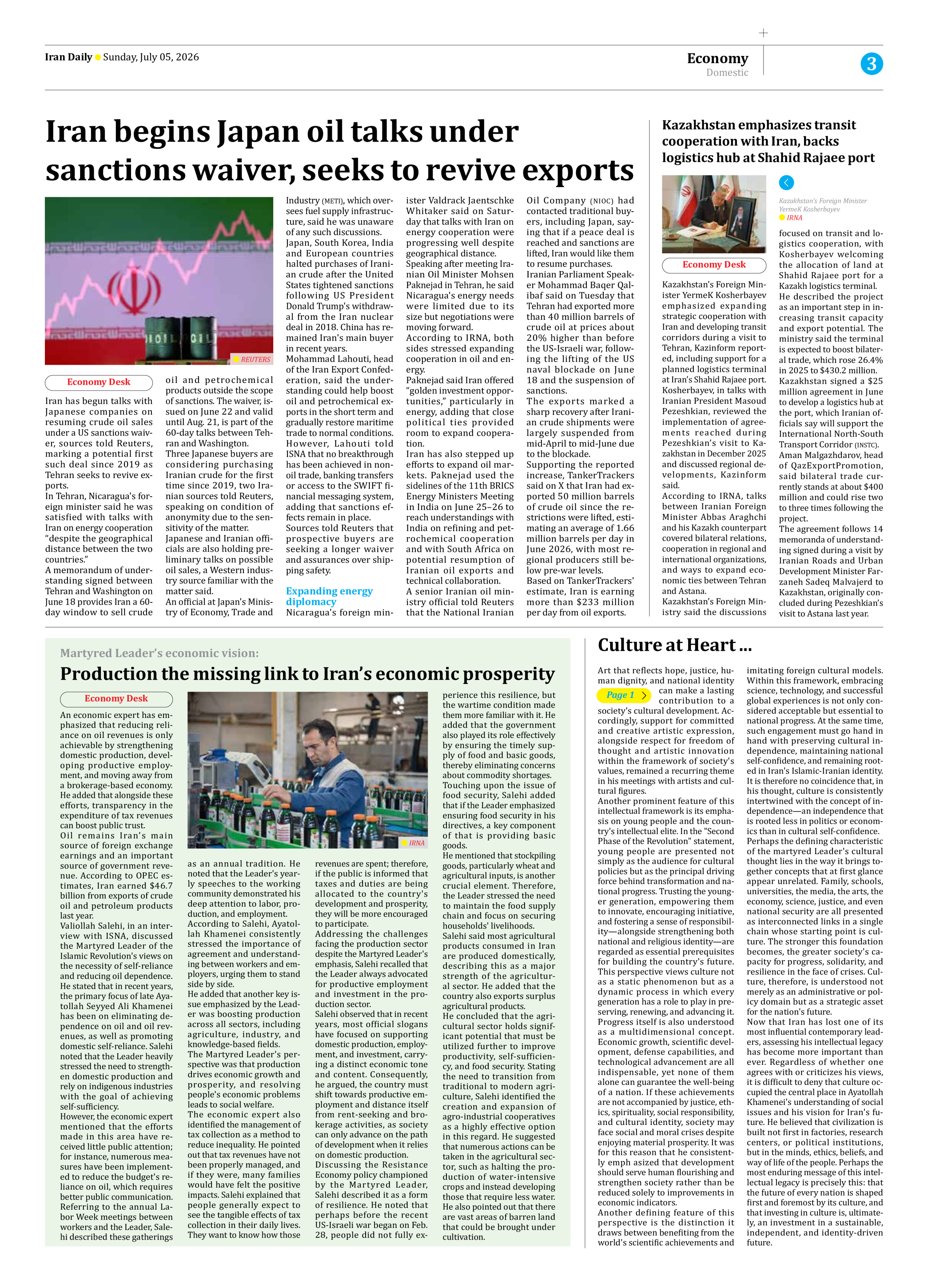
An economic expert has emphasized that reducing reliance on oil revenues is only achievable by strengthening domestic production, developing productive employment, and moving away from a brokerage-based economy. He added that alongside these efforts, transparency in the expenditure of tax revenues can boost public trust.
Oil remains Iran’s main source of foreign exchange earnings and an important source of government revenue. According to OPEC estimates, Iran earned $46.7 billion from exports of crude oil and petroleum products last year.
Valiollah Salehi, in an interview with ISNA, discussed the Martyred Leader of the Islamic Revolution's views on the necessity of self-reliance and reducing oil dependence.
He stated that in recent years, the primary focus of late Ayatollah Seyyed Ali Khamenei has been on eliminating dependence on oil and oil revenues, as well as promoting domestic self-reliance. Salehi noted that the Leader heavily stressed the need to strengthen domestic production and rely on indigenous industries with the goal of achieving self-sufficiency.
However, the economic expert mentioned that the efforts made in this area have received little public attention; for instance, numerous measures have been implemented to reduce the budget's reliance on oil, which requires better public communication.
Referring to the annual Labor Week meetings between workers and the Leader, Salehi described these gatherings as an annual tradition. He noted that the Leader's yearly speeches to the working community demonstrated his deep attention to labor, production, and employment.
According to Salehi, Ayatollah Khamenei consistently stressed the importance of agreement and understanding between workers and employers, urging them to stand side by side.
He added that another key issue emphasized by the Leader was boosting production across all sectors, including agriculture, industry, and knowledge-based fields.
The Martyred Leader's perspective was that production drives economic growth and prosperity, and resolving people's economic problems leads to social welfare.
The economic expert also identified the management of tax collection as a method to reduce inequality. He pointed out that tax revenues have not been properly managed, and if they were, many families would have felt the positive impacts. Salehi explained that people generally expect to see the tangible effects of tax collection in their daily lives. They want to know how those revenues are spent; therefore, if the public is informed that taxes and duties are being allocated to the country's development and prosperity, they will be more encouraged to participate.
Addressing the challenges facing the production sector despite the Martyred Leader's emphasis, Salehi recalled that the Leader always advocated for productive employment and investment in the production sector.
Salehi observed that in recent years, most official slogans have focused on supporting domestic production, employment, and investment, carrying a distinct economic tone and content. Consequently, he argued, the country must shift towards productive employment and distance itself from rent-seeking and brokerage activities, as society can only advance on the path of development when it relies on domestic production.
Discussing the Resistance Economy policy championed by the Martyred Leader, Salehi described it as a form of resilience. He noted that perhaps before the recent US-Israeli war began on Feb. 28, people did not fully experience this resilience, but the wartime condition made them more familiar with it. He added that the government also played its role effectively by ensuring the timely supply of food and basic goods, thereby eliminating concerns about commodity shortages.
Touching upon the issue of food security, Salehi added that if the Leader emphasized ensuring food security in his directives, a key component of that is providing basic goods.
He mentioned that stockpiling goods, particularly wheat and agricultural inputs, is another crucial element. Therefore, the Leader stressed the need to maintain the food supply chain and focus on securing households' livelihoods.
Salehi said most agricultural products consumed in Iran are produced domestically, describing this as a major strength of the agricultural sector. He added that the country also exports surplus agricultural products.
He concluded that the agricultural sector holds significant potential that must be utilized further to improve productivity, self-sufficiency, and food security. Stating the need to transition from traditional to modern agriculture, Salehi identified the creation and expansion of agro-industrial cooperatives as a highly effective option in this regard. He suggested that numerous actions can be taken in the agricultural sector, such as halting the production of water-intensive crops and instead developing those that require less water. He also pointed out that there are vast areas of barren land that could be brought under cultivation.