





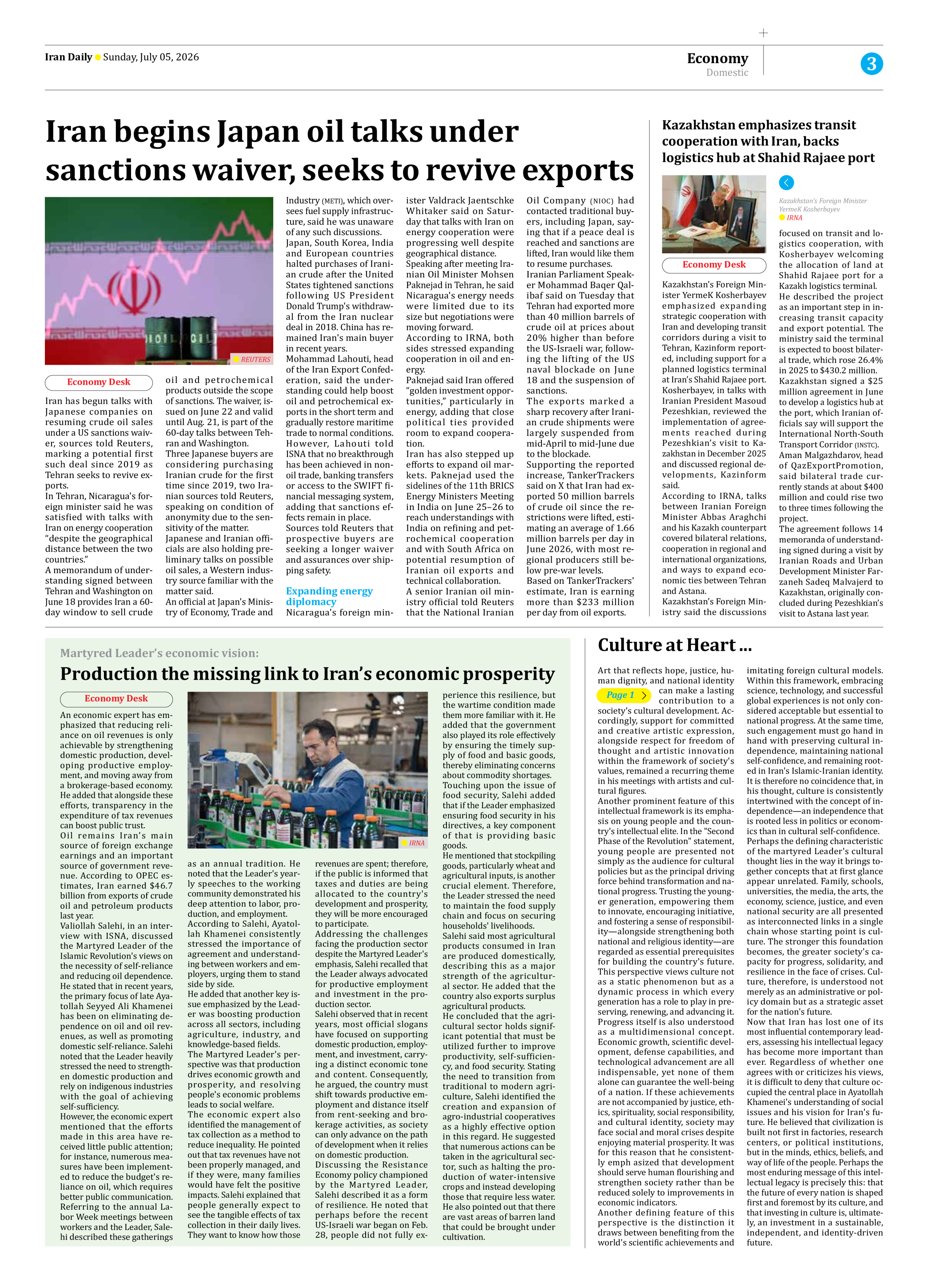


Iran begins Japan oil talks under sanctions waiver, seeks to revive exports
Iran has begun talks with Japanese companies on resuming crude oil sales under a US sanctions waiver, sources told Reuters, marking a potential first such deal since 2019 as Tehran seeks to revive exports.
In Tehran, Nicaragua's foreign minister said he was satisfied with talks with Iran on energy cooperation “despite the geographical distance between the two countries.”
A memorandum of understanding signed between Tehran and Washington on June 18 provides Iran a 60-day window to sell crude oil and petrochemical products outside the scope of sanctions. The waiver, issued on June 22 and valid until Aug. 21, is part of the 60-day talks between Tehran and Washington.
Three Japanese buyers are considering purchasing Iranian crude for the first time since 2019, two Iranian sources told Reuters, speaking on condition of anonymity due to the sensitivity of the matter.
Japanese and Iranian officials are also holding preliminary talks on possible oil sales, a Western industry source familiar with the matter said.
An official at Japan's Ministry of Economy, Trade and Industry (METI), which oversees fuel supply infrastructure, said he was unaware of any such discussions.
Japan, South Korea, India and European countries halted purchases of Iranian crude after the United States tightened sanctions following US President Donald Trump's withdrawal from the Iran nuclear deal in 2018. China has remained Iran's main buyer in recent years.
Mohammad Lahouti, head of the Iran Export Confederation, said the understanding could help boost oil and petrochemical exports in the short term and gradually restore maritime trade to normal conditions.
However, Lahouti told ISNA that no breakthrough has been achieved in non-oil trade, banking transfers or access to the SWIFT financial messaging system, adding that sanctions effects remain in place.
Sources told Reuters that prospective buyers are seeking a longer waiver and assurances over shipping safety.
Expanding energy diplomacy
Nicaragua's foreign minister Valdrack Jaentschke Whitaker said on Saturday that talks with Iran on energy cooperation were progressing well despite geographical distance.
Speaking after meeting Iranian Oil Minister Mohsen Paknejad in Tehran, he said Nicaragua's energy needs were limited due to its size but negotiations were moving forward.
According to IRNA, both sides stressed expanding cooperation in oil and energy.
Paknejad said Iran offered “golden investment opportunities,” particularly in energy, adding that close political ties provided room to expand cooperation.
Iran has also stepped up efforts to expand oil markets. Paknejad used the sidelines of the 11th BRICS Energy Ministers Meeting in India on June 25–26 to reach understandings with India on refining and petrochemical cooperation and with South Africa on potential resumption of Iranian oil exports and technical collaboration.
A senior Iranian oil ministry official told Reuters that the National Iranian Oil Company (NIOC) had contacted traditional buyers, including Japan, saying that if a peace deal is reached and sanctions are lifted, Iran would like them to resume purchases.
Iranian Parliament Speaker Mohammad Baqer Qalibaf said on Tuesday that Tehran had exported more than 40 million barrels of crude oil at prices about 20% higher than before the US-Israeli war, following the lifting of the US naval blockade on June 18 and the suspension of sanctions.
The exports marked a sharp recovery after Iranian crude shipments were largely suspended from mid-April to mid-June due to the blockade.
Supporting the reported increase, TankerTrackers said on X that Iran had exported 50 million barrels of crude oil since the restrictions were lifted, estimating an average of 1.66 million barrels per day in June 2026, with most regional producers still below pre-war levels.
Based on TankerTrackers' estimate, Iran is earning more than $233 million per day from oil exports.