







Zavin village; a historic silk weaving hub in northeastern Iran
Zavin village, located in Kalat, Khorasan Razavi Province, has long been recognized as a notable name in the global textile industry. In 1977 CE, the village gained international recognition when UNESCO awarded its handwoven silk textiles the title of the finest and most delicate handicraft in the world. The honor, presented to the works of a local female artisan, helped establish Iranian traditional silk weaving on the global cultural map.
Today, Zavin village is considered one of the main silk production hubs in Kalat, in northeastern Iran. Supported by abundant mulberry orchards and between 300 and 350 active workshops, the village maintains a complete silk production chain — from silkworm breeding to the weaving of traditional fabrics.
Despite the high quality of its products and their presence in international exhibitions, local artisans say their main challenge is direct access to consumer markets. They emphasize the need for a permanent exhibition center in the region, arguing that such a facility would eliminate intermediaries, increase rural producers’ income, and serve as a cultural and tourism hub showcasing Zavin’s handicraft heritage.
The Head of Cultural Heritage, Tourism and Handicrafts Department of Kalat highlighted the national registration of Zavin silk weaving alongside other regional crafts such as Layen ribbon weaving and Aqdash kilim. He said a revival of sericulture and the operation of around 300 silk workshops in Zavin, stressing the importance of establishing a permanent exhibition space to connect artisans directly with global markets.
Sh’abanali Farahmand described silk weaving in Zavin as more than an industry, calling it a deeply rooted cultural tradition with historical significance that plays an important role in employment, production, and the preservation of local heritage. He noted that Kalat, thanks to its suitable climate and extensive mulberry groves, is one of the main silk-producing regions in Khorasan Razavi Province.
Zavin, located about 50 kilometers from the city of Kalat, has long been home to families engaged in sericulture and silk cocoon production. Historically, daily output from workshops reached 8-9 kilograms. The locally produced silk is known for its softness and quality and is used in garments, scarves, cushions, children’s clothing, and traditional dolls.
While most of the clothing produced in Zavin is consumed locally, some artisans have modernized their work to participate in international exhibitions and global markets. He also emphasized the importance of nationally registering traditional crafts in the region, noting that Zavin silk weaving, Layen ribbon weaving, and Aqdash kilim remain among the most prominent handicrafts of Greater Khorasan.
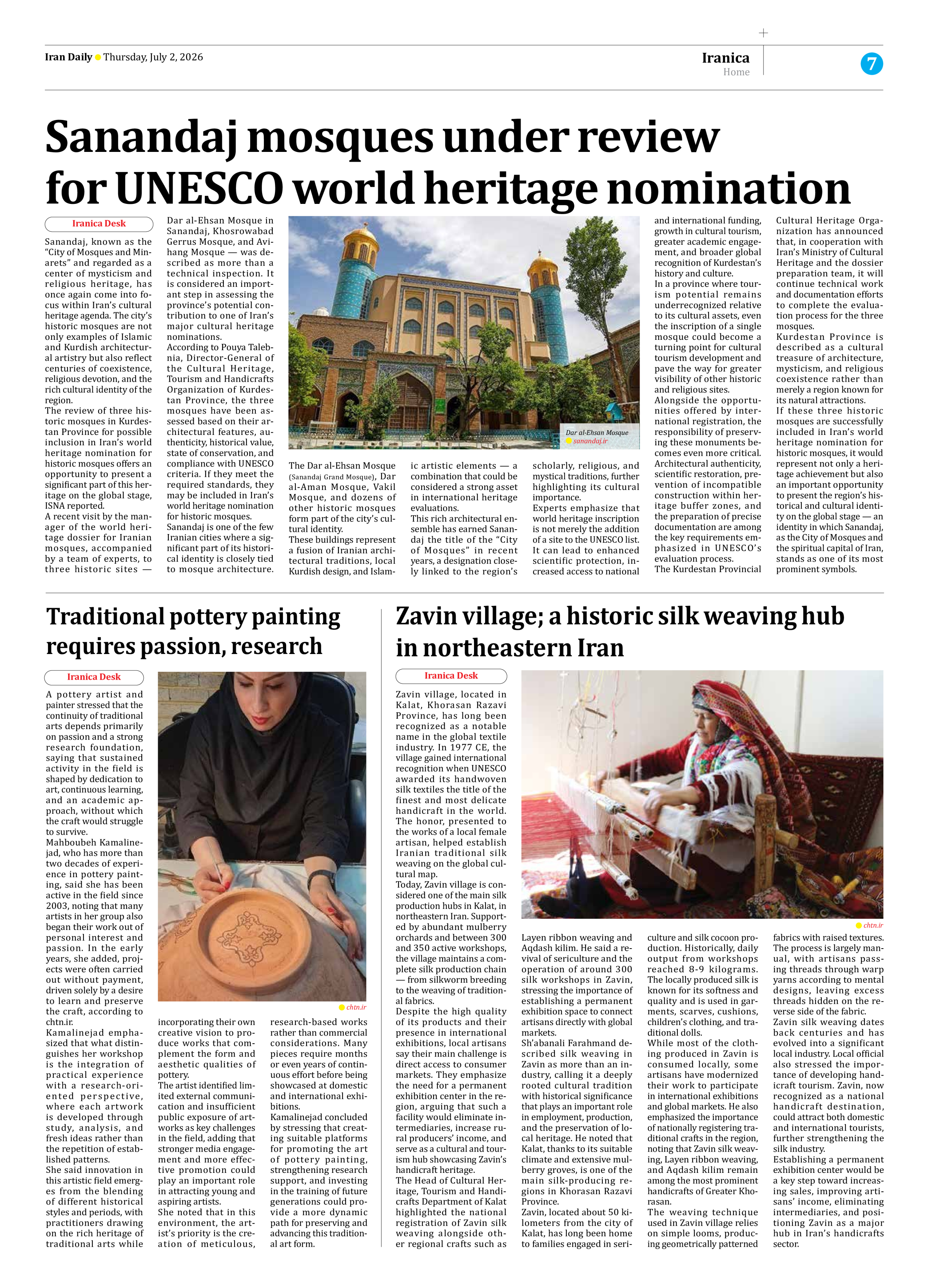
The weaving technique used in Zavin village relies on simple looms, producing geometrically patterned fabrics with raised textures. The process is largely manual, with artisans passing threads through warp yarns according to mental designs, leaving excess threads hidden on the reverse side of the fabric.
Zavin silk weaving dates back centuries and has evolved into a significant local industry. Local official also stressed the importance of developing handicraft tourism. Zavin, now recognized as a national handicraft destination, could attract both domestic and international tourists, further strengthening the silk industry.
Establishing a permanent exhibition center would be a key step toward increasing sales, improving artisans’ income, eliminating intermediaries, and positioning Zavin as a major hub in Iran’s handicrafts sector.