







Sanandaj mosques under review for UNESCO world heritage nomination
Sanandaj, known as the “City of Mosques and Minarets” and regarded as a center of mysticism and religious heritage, has once again come into focus within Iran’s cultural heritage agenda. The city’s historic mosques are not only examples of Islamic and Kurdish architectural artistry but also reflect centuries of coexistence, religious devotion, and the rich cultural identity of the region.
The review of three historic mosques in Kurdestan Province for possible inclusion in Iran’s world heritage nomination for historic mosques offers an opportunity to present a significant part of this heritage on the global stage, ISNA reported.
A recent visit by the manager of the world heritage dossier for Iranian mosques, accompanied by a team of experts, to three historic sites — Dar al-Ehsan Mosque in Sanandaj, Khosrowabad Gerrus Mosque, and Avihang Mosque — was described as more than a technical inspection. It is considered an important step in assessing the province’s potential contribution to one of Iran’s major cultural heritage nominations.
According to Pouya Talebnia, Director-General of the Cultural Heritage, Tourism and Handicrafts Organization of Kurdestan Province, the three mosques have been assessed based on their architectural features, authenticity, historical value, state of conservation, and compliance with UNESCO criteria. If they meet the required standards, they may be included in Iran’s world heritage nomination for historic mosques.
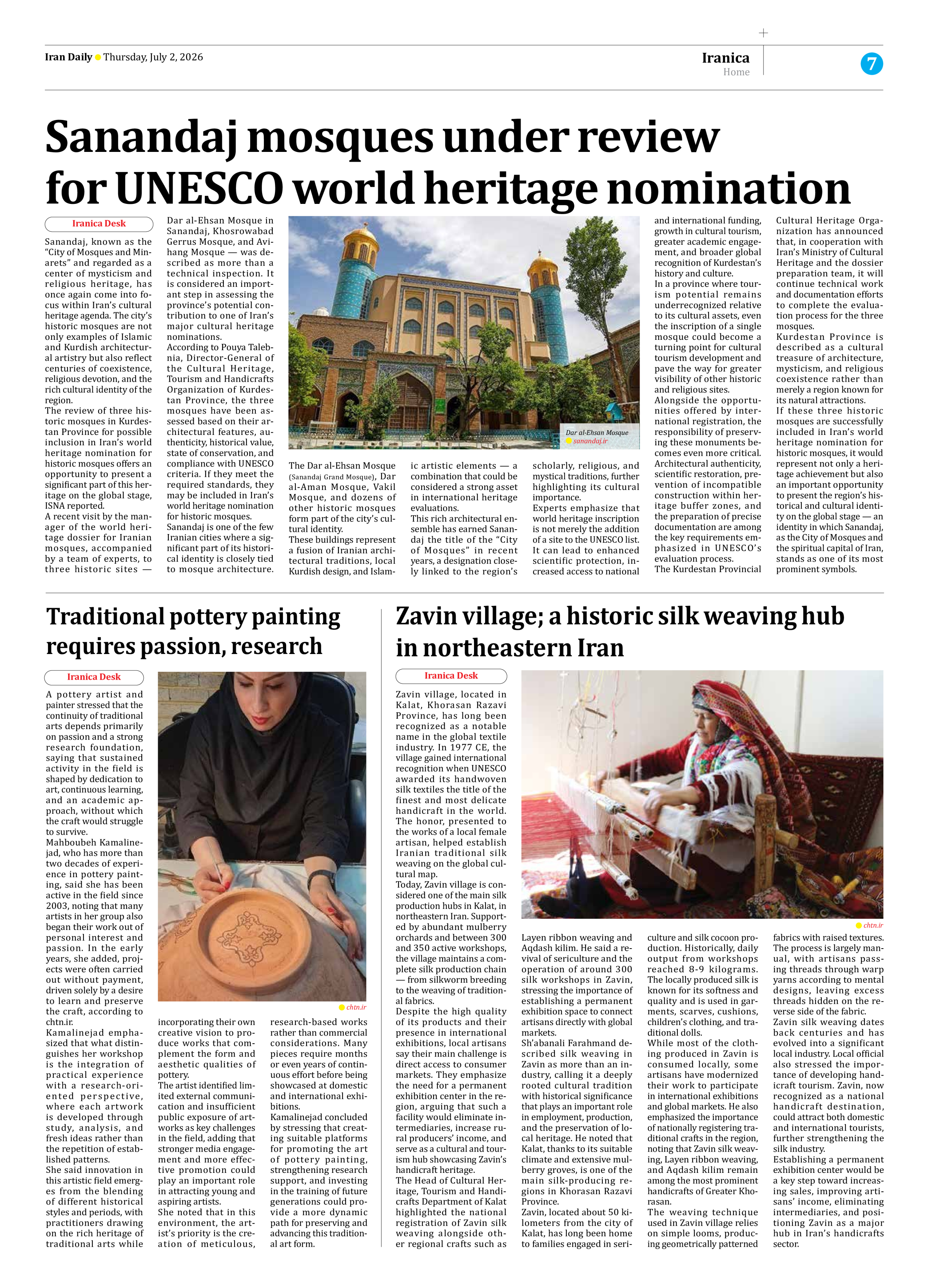
Sanandaj is one of the few Iranian cities where a significant part of its historical identity is closely tied to mosque architecture. The Dar al-Ehsan Mosque (Sanandaj Grand Mosque), Dar al-Aman Mosque, Vakil Mosque, and dozens of other historic mosques form part of the city’s cultural identity.
These buildings represent a fusion of Iranian architectural traditions, local Kurdish design, and Islamic artistic elements — a combination that could be considered a strong asset in international heritage evaluations.
This rich architectural ensemble has earned Sanandaj the title of the “City of Mosques” in recent years, a designation closely linked to the region’s scholarly, religious, and mystical traditions, further highlighting its cultural importance.
Experts emphasize that world heritage inscription is not merely the addition of a site to the UNESCO list. It can lead to enhanced scientific protection, increased access to national and international funding, growth in cultural tourism, greater academic engagement, and broader global recognition of Kurdestan’s history and culture.
In a province where tourism potential remains underrecognized relative to its cultural assets, even the inscription of a single mosque could become a turning point for cultural tourism development and pave the way for greater visibility of other historic and religious sites.
Alongside the opportunities offered by international registration, the responsibility of preserving these monuments becomes even more critical. Architectural authenticity, scientific restoration, prevention of incompatible construction within heritage buffer zones, and the preparation of precise documentation are among the key requirements emphasized in UNESCO’s evaluation process.
The Kurdestan Provincial Cultural Heritage Organization has announced that, in cooperation with Iran’s Ministry of Cultural Heritage and the dossier preparation team, it will continue technical work and documentation efforts to complete the evaluation process for the three mosques.
Kurdestan Province is described as a cultural treasure of architecture, mysticism, and religious coexistence rather than merely a region known for its natural attractions.
If these three historic mosques are successfully included in Iran’s world heritage nomination for historic mosques, it would represent not only a heritage achievement but also an important opportunity to present the region’s historical and cultural identity on the global stage — an identity in which Sanandaj, as the City of Mosques and the spiritual capital of Iran, stands as one of its most prominent symbols.