





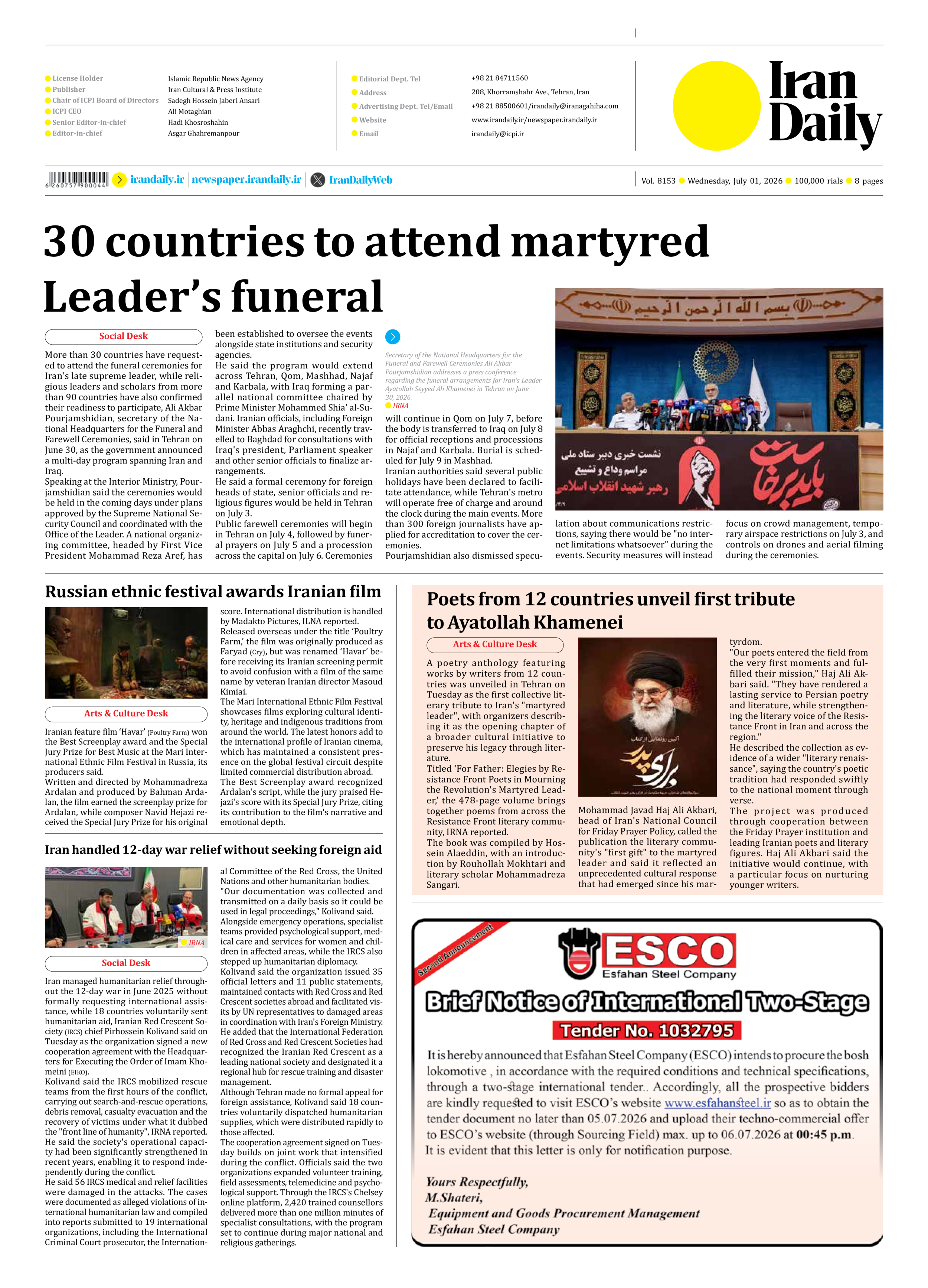


Iran handled 12-day war relief without seeking foreign aid
Iran managed humanitarian relief throughout the 12-day war in June 2025 without formally requesting international assistance, while 18 countries voluntarily sent humanitarian aid, Iranian Red Crescent Society (IRCS) chief Pirhossein Kolivand said on Tuesday as the organization signed a new cooperation agreement with the Headquarters for Executing the Order of Imam Khomeini (EIKO).
Kolivand said the IRCS mobilized rescue teams from the first hours of the conflict, carrying out search-and-rescue operations, debris removal, casualty evacuation and the recovery of victims under what it dubbed the "front line of humanity", IRNA reported.
He said the society's operational capacity had been significantly strengthened in recent years, enabling it to respond independently during the conflict.
He said 56 IRCS medical and relief facilities were damaged in the attacks. The cases were documented as alleged violations of international humanitarian law and compiled into reports submitted to 19 international organizations, including the International Criminal Court prosecutor, the International Committee of the Red Cross, the United Nations and other humanitarian bodies.
"Our documentation was collected and transmitted on a daily basis so it could be used in legal proceedings," Kolivand said.
Alongside emergency operations, specialist teams provided psychological support, medical care and services for women and children in affected areas, while the IRCS also stepped up humanitarian diplomacy.
Kolivand said the organization issued 35 official letters and 11 public statements, maintained contacts with Red Cross and Red Crescent societies abroad and facilitated visits by UN representatives to damaged areas in coordination with Iran's Foreign Ministry.
He added that the International Federation of Red Cross and Red Crescent Societies had recognized the Iranian Red Crescent as a leading national society and designated it a regional hub for rescue training and disaster management.
Although Tehran made no formal appeal for foreign assistance, Kolivand said 18 countries voluntarily dispatched humanitarian supplies, which were distributed rapidly to those affected.
The cooperation agreement signed on Tuesday builds on joint work that intensified during the conflict. Officials said the two organizations expanded volunteer training, field assessments, telemedicine and psychological support. Through the IRCS's Chelsey online platform, 2,420 trained counsellors delivered more than one million minutes of specialist consultations, with the program set to continue during major national and religious gatherings.