







30 countries to attend martyred Leader’s funeral
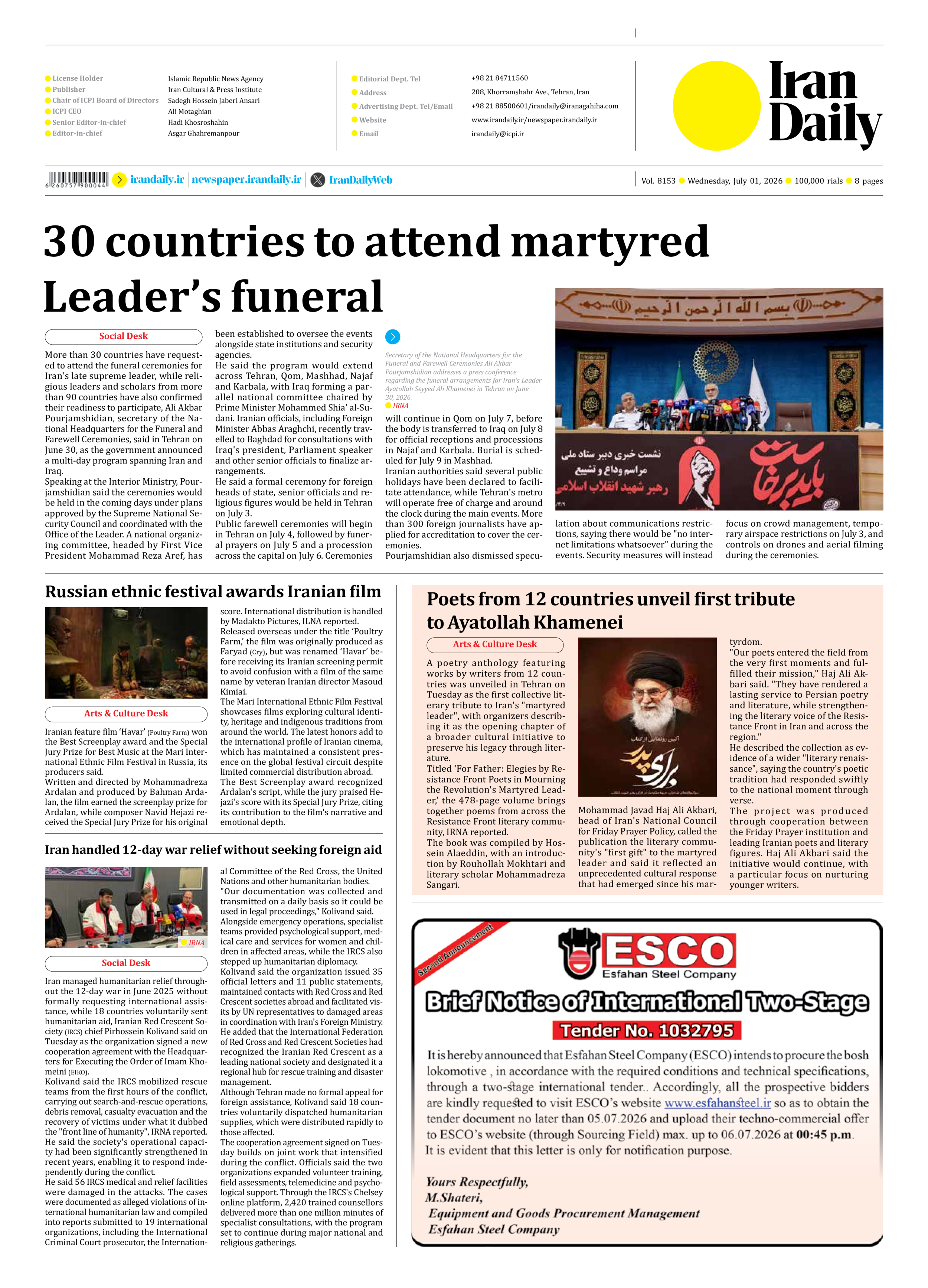
More than 30 countries have requested to attend the funeral ceremonies for Iran's late supreme leader, while religious leaders and scholars from more than 90 countries have also confirmed their readiness to participate, Ali Akbar Pourjamshidian, secretary of the National Headquarters for the Funeral and Farewell Ceremonies, said in Tehran on June 30, as the government announced a multi-day program spanning Iran and Iraq.
Speaking at the Interior Ministry, Pourjamshidian said the ceremonies would be held in the coming days under plans approved by the Supreme National Security Council and coordinated with the Office of the Leader. A national organizing committee, headed by First Vice President Mohammad Reza Aref, has been established to oversee the events alongside state institutions and security agencies.
He said the program would extend across Tehran, Qom, Mashhad, Najaf and Karbala, with Iraq forming a parallel national committee chaired by Prime Minister Mohammed Shia' al-Sudani. Iranian officials, including Foreign Minister Abbas Araghchi, recently travelled to Baghdad for consultations with Iraq's president, Parliament speaker and other senior officials to finalize arrangements.
He said a formal ceremony for foreign heads of state, senior officials and religious figures would be held in Tehran on July 3.
Public farewell ceremonies will begin in Tehran on July 4, followed by funeral prayers on July 5 and a procession across the capital on July 6. Ceremonies will continue in Qom on July 7, before the body is transferred to Iraq on July 8 for official receptions and processions in Najaf and Karbala. Burial is scheduled for July 9 in Mashhad.
Iranian authorities said several public holidays have been declared to facilitate attendance, while Tehran's metro will operate free of charge and around the clock during the main events. More than 300 foreign journalists have applied for accreditation to cover the ceremonies.
Pourjamshidian also dismissed speculation about communications restrictions, saying there would be "no internet limitations whatsoever" during the events. Security measures will instead focus on crowd management, temporary airspace restrictions on July 3, and controls on drones and aerial filming during the ceremonies.