







Copy in clipboard...
Quiet strength of Simin-Dokht Vahidi’s verse lives on
The passing of poet Simin-Dokht Vahidi marked the end of a remarkable literary life, but her true legacy reaches far beyond the mourning ceremonies that followed. While tributes at her funeral celebrated her place among the pioneers of post-revolutionary Persian poetry, those who knew her work suggest her greatest achievement was not simply what she wrote, but how she shaped generations of poets through a language that remained accessible, compassionate and deeply rooted in faith, patriotism and lived experience.
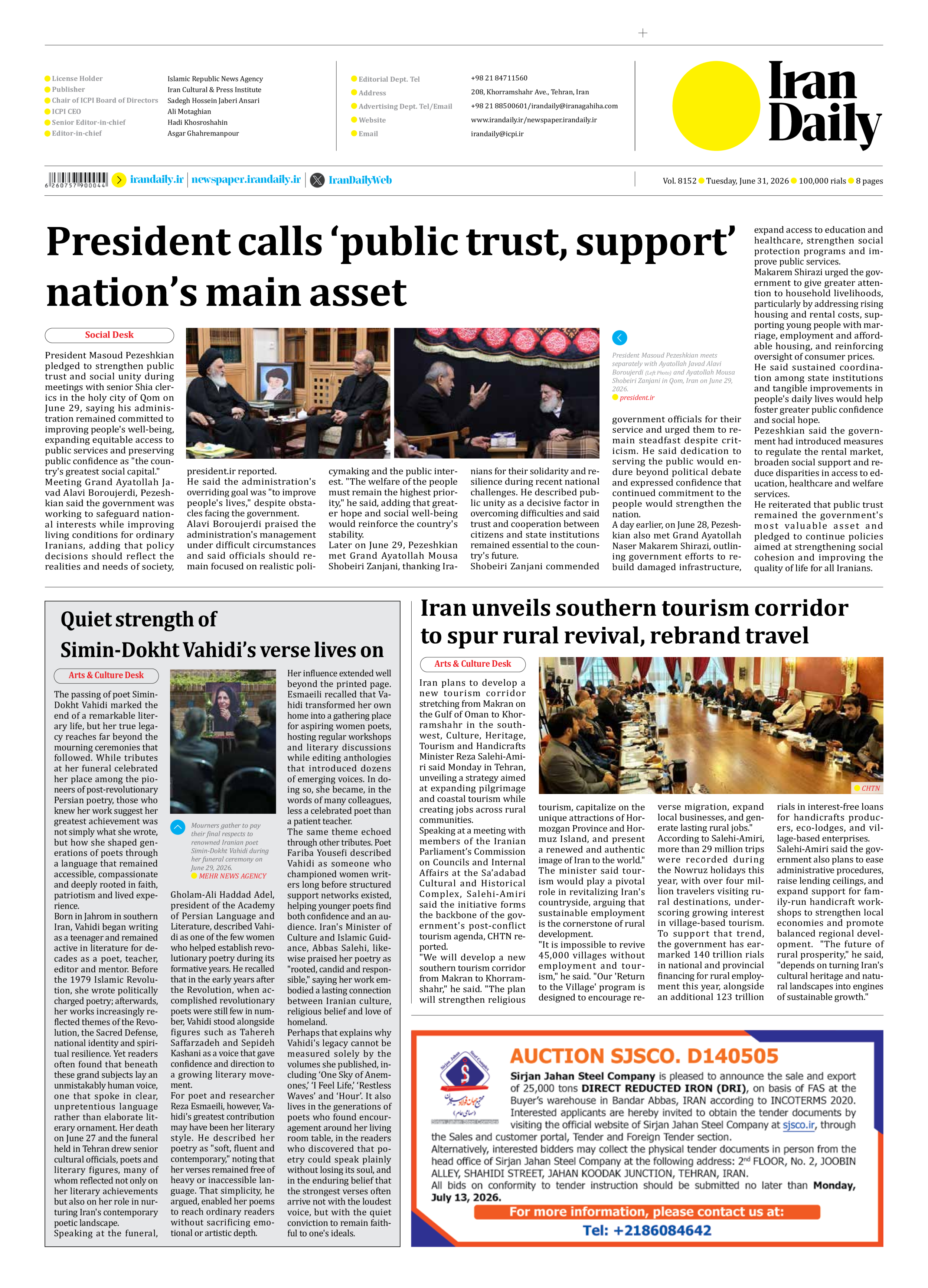
Born in Jahrom in southern Iran, Vahidi began writing as a teenager and remained active in literature for decades as a poet, teacher, editor and mentor. Before the 1979 Islamic Revolution, she wrote politically charged poetry; afterwards, her works increasingly reflected themes of the Revolution, the Sacred Defense, national identity and spiritual resilience. Yet readers often found that beneath these grand subjects lay an unmistakably human voice, one that spoke in clear, unpretentious language rather than elaborate literary ornament. Her death on June 27 and the funeral held in Tehran drew senior cultural officials, poets and literary figures, many of whom reflected not only on her literary achievements but also on her role in nurturing Iran's contemporary poetic landscape.
Speaking at the funeral, Gholam-Ali Haddad Adel, president of the Academy of Persian Language and Literature, described Vahidi as one of the few women who helped establish revolutionary poetry during its formative years. He recalled that in the early years after the Revolution, when accomplished revolutionary poets were still few in number, Vahidi stood alongside figures such as Tahereh Saffarzadeh and Sepideh Kashani as a voice that gave confidence and direction to a growing literary movement.
For poet and researcher Reza Esmaeili, however, Vahidi's greatest contribution may have been her literary style. He described her poetry as "soft, fluent and contemporary," noting that her verses remained free of heavy or inaccessible language. That simplicity, he argued, enabled her poems to reach ordinary readers without sacrificing emotional or artistic depth.
Her influence extended well beyond the printed page. Esmaeili recalled that Vahidi transformed her own home into a gathering place for aspiring women poets, hosting regular workshops and literary discussions while editing anthologies that introduced dozens of emerging voices. In doing so, she became, in the words of many colleagues, less a celebrated poet than a patient teacher.
The same theme echoed through other tributes. Poet Fariba Yousefi described Vahidi as someone who championed women writers long before structured support networks existed, helping younger poets find both confidence and an audience. Iran's Minister of Culture and Islamic Guidance, Abbas Salehi, likewise praised her poetry as "rooted, candid and responsible," saying her work embodied a lasting connection between Iranian culture, religious belief and love of homeland.
Perhaps that explains why Vahidi's legacy cannot be measured solely by the volumes she published, including ‘One Sky of Anemones,’ ‘I Feel Life,’ ‘Restless Waves’ and ‘Hour’. It also lives in the generations of poets who found encouragement around her living room table, in the readers who discovered that poetry could speak plainly without losing its soul, and in the enduring belief that the strongest verses often arrive not with the loudest voice, but with the quiet conviction to remain faithful to one's ideals.