







Copy in clipboard...
Coffeehouse painting in Iran’s collective memory
Also known as “imaginative painting” or “folk painting,” coffeehouse painting is deeply intertwined with oral traditions, storytelling, religious passion plays, and Shi’a rituals, making it one of the most significant manifestations of popular art in Iran, according to IBNA.
Researchers trace the earliest roots of this art form to the Safavid era, when Shi’a Islam became the state religion and religious and epic narratives gained unprecedented prominence in public culture. Although what is recognized today as coffeehouse painting largely flourished during the Qajar period—particularly alongside the Constitutional Revolution—its intellectual and narrative foundations can be found in the religious banners, Shi’a iconography, and storytelling traditions of the Safavid age.
In his book Painting in the Coffeehouse, Hossein Mirmostafa describes the origins of the genre as follows: “Coffeehouse painting emerged from the working-class and lower social strata without any formal academic training and independently of official artistic schools, gradually developing into a distinctive and self-sufficient style.”
This characteristic has led many art historians to regard coffeehouse painting as Iran’s first truly popular artistic movement.
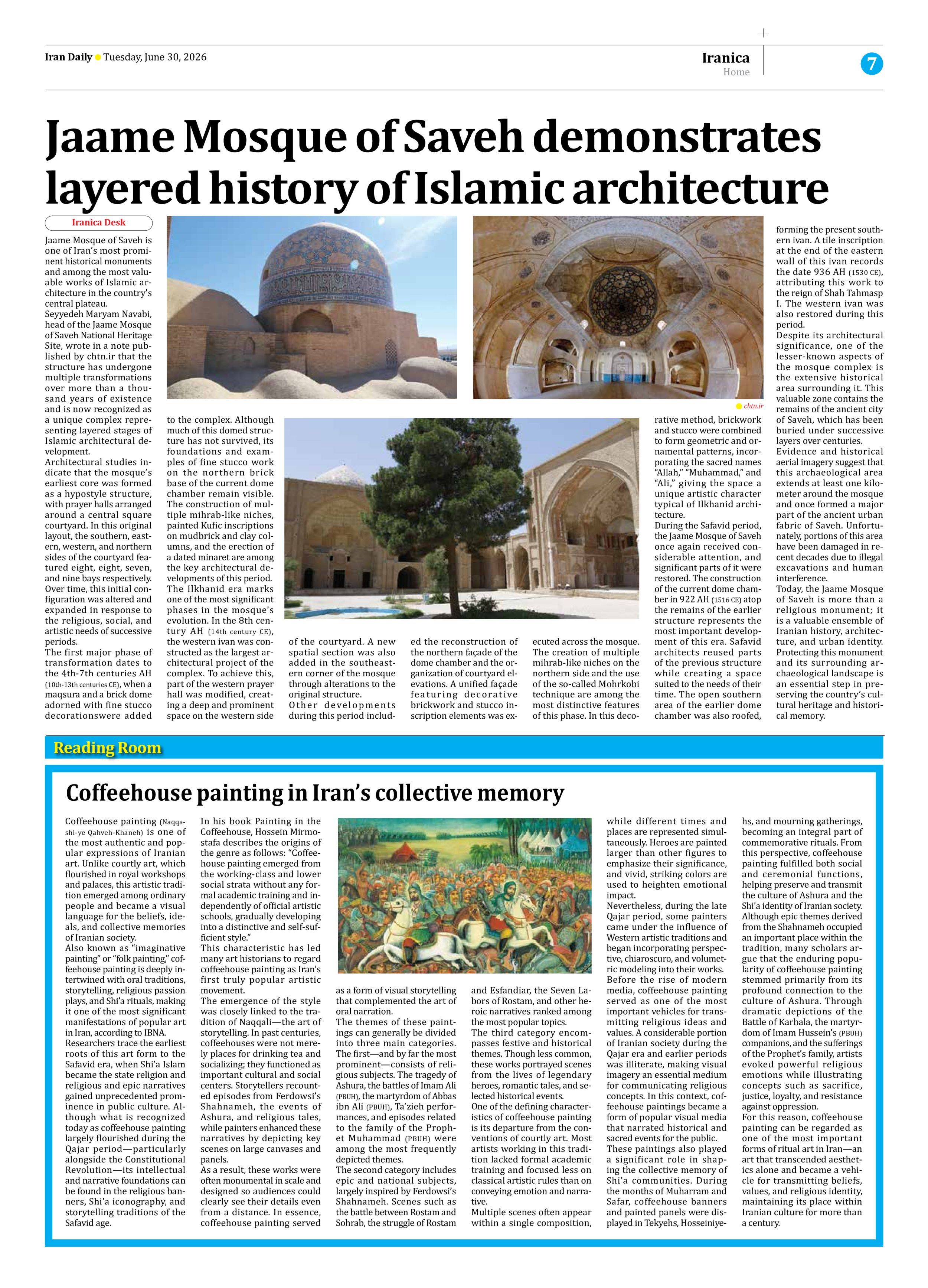
The emergence of the style was closely linked to the tradition of Naqqali—the art of storytelling. In past centuries, coffeehouses were not merely places for drinking tea and socializing; they functioned as important cultural and social centers. Storytellers recounted episodes from Ferdowsi’s Shahnameh, the events of Ashura, and religious tales, while painters enhanced these narratives by depicting key scenes on large canvases and panels.
As a result, these works were often monumental in scale and designed so audiences could clearly see their details even from a distance. In essence, coffeehouse painting served as a form of visual storytelling that complemented the art of oral narration.
The themes of these paintings can generally be divided into three main categories. The first—and by far the most prominent—consists of religious subjects. The tragedy of Ashura, the battles of Imam Ali (PBUH), the martyrdom of Abbas ibn Ali (PBUH), Ta’zieh performances, and episodes related to the family of the Prophet Muhammad (PBUH) were among the most frequently depicted themes.
The second category includes epic and national subjects, largely inspired by Ferdowsi’s Shahnameh. Scenes such as the battle between Rostam and Sohrab, the struggle of Rostam and Esfandiar, the Seven Labors of Rostam, and other heroic narratives ranked among the most popular topics.
The third category encompasses festive and historical themes. Though less common, these works portrayed scenes from the lives of legendary heroes, romantic tales, and selected historical events.
One of the defining characteristics of coffeehouse painting is its departure from the conventions of courtly art. Most artists working in this tradition lacked formal academic training and focused less on classical artistic rules than on conveying emotion and narrative.
Multiple scenes often appear within a single composition, while different times and places are represented simultaneously. Heroes are painted larger than other figures to emphasize their significance, and vivid, striking colors are used to heighten emotional impact.
Nevertheless, during the late Qajar period, some painters came under the influence of Western artistic traditions and began incorporating perspective, chiaroscuro, and volumetric modeling into their works.
Before the rise of modern media, coffeehouse painting served as one of the most important vehicles for transmitting religious ideas and values. A considerable portion of Iranian society during the Qajar era and earlier periods was illiterate, making visual imagery an essential medium for communicating religious concepts. In this context, coffeehouse paintings became a form of popular visual media that narrated historical and sacred events for the public.
These paintings also played a significant role in shaping the collective memory of Shi’a communities. During the months of Muharram and Safar, coffeehouse banners and painted panels were displayed in Tekyehs, Hosseiniyehs, and mourning gatherings, becoming an integral part of commemorative rituals. From this perspective, coffeehouse painting fulfilled both social and ceremonial functions, helping preserve and transmit the culture of Ashura and the Shi’a identity of Iranian society.
Although epic themes derived from the Shahnameh occupied an important place within the tradition, many scholars argue that the enduring popularity of coffeehouse painting stemmed primarily from its profound connection to the culture of Ashura. Through dramatic depictions of the Battle of Karbala, the martyrdom of Imam Hussein’s (PBUH) companions, and the sufferings of the Prophet’s family, artists evoked powerful religious emotions while illustrating concepts such as sacrifice, justice, loyalty, and resistance against oppression.
For this reason, coffeehouse painting can be regarded as one of the most important forms of ritual art in Iran—an art that transcended aesthetics alone and became a vehicle for transmitting beliefs, values, and religious identity, maintaining its place within Iranian culture for more than a century.