







Copy in clipboard...
Jaame Mosque of Saveh demonstrates layered history of Islamic architecture
Seyyedeh Maryam Navabi, head of the Jaame Mosque of Saveh National Heritage Site, wrote in a note published by chtn.ir that the structure has undergone multiple transformations over more than a thousand years of existence and is now recognized as a unique complex representing layered stages of Islamic architectural development.
Architectural studies indicate that the mosque’s earliest core was formed as a hypostyle structure, with prayer halls arranged around a central square courtyard. In this original layout, the southern, eastern, western, and northern sides of the courtyard featured eight, eight, seven, and nine bays respectively. Over time, this initial configuration was altered and expanded in response to the religious, social, and artistic needs of successive periods.
The first major phase of transformation dates to the 4th-7th centuries AH (10th-13th centuries CE), when a maqsura and a brick dome adorned with fine stucco decorationswere added to the complex. Although much of this domed structure has not survived, its foundations and examples of fine stucco work on the northern brick base of the current dome chamber remain visible. The construction of multiple mihrab-like niches, painted Kufic inscriptions on mudbrick and clay columns, and the erection of a dated minaret are among the key architectural developments of this period.
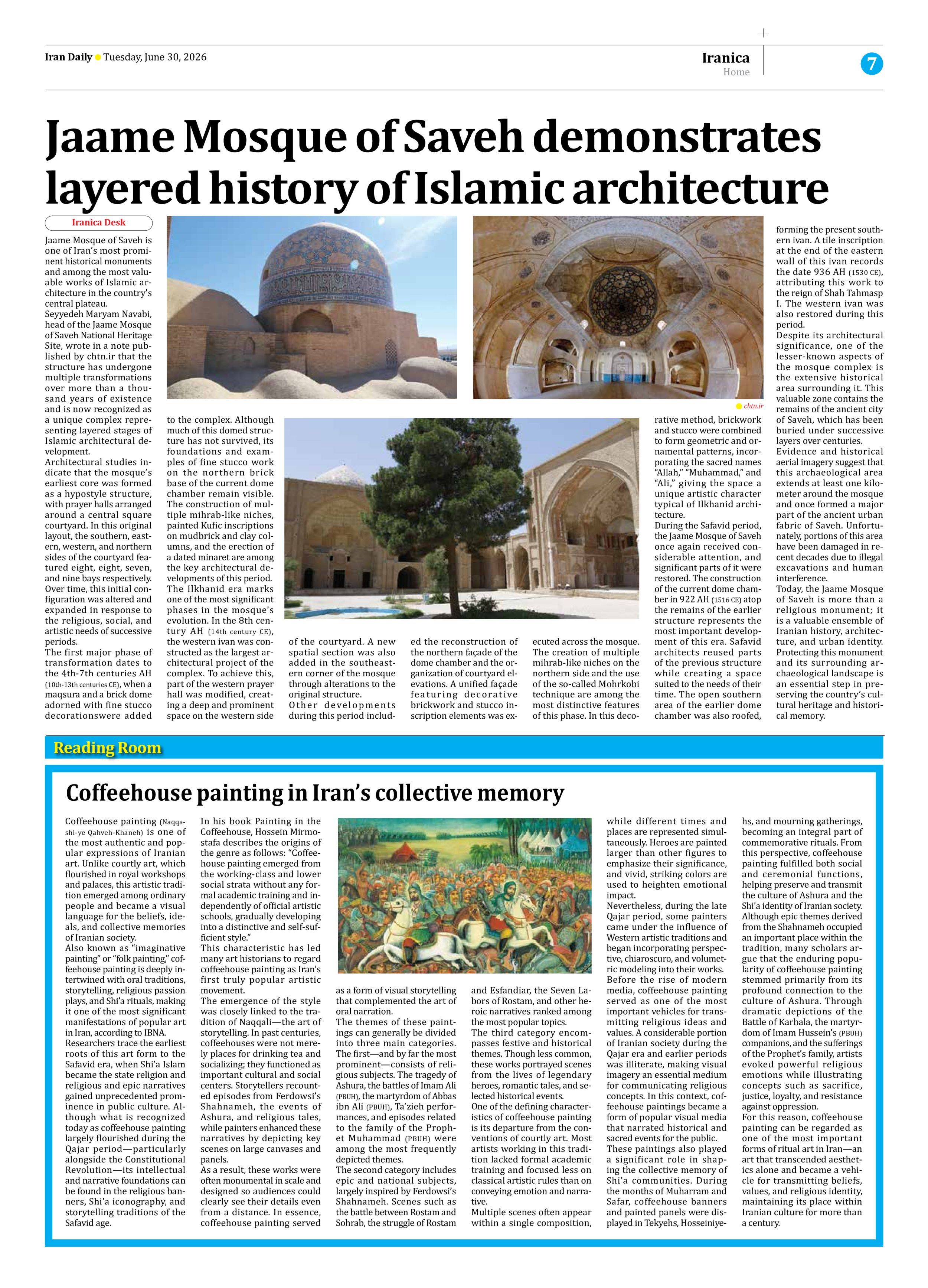
The Ilkhanid era marks one of the most significant phases in the mosque’s evolution. In the 8th century AH (14th century CE), the western ivan was constructed as the largest architectural project of the complex. To achieve this, part of the western prayer hall was modified, creating a deep and prominent space on the western side of the courtyard. A new spatial section was also added in the southeastern corner of the mosque through alterations to the original structure.
Other developments during this period included the reconstruction of the northern façade of the dome chamber and the organization of courtyard elevations. A unified façade featuring decorative brickwork and stucco inscription elements was executed across the mosque. The creation of multiple mihrab-like niches on the northern side and the use of the so-called Mohrkobi technique are among the most distinctive features of this phase. In this decorative method, brickwork and stucco were combined to form geometric and ornamental patterns, incorporating the sacred names “Allah,” “Muhammad,” and “Ali,” giving the space a unique artistic character typical of Ilkhanid architecture.
During the Safavid period, the Jaame Mosque of Saveh once again received considerable attention, and significant parts of it were restored. The construction of the current dome chamber in 922 AH (1516 CE) atop the remains of the earlier structure represents the most important development of this era. Safavid architects reused parts of the previous structure while creating a space suited to the needs of their time. The open southern area of the earlier dome chamber was also roofed, forming the present southern ivan. A tile inscription at the end of the eastern wall of this ivan records the date 936 AH (1530 CE), attributing this work to the reign of Shah Tahmasp I. The western ivan was also restored during this period.
Despite its architectural significance, one of the lesser-known aspects of the mosque complex is the extensive historical area surrounding it. This valuable zone contains the remains of the ancient city of Saveh, which has been buried under successive layers over centuries.
Evidence and historical aerial imagery suggest that this archaeological area extends at least one kilometer around the mosque and once formed a major part of the ancient urban fabric of Saveh. Unfortunately, portions of this area have been damaged in recent decades due to illegal excavations and human interference.
Today, the Jaame Mosque of Saveh is more than a religious monument; it is a valuable ensemble of Iranian history, architecture, and urban identity. Protecting this monument and its surrounding archaeological landscape is an essential step in preserving the country’s cultural heritage and historical memory.