







Palm-leaf broom craft faces decline in Qasr-e Shirin
In the old and expansive palm groves of the border city of Qasr-e Shirin in Kermanshah Province, a deeply rooted local craft has long been woven into everyday life. Once an essential part of rural livelihoods, culture, and the household economy, palm-leaf broom weaving (Jaru-Bafi) is now steadily fading under the pressure of lifestyle changes and the spread of industrial products.
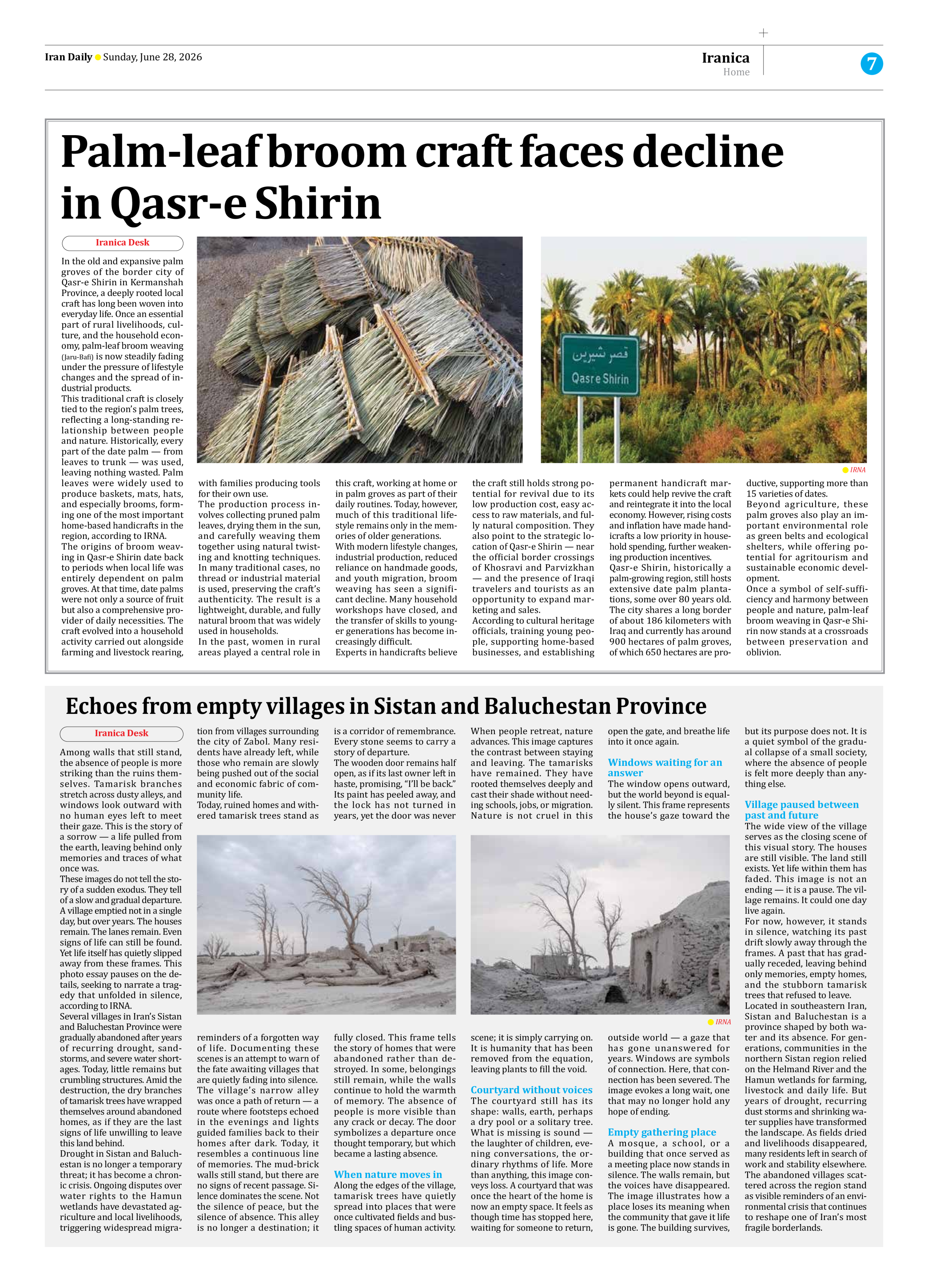
This traditional craft is closely tied to the region’s palm trees, reflecting a long-standing relationship between people and nature. Historically, every part of the date palm — from leaves to trunk — was used, leaving nothing wasted. Palm leaves were widely used to produce baskets, mats, hats, and especially brooms, forming one of the most important home-based handicrafts in the region, according to IRNA.
The origins of broom weaving in Qasr-e Shirin date back to periods when local life was entirely dependent on palm groves. At that time, date palms were not only a source of fruit but also a comprehensive provider of daily necessities. The craft evolved into a household activity carried out alongside farming and livestock rearing, with families producing tools for their own use.
The production process involves collecting pruned palm leaves, drying them in the sun, and carefully weaving them together using natural twisting and knotting techniques. In many traditional cases, no thread or industrial material is used, preserving the craft’s authenticity. The result is a lightweight, durable, and fully natural broom that was widely used in households.
In the past, women in rural areas played a central role in this craft, working at home or in palm groves as part of their daily routines. Today, however, much of this traditional lifestyle remains only in the memories of older generations.
With modern lifestyle changes, industrial production, reduced reliance on handmade goods, and youth migration, broom weaving has seen a significant decline. Many household workshops have closed, and the transfer of skills to younger generations has become increasingly difficult.
Experts in handicrafts believe the craft still holds strong potential for revival due to its low production cost, easy access to raw materials, and fully natural composition. They also point to the strategic location of Qasr-e Shirin — near the official border crossings of Khosravi and Parvizkhan — and the presence of Iraqi travelers and tourists as an opportunity to expand marketing and sales.
According to cultural heritage officials, training young people, supporting home-based businesses, and establishing permanent handicraft markets could help revive the craft and reintegrate it into the local economy. However, rising costs and inflation have made handicrafts a low priority in household spending, further weakening production incentives.
Qasr-e Shirin, historically a palm-growing region, still hosts extensive date palm plantations, some over 80 years old. The city shares a long border of about 186 kilometers with Iraq and currently has around 900 hectares of palm groves, of which 650 hectares are productive, supporting more than 15 varieties of dates.
Beyond agriculture, these palm groves also play an important environmental role as green belts and ecological shelters, while offering potential for agritourism and sustainable economic development.
Once a symbol of self-sufficiency and harmony between people and nature, palm-leaf broom weaving in Qasr-e Shirin now stands at a crossroads between preservation and oblivion.