





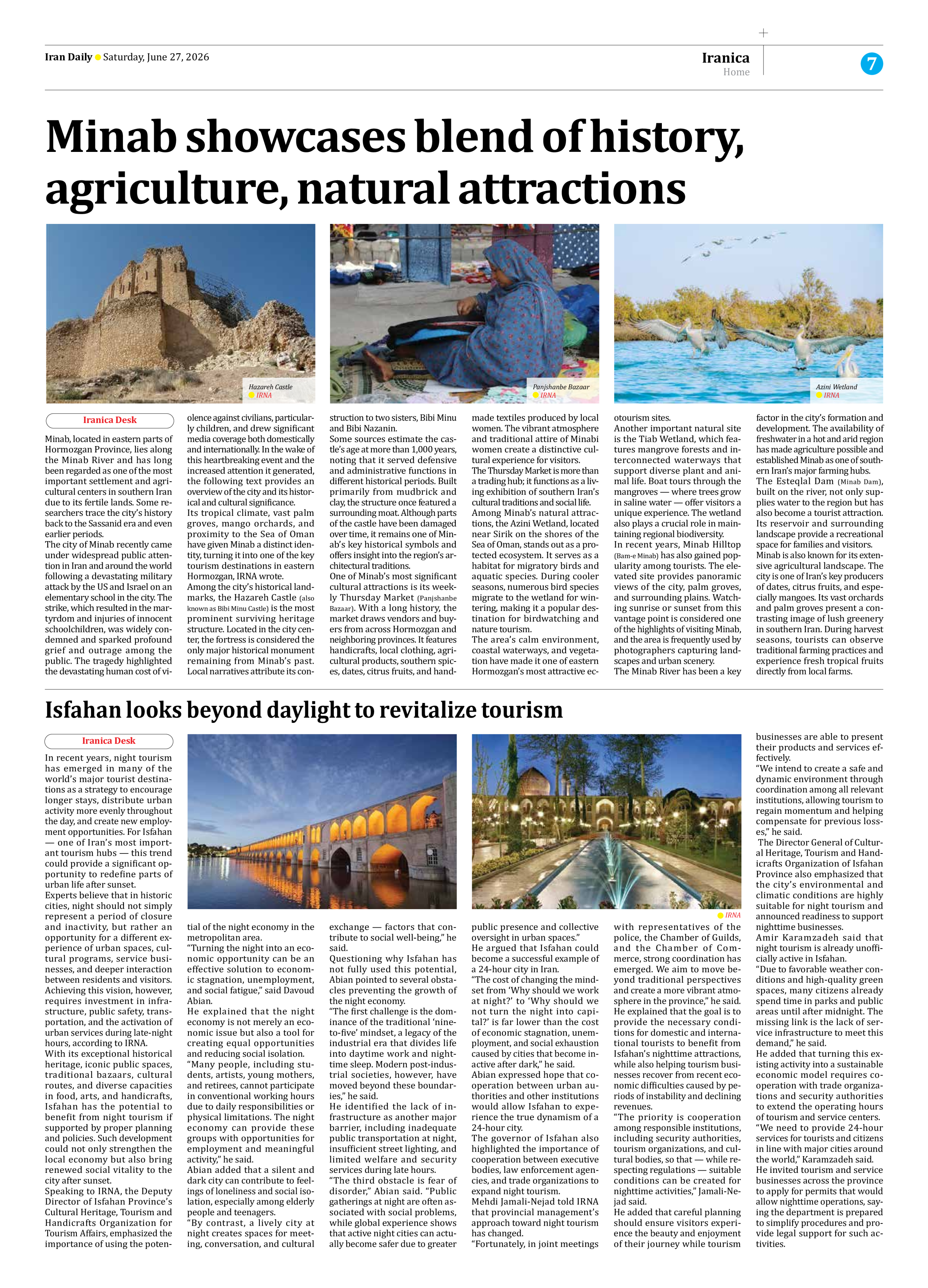


Isfahan looks beyond daylight to revitalize tourism
In recent years, night tourism has emerged in many of the world’s major tourist destinations as a strategy to encourage longer stays, distribute urban activity more evenly throughout the day, and create new employment opportunities. For Isfahan — one of Iran’s most important tourism hubs — this trend could provide a significant opportunity to redefine parts of urban life after sunset.
Experts believe that in historic cities, night should not simply represent a period of closure and inactivity, but rather an opportunity for a different experience of urban spaces, cultural programs, service businesses, and deeper interaction between residents and visitors. Achieving this vision, however, requires investment in infrastructure, public safety, transportation, and the activation of urban services during late-night hours, according to IRNA.
With its exceptional historical heritage, iconic public spaces, traditional bazaars, cultural routes, and diverse capacities in food, arts, and handicrafts, Isfahan has the potential to benefit from night tourism if supported by proper planning and policies. Such development could not only strengthen the local economy but also bring renewed social vitality to the city after sunset.
Speaking to IRNA, the Deputy Director of Isfahan Province’s Cultural Heritage, Tourism and Handicrafts Organization for Tourism Affairs, emphasized the importance of using the potential of the night economy in the metropolitan area.
“Turning the night into an economic opportunity can be an effective solution to economic stagnation, unemployment, and social fatigue,” said Davoud Abian.
He explained that the night economy is not merely an economic issue but also a tool for creating equal opportunities and reducing social isolation.
“Many people, including students, artists, young mothers, and retirees, cannot participate in conventional working hours due to daily responsibilities or physical limitations. The night economy can provide these groups with opportunities for employment and meaningful activity,” he said.
Abian added that a silent and dark city can contribute to feelings of loneliness and social isolation, especially among elderly people and teenagers.
“By contrast, a lively city at night creates spaces for meeting, conversation, and cultural exchange — factors that contribute to social well-being,” he said.
Questioning why Isfahan has not fully used this potential, Abian pointed to several obstacles preventing the growth of the night economy.
“The first challenge is the dominance of the traditional ‘nine-to-five’ mindset, a legacy of the industrial era that divides life into daytime work and nighttime sleep. Modern post-industrial societies, however, have moved beyond these boundaries,” he said.
He identified the lack of infrastructure as another major barrier, including inadequate public transportation at night, insufficient street lighting, and limited welfare and security services during late hours.
“The third obstacle is fear of disorder,” Abian said. “Public gatherings at night are often associated with social problems, while global experience shows that active night cities can actually become safer due to greater public presence and collective oversight in urban spaces.”
He argued that Isfahan could become a successful example of a 24-hour city in Iran.
“The cost of changing the mindset from ‘Why should we work at night?’ to ‘Why should we not turn the night into capital?’ is far lower than the cost of economic stagnation, unemployment, and social exhaustion caused by cities that become inactive after dark,” he said.
Abian expressed hope that cooperation between urban authorities and other institutions would allow Isfahan to experience the true dynamism of a 24-hour city.
The governor of Isfahan also highlighted the importance of cooperation between executive bodies, law enforcement agencies, and trade organizations to expand night tourism.
Mehdi Jamali-Nejad told IRNA that provincial management’s approach toward night tourism has changed.
“Fortunately, in joint meetings with representatives of the police, the Chamber of Guilds, and the Chamber of Commerce, strong coordination has emerged. We aim to move beyond traditional perspectives and create a more vibrant atmosphere in the province,” he said.
He explained that the goal is to provide the necessary conditions for domestic and international tourists to benefit from Isfahan’s nighttime attractions, while also helping tourism businesses recover from recent economic difficulties caused by periods of instability and declining revenues.
“The priority is cooperation among responsible institutions, including security authorities, tourism organizations, and cultural bodies, so that — while respecting regulations — suitable conditions can be created for nighttime activities,” Jamali-Nejad said.
He added that careful planning should ensure visitors experience the beauty and enjoyment of their journey while tourism businesses are able to present their products and services effectively.
“We intend to create a safe and dynamic environment through coordination among all relevant institutions, allowing tourism to regain momentum and helping compensate for previous losses,” he said.
The Director General of Cultural Heritage, Tourism and Handicrafts Organization of Isfahan Province also emphasized that the city’s environmental and climatic conditions are highly suitable for night tourism and announced readiness to support nighttime businesses.
Amir Karamzadeh said that night tourism is already unofficially active in Isfahan.
“Due to favorable weather conditions and high-quality green spaces, many citizens already spend time in parks and public areas until after midnight. The missing link is the lack of service infrastructure to meet this demand,” he said.
He added that turning this existing activity into a sustainable economic model requires cooperation with trade organizations and security authorities to extend the operating hours of tourism and service centers.
“We need to provide 24-hour services for tourists and citizens in line with major cities around the world,” Karamzadeh said.
He invited tourism and service businesses across the province to apply for permits that would allow nighttime operations, saying the department is prepared to simplify procedures and provide legal support for such activities.