







Reading Room
Ashura; timeless narrative of justice, sacrifice, human values
Professor of Baqir al-Olum University
The event of Ashura, the martyrdom of Imam Hussein (PBUH) and his companions in Karbala, is among the few occurrences in human history whose influence has not diminished after more than fourteen centuries. On the contrary, its presence and impact across cultural, social, political, artistic, and spiritual spheres have continued to expand over time.
Thousands of books, articles, lectures, and academic studies have been dedicated to Ashura, with each generation attempting to understand this profound event from a particular perspective.
Some researchers have examined Ashura through a historical lens, seeking to reconstruct the events that took place in the year 61 AH. Others have analyzed the social conditions that shaped the movement from a sociological viewpoint. Many have explored it through psychological, cultural, educational, ethical, or political approaches. All of these perspectives are valuable and necessary, but a fundamental question remains: Can the full potential of Ashura be understood within these frameworks alone, or are there broader horizons for studying this historic movement?
Many scholars argue that Ashura possesses such depth and breadth that it cannot be viewed merely as a historical episode. From this perspective, two new approaches can be proposed: Examining Ashura at a civilizational level and studying its mythological dimensions.
In the humanities, there is a distinction between “perspective” and “level of analysis.” Perspective refers to the lens through which a phenomenon is studied — whether historical, sociological, psychological, or cultural.
The level of analysis, however, concerns the scale at which a subject is examined. A phenomenon may be studied at an individual, family, social, national, regional, global, or civilizational level.
Many studies of Ashura have remained focused on the level of the event itself — examining it as a historical incident that took place at a specific time and location. Within this framework, key questions revolve around what happened, who participated, what circumstances led to the event, and what consequences followed. This approach is essential, but it may not be sufficient.
A civilizational perspective refers to the broadest and most complex level of human relations. Civilization is not merely a collection of political or economic structures; rather, it includes a network of values, ideals, lifestyles, cultural patterns, systems of meaning, and visions for the future.
A civilizational approach studies a phenomenon in relation to both distant history and future generations. At this level, the question is not only what impact an event had in its own era, but also what capacities it contains to shape humanity’s historical path.
From this viewpoint, Ashura is not limited to the year 61 AH. Over centuries, it has inspired movements for freedom, justice, cultural transformation, and spiritual renewal. In this sense, Ashura can be described as having a “civilizational character” — containing capacities usually associated with civilizations themselves.
One of the most remarkable aspects of Ashura is the way it appears to concentrate major themes of human history within a single event: the struggle between truth and falsehood, justice and oppression, freedom and tyranny, loyalty and betrayal, and moral conviction and personal interest.
On one side, Imam Hussein (PBUH) and his companions represent the highest human ideals; on the other, the opposing force symbolizes moral decline and human degradation. From this perspective, Ashura is not merely the story of a battle, but a condensed reflection of humanity’s ongoing struggle between good and evil.
Alongside the civilizational level of analysis, another perspective can be considered: what may be called the “mythological dimension” of Ashura. In everyday language, the word “myth” is sometimes understood as a fictional story. However, in modern mythology studies, myths have a much broader meaning. They are narratives that represent humanity’s deepest values, hopes, fears, aspirations, and experiences through symbols and characters.
Therefore, describing the mythological dimension of Ashura does not mean treating it as a legend or fiction. Ashura is a historical reality, and its historical nature must be emphasized. At the same time, the greatness of its figures and the depth of its values have given it many qualities associated with the great myths of humanity.
Human beings have always needed meaning, identity, and role models. Myths respond to these needs by providing symbols and narratives that help societies understand themselves.
As traditional myths declined in modern societies, new forms of symbolic heroes emerged — from fictional characters in cinema to influential cultural and political figures.
Myths often develop around heroes: individuals who move beyond ordinary limitations and represent values greater than personal interests. Ashura presents a powerful collection of such figures. The level of sacrifice, devotion, loyalty, and commitment to truth demonstrated by them has made Ashura one of the richest sources of human ideals.
Meanwhile, one of the most important roles of myths is their influence on art. Many of the world’s greatest literary and artistic works have been inspired by mythological narratives.
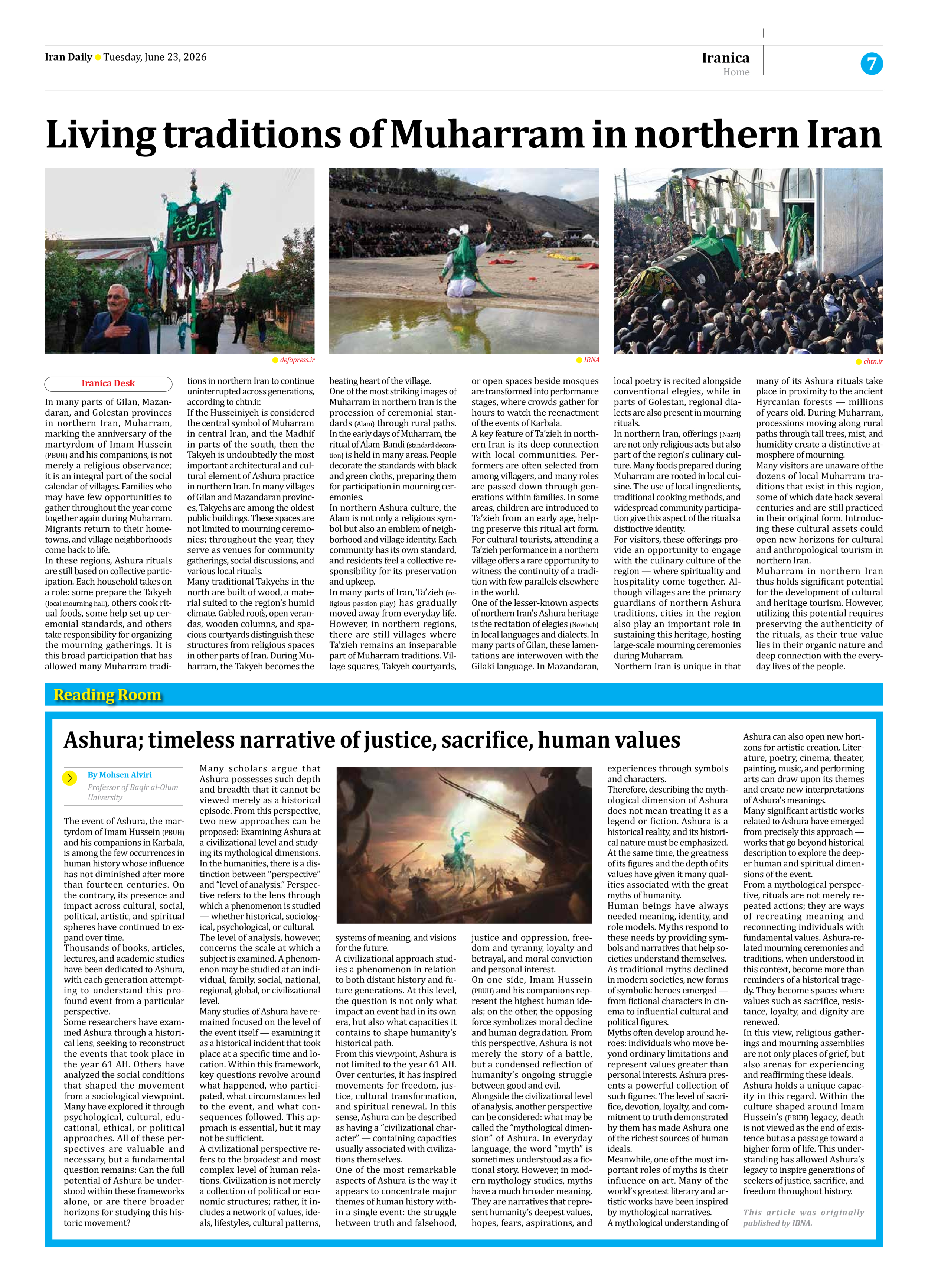
A mythological understanding of Ashura can also open new horizons for artistic creation. Literature, poetry, cinema, theater, painting, music, and performing arts can draw upon its themes and create new interpretations of Ashura’s meanings.
Many significant artistic works related to Ashura have emerged from precisely this approach — works that go beyond historical description to explore the deeper human and spiritual dimensions of the event.
From a mythological perspective, rituals are not merely repeated actions; they are ways of recreating meaning and reconnecting individuals with fundamental values. Ashura-related mourning ceremonies and traditions, when understood in this context, become more than reminders of a historical tragedy. They become spaces where values such as sacrifice, resistance, loyalty, and dignity are renewed.
In this view, religious gatherings and mourning assemblies are not only places of grief, but also arenas for experiencing and reaffirming these ideals.
Ashura holds a unique capacity in this regard. Within the culture shaped around Imam Hussein’s (PBUH) legacy, death is not viewed as the end of existence but as a passage toward a higher form of life. This understanding has allowed Ashura’s legacy to inspire generations of seekers of justice, sacrifice, and freedom throughout history.
This article was originally
published by IBNA.