







Living traditions of Muharram in northern Iran
In many parts of Gilan, Mazandaran, and Golestan provinces in northern Iran, Muharram, marking the anniversary of the martyrdom of Imam Hussein (PBUH) and his companions, is not merely a religious observance; it is an integral part of the social calendar of villages. Families who may have few opportunities to gather throughout the year come together again during Muharram. Migrants return to their hometowns, and village neighborhoods come back to life.
In these regions, Ashura rituals are still based on collective participation. Each household takes on a role: some prepare the Takyeh (local mourning hall), others cook ritual foods, some help set up ceremonial standards, and others take responsibility for organizing the mourning gatherings. It is this broad participation that has allowed many Muharram traditions in northern Iran to continue uninterrupted across generations, according to chtn.ir.
If the Husseiniyeh is considered the central symbol of Muharram in central Iran, and the Madhif in parts of the south, then the Takyeh is undoubtedly the most important architectural and cultural element of Ashura practice in northern Iran. In many villages of Gilan and Mazandaran provinces, Takyehs are among the oldest public buildings. These spaces are not limited to mourning ceremonies; throughout the year, they serve as venues for community gatherings, social discussions, and various local rituals.
Many traditional Takyehs in the north are built of wood, a material suited to the region’s humid climate. Gabled roofs, open verandas, wooden columns, and spacious courtyards distinguish these structures from religious spaces in other parts of Iran. During Muharram, the Takyeh becomes the beating heart of the village.
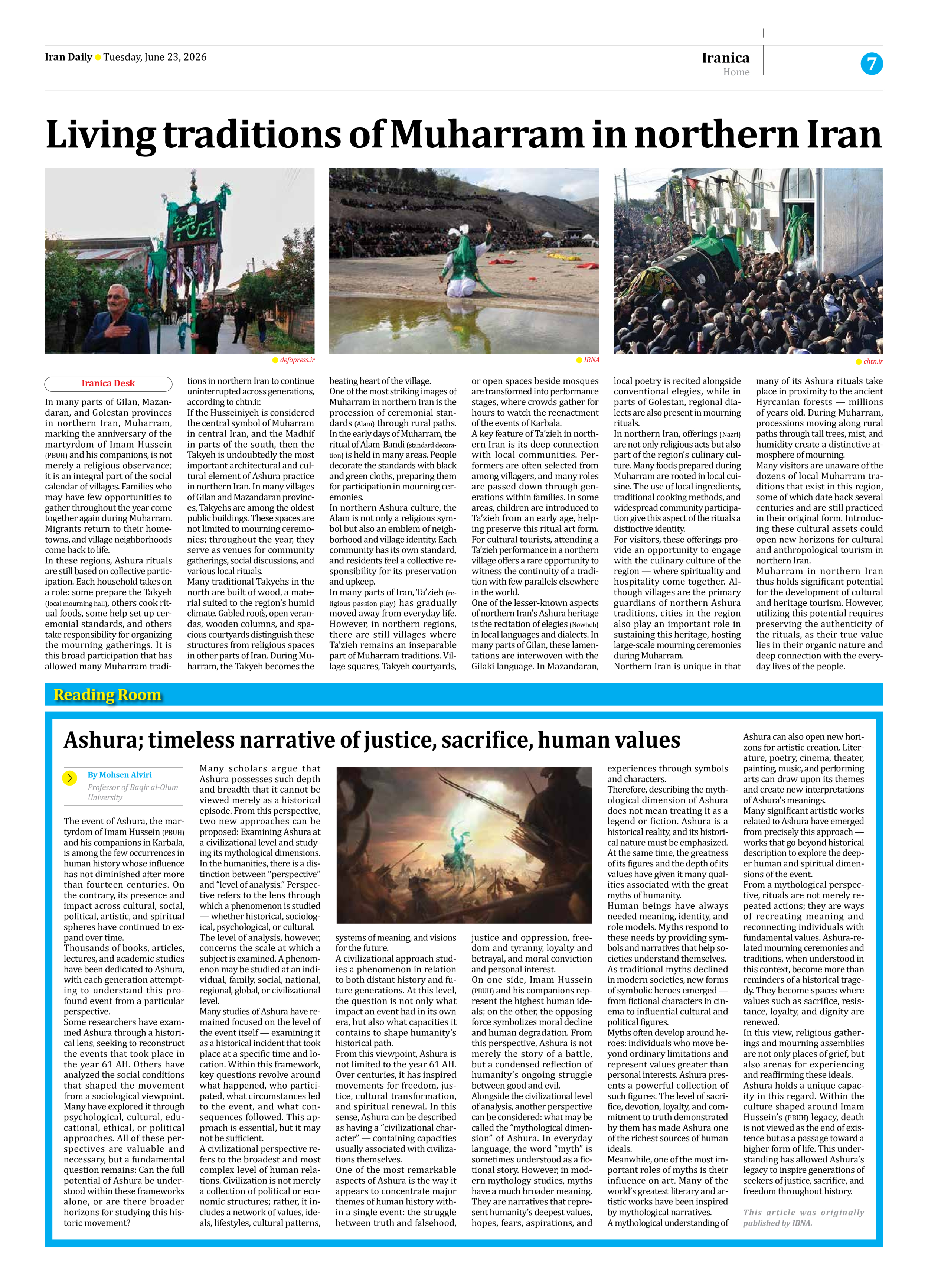
One of the most striking images of Muharram in northern Iran is the procession of ceremonial standards (Alam) through rural paths. In the early days of Muharram, the ritual of Alam-Bandi (standard decoration) is held in many areas. People decorate the standards with black and green cloths, preparing them for participation in mourning ceremonies.
In northern Ashura culture, the Alam is not only a religious symbol but also an emblem of neighborhood and village identity. Each community has its own standard, and residents feel a collective responsibility for its preservation and upkeep.
In many parts of Iran, Ta’zieh (religious passion play) has gradually moved away from everyday life. However, in northern regions, there are still villages where Ta’zieh remains an inseparable part of Muharram traditions. Village squares, Takyeh courtyards, or open spaces beside mosques are transformed into performance stages, where crowds gather for hours to watch the reenactment of the events of Karbala.
A key feature of Ta’zieh in northern Iran is its deep connection with local communities. Performers are often selected from among villagers, and many roles are passed down through generations within families. In some areas, children are introduced to Ta’zieh from an early age, helping preserve this ritual art form. For cultural tourists, attending a Ta’zieh performance in a northern village offers a rare opportunity to witness the continuity of a tradition with few parallels elsewhere in the world.
One of the lesser-known aspects of northern Iran’s Ashura heritage is the recitation of elegies (Nowheh) in local languages and dialects. In many parts of Gilan, these lamentations are interwoven with the Gilaki language. In Mazandaran, local poetry is recited alongside conventional elegies, while in parts of Golestan, regional dialects are also present in mourning rituals.
In northern Iran, offerings (Nazri) are not only religious acts but also part of the region’s culinary culture. Many foods prepared during Muharram are rooted in local cuisine. The use of local ingredients, traditional cooking methods, and widespread community participation give this aspect of the rituals a distinctive identity.
For visitors, these offerings provide an opportunity to engage with the culinary culture of the region — where spirituality and hospitality come together. Although villages are the primary guardians of northern Ashura traditions, cities in the region also play an important role in sustaining this heritage, hosting large-scale mourning ceremonies during Muharram.
Northern Iran is unique in that many of its Ashura rituals take place in proximity to the ancient Hyrcanian forests — millions of years old. During Muharram, processions moving along rural paths through tall trees, mist, and humidity create a distinctive atmosphere of mourning.
Many visitors are unaware of the dozens of local Muharram traditions that exist in this region, some of which date back several centuries and are still practiced in their original form. Introducing these cultural assets could open new horizons for cultural and anthropological tourism in northern Iran.
Muharram in northern Iran thus holds significant potential for the development of cultural and heritage tourism. However, utilizing this potential requires preserving the authenticity of the rituals, as their true value lies in their organic nature and deep connection with the everyday lives of the people.