







Copy in clipboard...
Chinese translation of Nizami’s ‘Khamsa’ unveiled in Beijing
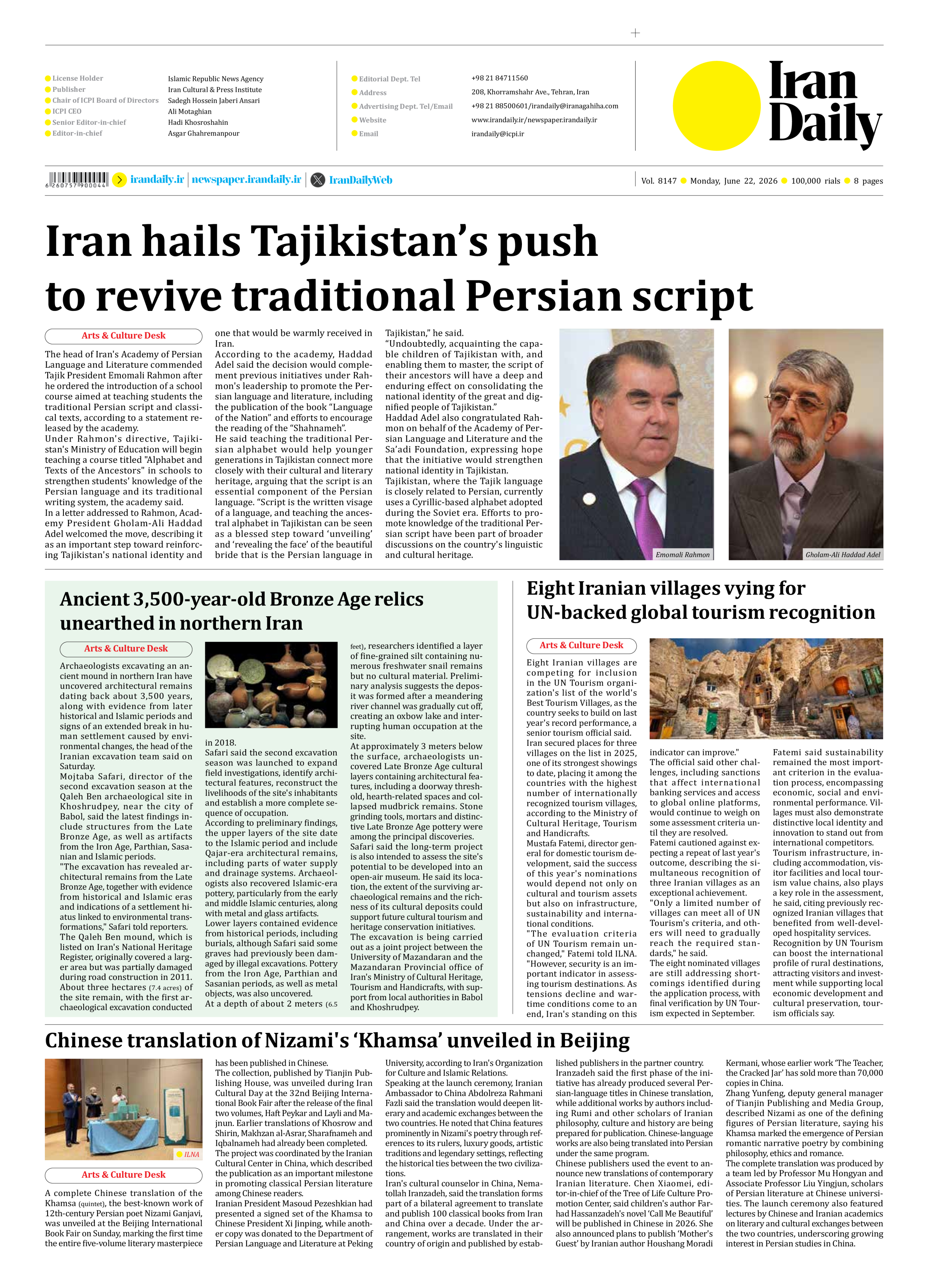
A complete Chinese translation of the Khamsa (quintet), the best-known work of 12th-century Persian poet Nizami Ganjavi, was unveiled at the Beijing International Book Fair on Sunday, marking the first time the entire five-volume literary masterpiece has been published in Chinese.
The collection, published by Tianjin Publishing House, was unveiled during Iran Cultural Day at the 32nd Beijing International Book Fair after the release of the final two volumes, Haft Peykar and Layli and Majnun. Earlier translations of Khosrow and Shirin, Makhzan al-Asrar, Sharafnameh and Iqbalnameh had already been completed.
The project was coordinated by the Iranian Cultural Center in China, which described the publication as an important milestone in promoting classical Persian literature among Chinese readers.
Iranian President Masoud Pezeshkian had presented a signed set of the Khamsa to Chinese President Xi Jinping, while another copy was donated to the Department of Persian Language and Literature at Peking University, according to Iran's Organization for Culture and Islamic Relations.
Speaking at the launch ceremony, Iranian Ambassador to China Abdolreza Rahmani Fazli said the translation would deepen literary and academic exchanges between the two countries. He noted that China features prominently in Nizami's poetry through references to its rulers, luxury goods, artistic traditions and legendary settings, reflecting the historical ties between the two civilizations.
Iran's cultural counselor in China, Nematollah Iranzadeh, said the translation forms part of a bilateral agreement to translate and publish 100 classical books from Iran and China over a decade. Under the arrangement, works are translated in their country of origin and published by established publishers in the partner country.
Iranzadeh said the first phase of the initiative has already produced several Persian-language titles in Chinese translation, while additional works by authors including Rumi and other scholars of Iranian philosophy, culture and history are being prepared for publication. Chinese-language works are also being translated into Persian under the same program.
Chinese publishers used the event to announce new translations of contemporary Iranian literature. Chen Xiaomei, editor-in-chief of the Tree of Life Culture Promotion Center, said children's author Farhad Hassanzadeh's novel ‘Call Me Beautiful’ will be published in Chinese in 2026. She also announced plans to publish ‘Mother's Guest’ by Iranian author Houshang Moradi Kermani, whose earlier work ‘The Teacher, the Cracked Jar’ has sold more than 70,000 copies in China.
Zhang Yunfeng, deputy general manager of Tianjin Publishing and Media Group, described Nizami as one of the defining figures of Persian literature, saying his Khamsa marked the emergence of Persian romantic narrative poetry by combining philosophy, ethics and romance.
The complete translation was produced by a team led by Professor Mu Hongyan and Associate Professor Liu Yingjun, scholars of Persian literature at Chinese universities. The launch ceremony also featured lectures by Chinese and Iranian academics on literary and cultural exchanges between the two countries, underscoring growing interest in Persian studies in China.