





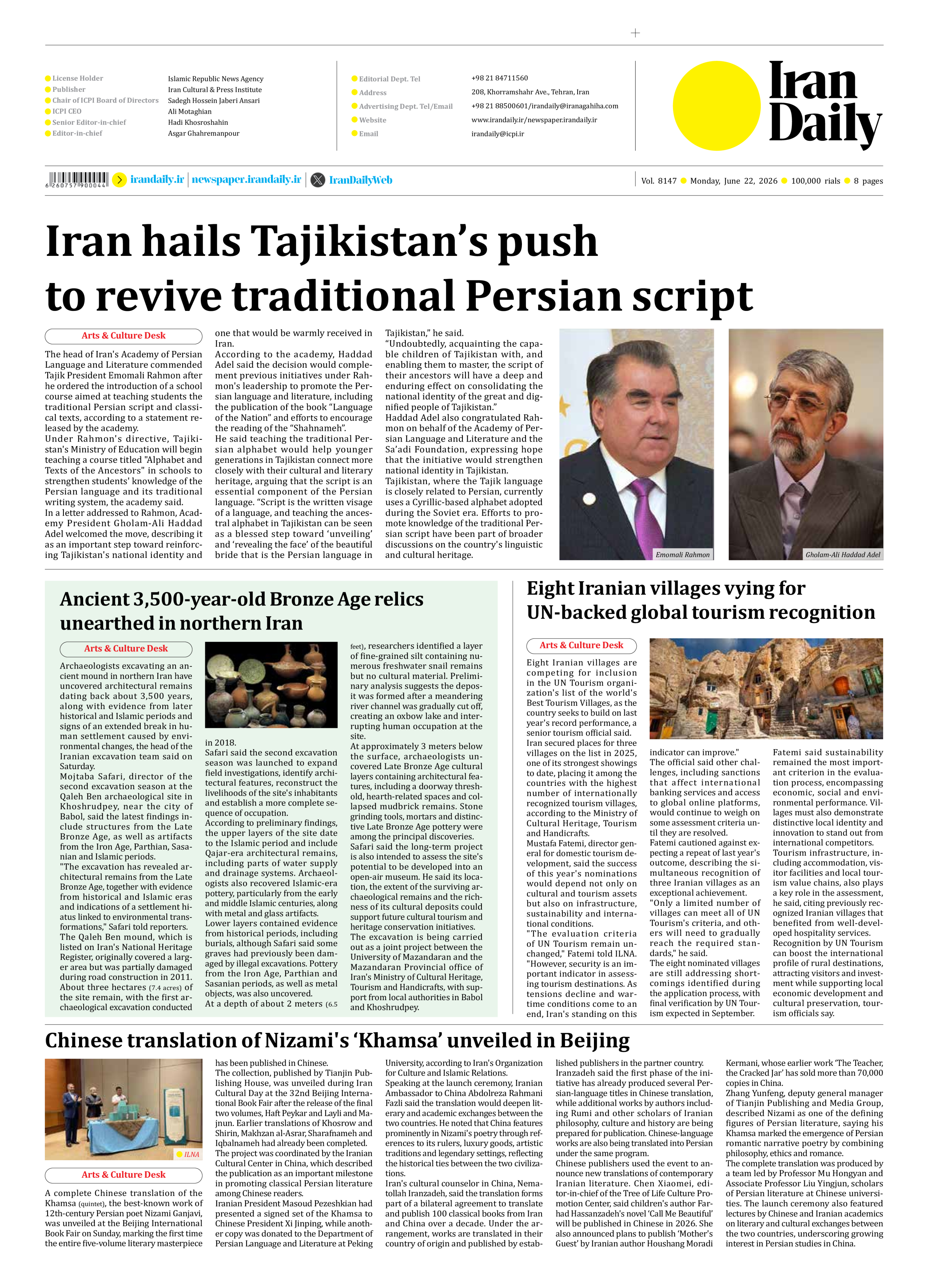


Ancient 3,500-year-old Bronze Age relics unearthed in northern Iran
Archaeologists excavating an ancient mound in northern Iran have uncovered architectural remains dating back about 3,500 years, along with evidence from later historical and Islamic periods and signs of an extended break in human settlement caused by environmental changes, the head of the Iranian excavation team said on Saturday.
Mojtaba Safari, director of the second excavation season at the Qaleh Ben archaeological site in Khoshrudpey, near the city of Babol, said the latest findings include structures from the Late Bronze Age, as well as artifacts from the Iron Age, Parthian, Sasanian and Islamic periods.
"The excavation has revealed architectural remains from the Late Bronze Age, together with evidence from historical and Islamic eras and indications of a settlement hiatus linked to environmental transformations," Safari told reporters.
The Qaleh Ben mound, which is listed on Iran's National Heritage Register, originally covered a larger area but was partially damaged during road construction in 2011. About three hectares (7.4 acres) of the site remain, with the first archaeological excavation conducted in 2018.
Safari said the second excavation season was launched to expand field investigations, identify architectural features, reconstruct the livelihoods of the site's inhabitants and establish a more complete sequence of occupation.
According to preliminary findings, the upper layers of the site date to the Islamic period and include Qajar-era architectural remains, including parts of water supply and drainage systems. Archaeologists also recovered Islamic-era pottery, particularly from the early and middle Islamic centuries, along with metal and glass artifacts.
Lower layers contained evidence from historical periods, including burials, although Safari said some graves had previously been damaged by illegal excavations. Pottery from the Iron Age, Parthian and Sasanian periods, as well as metal objects, was also uncovered.
At a depth of about 2 meters (6.5 feet), researchers identified a layer of fine-grained silt containing numerous freshwater snail remains but no cultural material. Preliminary analysis suggests the deposit was formed after a meandering river channel was gradually cut off, creating an oxbow lake and interrupting human occupation at the site.
At approximately 3 meters below the surface, archaeologists uncovered Late Bronze Age cultural layers containing architectural features, including a doorway threshold, hearth-related spaces and collapsed mudbrick remains. Stone grinding tools, mortars and distinctive Late Bronze Age pottery were among the principal discoveries.
Safari said the long-term project is also intended to assess the site's potential to be developed into an open-air museum. He said its location, the extent of the surviving archaeological remains and the richness of its cultural deposits could support future cultural tourism and heritage conservation initiatives.
The excavation is being carried out as a joint project between the University of Mazandaran and the Mazandaran Provincial office of Iran's Ministry of Cultural Heritage, Tourism and Handicrafts, with support from local authorities in Babol and Khoshrudpey.