







CBI chief unveils postwar roadmap as economy contracts
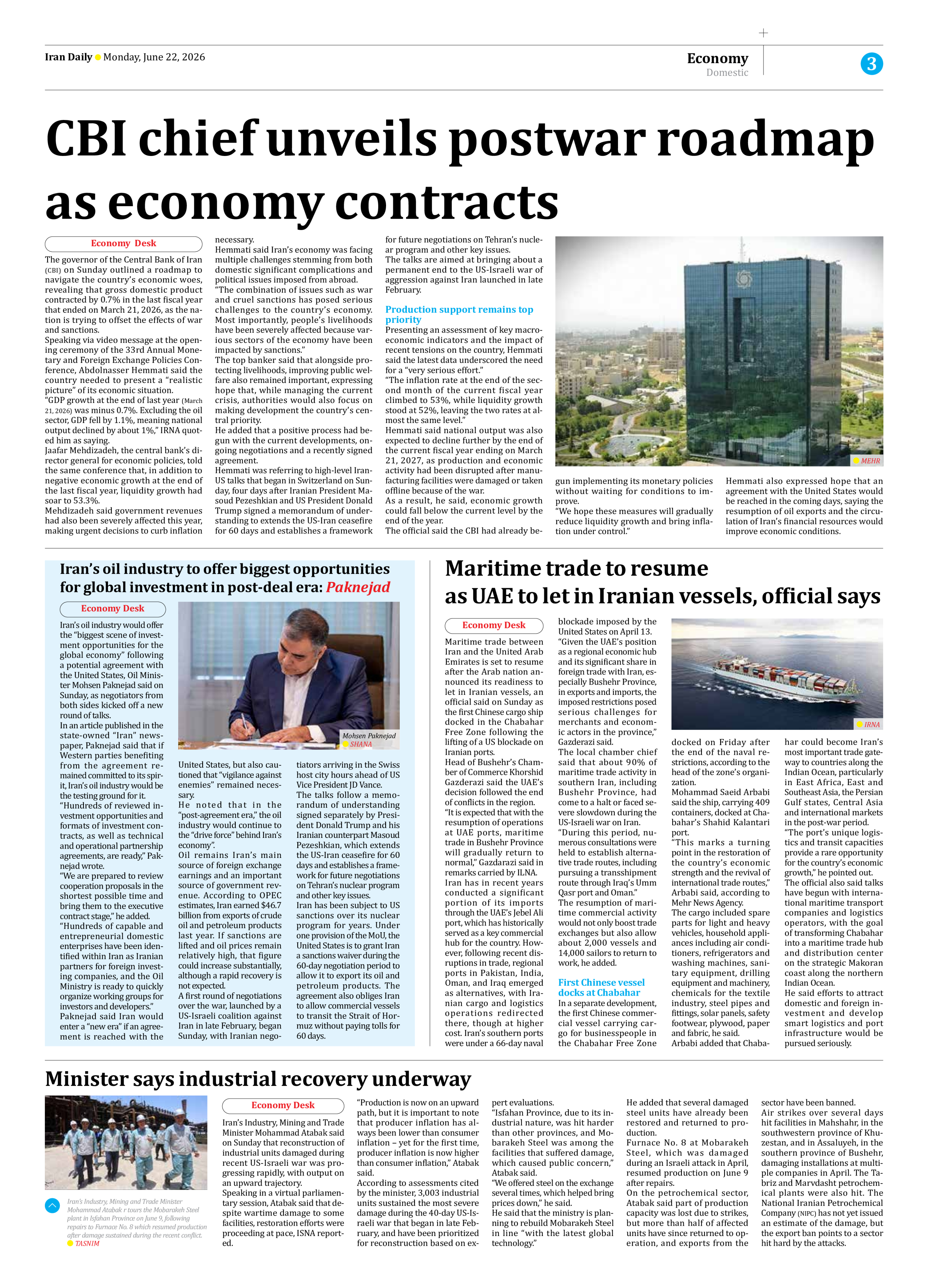
The governor of the Central Bank of Iran (CBI) on Sunday outlined a roadmap to navigate the country’s economic woes, revealing that gross domestic product contracted by 0.7% in the last fiscal year that ended on March 21, 2026, as the nation is trying to offset the effects of war and sanctions.
Speaking via video message at the opening ceremony of the 33rd Annual Monetary and Foreign Exchange Policies Conference, Abdolnasser Hemmati said the country needed to present a “realistic picture” of its economic situation.
“GDP growth at the end of last year (March 21, 2026) was minus 0.7%. Excluding the oil sector, GDP fell by 1.1%, meaning national output declined by about 1%,” IRNA quoted him as saying.
Jaafar Mehdizadeh, the central bank’s director general for economic policies, told the same conference that, in addition to negative economic growth at the end of the last fiscal year, liquidity growth had soar to 53.3%.
Mehdizadeh said government revenues had also been severely affected this year, making urgent decisions to curb inflation necessary.
Hemmati said Iran’s economy was facing multiple challenges stemming from both domestic significant complications and political issues imposed from abroad.
“The combination of issues such as war and cruel sanctions has posed serious challenges to the country’s economy. Most importantly, people’s livelihoods have been severely affected because various sectors of the economy have been impacted by sanctions.”
The top banker said that alongside protecting livelihoods, improving public welfare also remained important, expressing hope that, while managing the current crisis, authorities would also focus on making development the country’s central priority.
He added that a positive process had begun with the current developments, ongoing negotiations and a recently signed agreement.
Hemmati was referring to high-level Iran-US talks that began in Switzerland on Sunday, four days after Iranian President Masoud Pezeshkian and US President Donald Trump signed a memorandum of understanding to extends the US-Iran ceasefire for 60 days and establishes a framework for future negotiations on Tehran’s nuclear program and other key issues.
The talks are aimed at bringing about a permanent end to the US-Israeli war of aggression against Iran launched in late February.
Production support remains top priority
Presenting an assessment of key macroeconomic indicators and the impact of recent tensions on the country, Hemmati said the latest data underscored the need for a “very serious effort.”
“The inflation rate at the end of the second month of the current fiscal year climbed to 53%, while liquidity growth stood at 52%, leaving the two rates at almost the same level.”
Hemmati said national output was also expected to decline further by the end of the current fiscal year ending on March 21, 2027, as production and economic activity had been disrupted after manufacturing facilities were damaged or taken offline because of the war.
As a result, he said, economic growth could fall below the current level by the end of the year.
The official said the CBI had already begun implementing its monetary policies without waiting for conditions to improve.
“We hope these measures will gradually reduce liquidity growth and bring inflation under control.”
Hemmati also expressed hope that an agreement with the United States would be reached in the coming days, saying the resumption of oil exports and the circulation of Iran’s financial resources would improve economic conditions.