





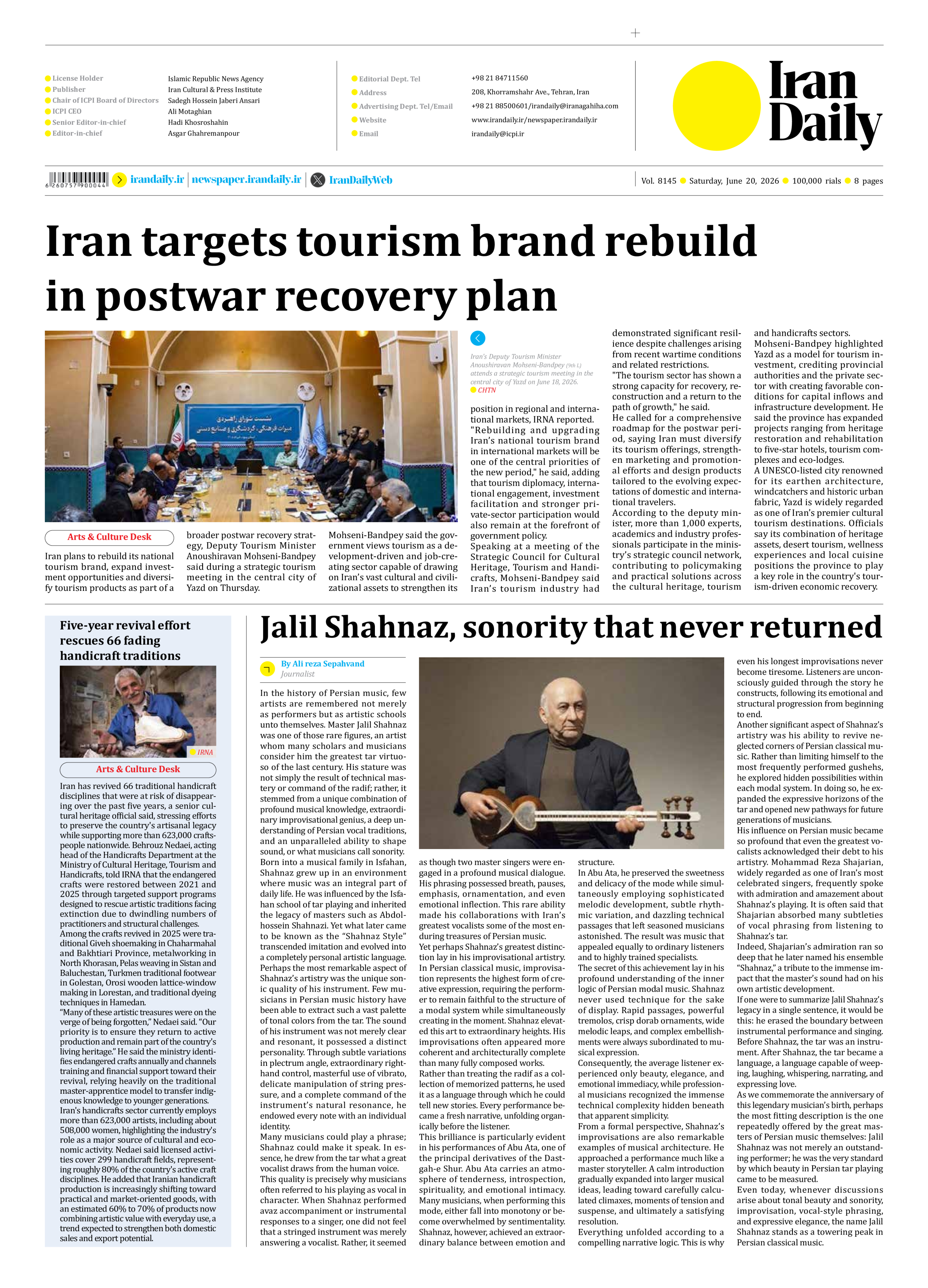


Jalil Shahnaz, sonority that never returned
By Ali reza Sepahvand
Journalist
In the history of Persian music, few artists are remembered not merely as performers but as artistic schools unto themselves. Master Jalil Shahnaz was one of those rare figures, an artist whom many scholars and musicians consider him the greatest tar virtuoso of the last century. His stature was not simply the result of technical mastery or command of the radif; rather, it stemmed from a unique combination of profound musical knowledge, extraordinary improvisational genius, a deep understanding of Persian vocal traditions, and an unparalleled ability to shape sound, or what musicians call sonority.
Born into a musical family in Isfahan, Shahnaz grew up in an environment where music was an integral part of daily life. He was influenced by the Isfahan school of tar playing and inherited the legacy of masters such as Abdolhossein Shahnazi. Yet what later came to be known as the “Shahnaz Style” transcended imitation and evolved into a completely personal artistic language.
Perhaps the most remarkable aspect of Shahnaz’s artistry was the unique sonic quality of his instrument. Few musicians in Persian music history have been able to extract such a vast palette of tonal colors from the tar. The sound of his instrument was not merely clear and resonant, it possessed a distinct personality. Through subtle variations in plectrum angle, extraordinary right-hand control, masterful use of vibrato, delicate manipulation of string pressure, and a complete command of the instrument’s natural resonance, he endowed every note with an individual identity.
Many musicians could play a phrase; Shahnaz could make it speak. In essence, he drew from the tar what a great vocalist draws from the human voice.
This quality is precisely why musicians often referred to his playing as vocal in character. When Shahnaz performed avaz accompaniment or instrumental responses to a singer, one did not feel that a stringed instrument was merely answering a vocalist. Rather, it seemed as though two master singers were engaged in a profound musical dialogue. His phrasing possessed breath, pauses, emphasis, ornamentation, and even emotional inflection. This rare ability made his collaborations with Iran’s greatest vocalists some of the most enduring treasures of Persian music.
Yet perhaps Shahnaz’s greatest distinction lay in his improvisational artistry. In Persian classical music, improvisation represents the highest form of creative expression, requiring the performer to remain faithful to the structure of a modal system while simultaneously creating in the moment. Shahnaz elevated this art to extraordinary heights. His improvisations often appeared more coherent and architecturally complete than many fully composed works.
Rather than treating the radif as a collection of memorized patterns, he used it as a language through which he could tell new stories. Every performance became a fresh narrative, unfolding organically before the listener.
This brilliance is particularly evident in his performances of Abu Ata, one of the principal derivatives of the Dastgah-e Shur. Abu Ata carries an atmosphere of tenderness, introspection, spirituality, and emotional intimacy. Many musicians, when performing this mode, either fall into monotony or become overwhelmed by sentimentality. Shahnaz, however, achieved an extraordinary balance between emotion and structure.
In Abu Ata, he preserved the sweetness and delicacy of the mode while simultaneously employing sophisticated melodic development, subtle rhythmic variation, and dazzling technical passages that left seasoned musicians astonished. The result was music that appealed equally to ordinary listeners and to highly trained specialists.
The secret of this achievement lay in his profound understanding of the inner logic of Persian modal music. Shahnaz never used technique for the sake of display. Rapid passages, powerful tremolos, crisp dorab ornaments, wide melodic leaps, and complex embellishments were always subordinated to musical expression.
Consequently, the average listener experienced only beauty, elegance, and emotional immediacy, while professional musicians recognized the immense technical complexity hidden beneath that apparent simplicity.
From a formal perspective, Shahnaz’s improvisations are also remarkable examples of musical architecture. He approached a performance much like a master storyteller. A calm introduction gradually expanded into larger musical ideas, leading toward carefully calculated climaxes, moments of tension and suspense, and ultimately a satisfying resolution.
Everything unfolded according to a compelling narrative logic. This is why even his longest improvisations never become tiresome. Listeners are unconsciously guided through the story he constructs, following its emotional and structural progression from beginning to end.
Another significant aspect of Shahnaz’s artistry was his ability to revive neglected corners of Persian classical music. Rather than limiting himself to the most frequently performed gushehs, he explored hidden possibilities within each modal system. In doing so, he expanded the expressive horizons of the tar and opened new pathways for future generations of musicians.
His influence on Persian music became so profound that even the greatest vocalists acknowledged their debt to his artistry. Mohammad Reza Shajarian, widely regarded as one of Iran’s most celebrated singers, frequently spoke with admiration and amazement about Shahnaz’s playing. It is often said that Shajarian absorbed many subtleties of vocal phrasing from listening to Shahnaz’s tar.
Indeed, Shajarian’s admiration ran so deep that he later named his ensemble “Shahnaz,” a tribute to the immense impact that the master’s sound had on his own artistic development.
If one were to summarize Jalil Shahnaz’s legacy in a single sentence, it would be this: he erased the boundary between instrumental performance and singing. Before Shahnaz, the tar was an instrument. After Shahnaz, the tar became a language, a language capable of weeping, laughing, whispering, narrating, and expressing love.
As we commemorate the anniversary of this legendary musician’s birth, perhaps the most fitting description is the one repeatedly offered by the great masters of Persian music themselves: Jalil Shahnaz was not merely an outstanding performer; he was the very standard by which beauty in Persian tar playing came to be measured.
Even today, whenever discussions arise about tonal beauty and sonority, improvisation, vocal-style phrasing, and expressive elegance, the name Jalil Shahnaz stands as a towering peak in Persian classical music.