





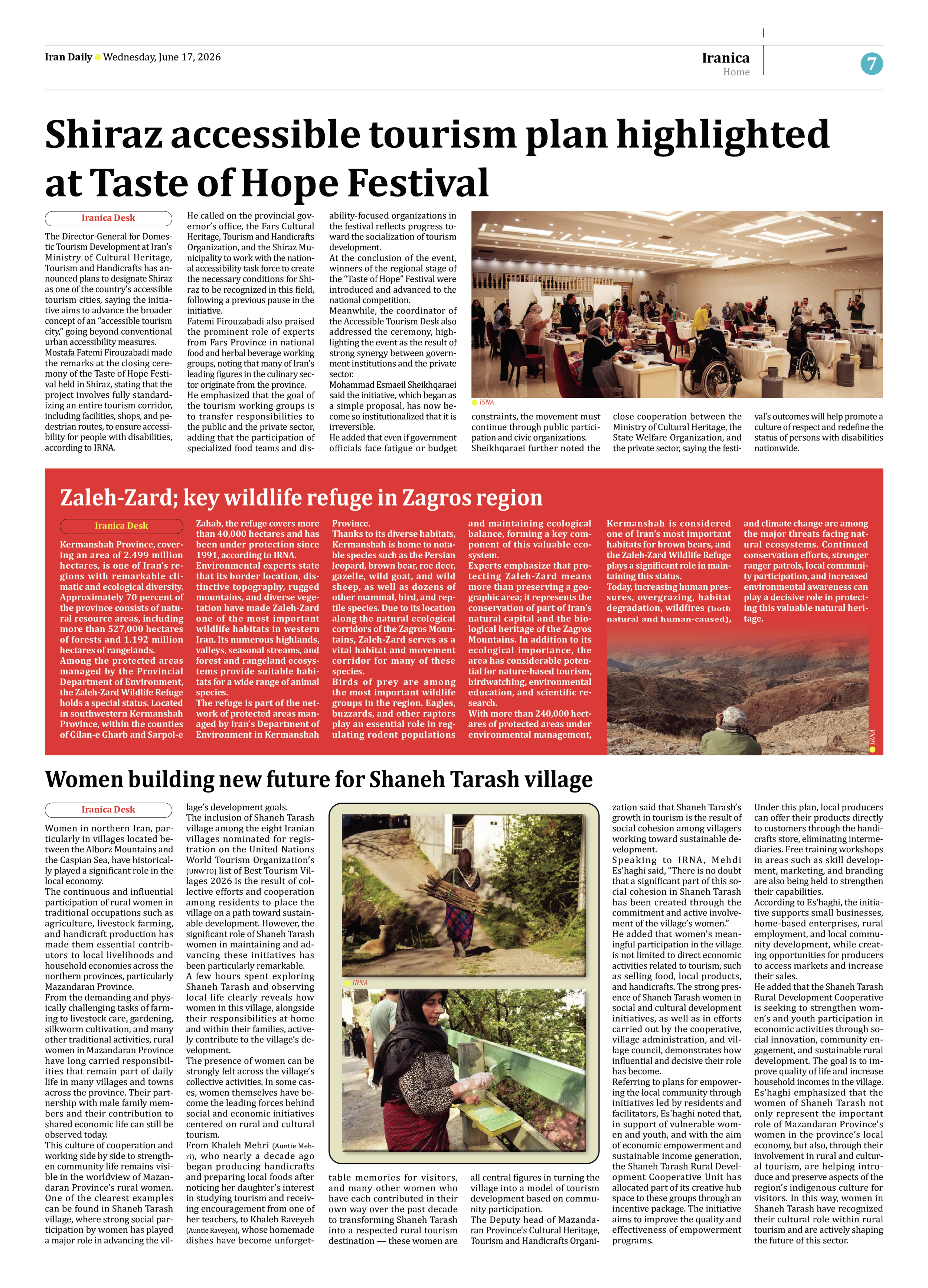


Women building new future for Shaneh Tarash village
Women in northern Iran, particularly in villages located between the Alborz Mountains and the Caspian Sea, have historically played a significant role in the local economy.
The continuous and influential participation of rural women in traditional occupations such as agriculture, livestock farming, and handicraft production has made them essential contributors to local livelihoods and household economies across the northern provinces, particularly Mazandaran Province.
From the demanding and physically challenging tasks of farming to livestock care, gardening, silkworm cultivation, and many other traditional activities, rural women in Mazandaran Province have long carried responsibilities that remain part of daily life in many villages and towns across the province. Their partnership with male family members and their contribution to shared economic life can still be observed today.
This culture of cooperation and working side by side to strengthen community life remains visible in the worldview of Mazandaran Province’s rural women. One of the clearest examples can be found in Shaneh Tarash village, where strong social participation by women has played a major role in advancing the village’s development goals.
The inclusion of Shaneh Tarash village among the eight Iranian villages nominated for registration on the United Nations World Tourism Organization’s (UNWTO) list of Best Tourism Villages 2026 is the result of collective efforts and cooperation among residents to place the village on a path toward sustainable development. However, the significant role of Shaneh Tarash women in maintaining and advancing these initiatives has been particularly remarkable.
A few hours spent exploring Shaneh Tarash and observing local life clearly reveals how women in this village, alongside their responsibilities at home and within their families, actively contribute to the village’s development.
The presence of women can be strongly felt across the village’s collective activities. In some cases, women themselves have become the leading forces behind social and economic initiatives centered on rural and cultural tourism.
From Khaleh Mehri (Auntie Mehri), who nearly a decade ago began producing handicrafts and preparing local foods after noticing her daughter’s interest in studying tourism and receiving encouragement from one of her teachers, to Khaleh Raveyeh (Auntie Raveyeh), whose homemade dishes have become unforgettable memories for visitors, and many other women who have each contributed in their own way over the past decade to transforming Shaneh Tarash into a respected rural tourism destination — these women are all central figures in turning the village into a model of tourism development based on community participation.
The Deputy head of Mazandaran Province's Cultural Heritage, Tourism and Handicrafts Organization said that Shaneh Tarash’s growth in tourism is the result of social cohesion among villagers working toward sustainable development.
Speaking to IRNA, Mehdi Es'haghi said, “There is no doubt that a significant part of this social cohesion in Shaneh Tarash has been created through the commitment and active involvement of the village’s women.”
He added that women’s meaningful participation in the village is not limited to direct economic activities related to tourism, such as selling food, local products, and handicrafts. The strong presence of Shaneh Tarash women in social and cultural development initiatives, as well as in efforts carried out by the cooperative, village administration, and village council, demonstrates how influential and decisive their role has become.
Referring to plans for empowering the local community through initiatives led by residents and facilitators, Es'haghi noted that, in support of vulnerable women and youth, and with the aim of economic empowerment and sustainable income generation, the Shaneh Tarash Rural Development Cooperative Unit has allocated part of its creative hub space to these groups through an incentive package. The initiative aims to improve the quality and effectiveness of empowerment programs.
Under this plan, local producers can offer their products directly to customers through the handicrafts store, eliminating intermediaries. Free training workshops in areas such as skill development, marketing, and branding are also being held to strengthen their capabilities.
According to Es'haghi, the initiative supports small businesses, home-based enterprises, rural employment, and local community development, while creating opportunities for producers to access markets and increase their sales.
He added that the Shaneh Tarash Rural Development Cooperative is seeking to strengthen women’s and youth participation in economic activities through social innovation, community engagement, and sustainable rural development. The goal is to improve quality of life and increase household incomes in the village.
Es'haghi emphasized that the women of Shaneh Tarash not only represent the important role of Mazandaran Province's women in the province’s local economy, but also, through their involvement in rural and cultural tourism, are helping introduce and preserve aspects of the region’s indigenous culture for visitors. In this way, women in Shaneh Tarash have recognized their cultural role within rural tourism and are actively shaping the future of this sector.